Question 15 Marks
A candidate in order to study the process of osmosis has taken 3 potato cubes and put them in 3 different beakers containing 3 different solutions. After 24 hours, in the first beaker the potato cube increased in size, in the second beaker the potato cube decreased in size and in the third beaker there was no change in the size of the potato cube. The following diagram shows the result of the same experiment:
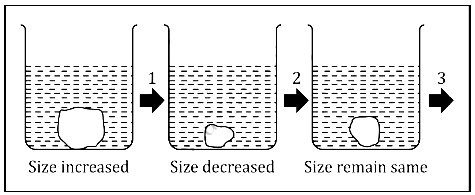 (i) Give the technical terms of the solutions used in beakers, 1, 2 and 3.
(ii) In beaker 3, the size of the potato cube remains the same. Explain the reason in brief.
(iii) Write the specific feature of the cell sap of root hairs which helps in absorption of water.
(iv) What is osmosis?
(v) How does a cell wall and a cell membrane differ in their permeability?
(i) Give the technical terms of the solutions used in beakers, 1, 2 and 3.(ii) In beaker 3, the size of the potato cube remains the same. Explain the reason in brief.
(iii) Write the specific feature of the cell sap of root hairs which helps in absorption of water.
(iv) What is osmosis?
(v) How does a cell wall and a cell membrane differ in their permeability?
Answer
View full question & answer→(i) Solution 1 – Hypotonic solution
Solution 2 – Hypertonic solution
Solution 3 – Isotonic solution (ii) In beaker three, the solution present is an isotonic solution, i.e. the relative concentration of water molecules and solutes is same in the solution as well as inside the cell. There is no movement of water molecules across the cell membrane. Hence, the size of the potato cubes remains same. (iii) The cell sap of root hairs has higher concentration of solute than the surrounding water. (iv) Osmosis is the diffusion of water molecules across the semi-permeable membrane from the region of dilute solution (i.e. a lower solute concentration) to the region of concentrated solution (i.e. a higher solute concentration). (v) The cell wall is freely permeable to all the substances, while the cell membrane is selectively permeable and allows only certain substances to enter or exit the cell.
Solution 2 – Hypertonic solution
Solution 3 – Isotonic solution (ii) In beaker three, the solution present is an isotonic solution, i.e. the relative concentration of water molecules and solutes is same in the solution as well as inside the cell. There is no movement of water molecules across the cell membrane. Hence, the size of the potato cubes remains same. (iii) The cell sap of root hairs has higher concentration of solute than the surrounding water. (iv) Osmosis is the diffusion of water molecules across the semi-permeable membrane from the region of dilute solution (i.e. a lower solute concentration) to the region of concentrated solution (i.e. a higher solute concentration). (v) The cell wall is freely permeable to all the substances, while the cell membrane is selectively permeable and allows only certain substances to enter or exit the cell.
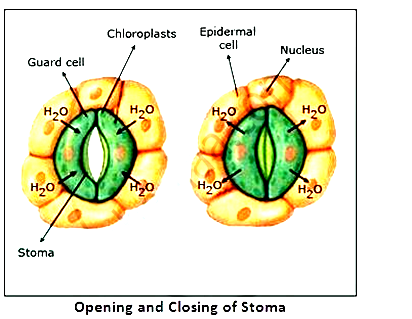 At night or when there is shortage of water in the leaf, the guard cells turn flaccid and their inner rigid walls become straight, thus closing the stomatal aperture.