Question types

Absorption by roots - The Processes Involved question types

188 questions across 9 question groups — pick any mix to generate a Biology paper with step-by-step answer keys.

188
Questions
9
Question groups
5
Question types
Sample Questions

Absorption by roots - The Processes Involved questions

One sample from each question group in this chapter. Select any group above to see the full set with answer keys.

Q 1MCQ1 Mark
The most appropriate characteristic of a semipermeable membrane is that $.......$
  • A
    it has minute pores
  • B
    it has no pores
  • C
    it allows the solute to pass through but not the solvent
  • it allows a solvent to pass through freely but prevents the passage of the solute

Answer: D.

View full solution
Q 2MCQ1 Mark
What is responsible for guttation?
  • A
    Osmotic pressure
  • Root pressure
  • C
    Suction pressure
  • D
    Capillarity

Answer: B.

View full solution
Q 3MCQ1 Mark
The space between the cell wall and plasma membrane in a plasmolysed cell is filled with ______.
  • A
    isotonic solution
  • B
    hypotonic solution
  • hypertonic solution
  • D
    water

Answer: C.

View full solution
Q 4MCQ1 Mark
The highest water potential $($capacity to move out higher concentrated solution$)$ is that of$.......$
  • Pure water
  • B
    $10\%$ salt solution
  • C
    Honey
  • D
    $50\%$ sugar solution

Answer: A.

View full solution
Q 5MCQ1 Mark
Osmosis and diffusion are the same except that osmosis there is $.......$
  • A
    a freely permeable membrane
  • B
    a cell wall in between
  • a selectively permeable membrane in between
  • D
    an endless inflow of water into a cell

Answer: C.

View full solution
Complete the following statements: The bending movements of certain flowers towards the sun and the sleep movements of certain plants at night are examples of ________ .
View full solution
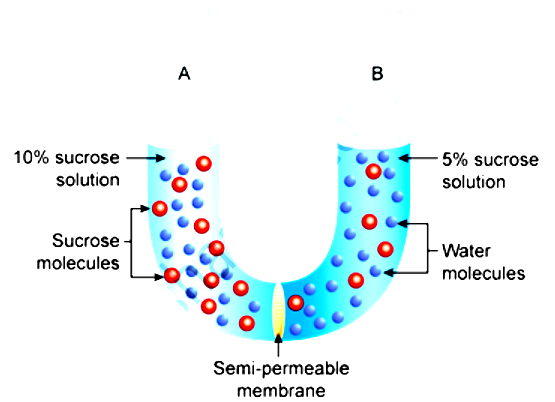
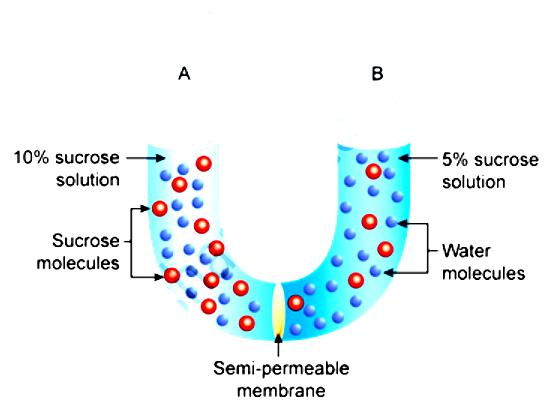
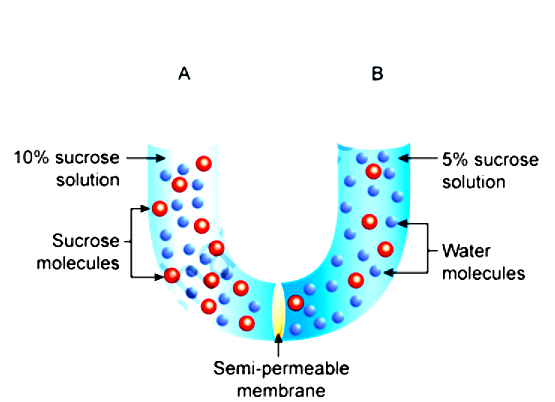
Study the experimental setup in the figure and then answer the question that follow.

What will you observe in the setup after about half an hour? Give reasons for your answer.
View full solution
Two potato cubes each 1 cm3 in size, were placed separately in two containers (A and B), the container A having water and the other (B) containing concentrated sugar solution. After 24 hours when the cubes were examined, those placed in water were found to be firm and had increased slightly in size and those placed in concentrated sugar solution were found to be soft and somewhat decreased in size. Use the above information to answer the questions that follow: Name and define the physical process being investigated in this experiment.
View full solution
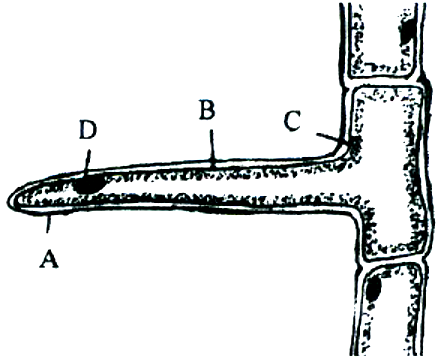
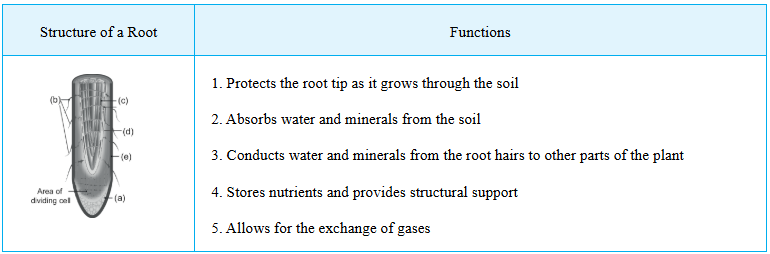
The diagram below represents a layer of epidermal cells showing a fully grown root hair. Study the diagram and answer the questions that follow:
Mention one distinct difference between the parts labelled A and B.
View full solution
Column IColumn II
A. Turgid(i) intake of mineral salts
B. Diffusion(ii) a cell charged with water
C. Active transport(iii) limiting membrane of a vacuole
D. Osmosis(iv) movement of particles from higher to lower concentration
 (v) movement of solvent across semi-permeable membrane
  • A-(ii), B-(iv), C-(i), D-(v), E-(iii)
  • B
    A-(iii), B-(iv), C-(i), D-(v), E-(ii)
  • C
    A-(i), B-(iv), C-(ii), D-(v), E-(iii)
  • D
    A-(ii), B-(v), C-(i), D-(iv), E-(iii)

Answer: A.

View full solution
Column IColumn II
(i) Exosmosis(a) The process by which roots absorb water from the soil.
(ii) Osmosis(b) The concentration of the solution when lower than that of the cell sap.
(iii) Plasmolysis(c) Two solutions which have equal osmotic pressure.
(iv) Hypotonic solution (d) The shrinkage of protoplasm when the cell is kept in a hypertonic solution
 (e) The exit or flow of water from the cell to the outer environment.
View full solution
Column IColumn II
(i) Diffusion(a) The pressure by which water rises upto some feet in a lofty tree.
(ii) Xylem(b) Two solutions which have equal osmotic pressure.
(iii) Root pressure(c) The tissue through which water and mineral salts move upward in a plant.
(iv) Isotonic solution(d) The process by which roots absorb water from the soil.
 (e) The process by which the molecules of perfume spread in the room when the bottle is open.
View full solution
Two potato cubes each 1 cm3 in size, were placed separately in two containers (A and B), the container A having water and the other (B) containing concentrated sugar solution. After 24 hours when the cubes were examined, those placed in water were found to be firm and had increased slightly in size and those placed in concentrated sugar solution were found to be soft and somewhat decreased in size. Use the above information to answer the questions that follow: Account for the softness and decrease in size of the potato cubes which were placed in sugar solution.
View full solution
Two potato cubes each 1 cm3 in size, were placed separately in two containers (A&B), the container (A) having water and the other (B) containing concentrated sugar solution. After 24 hours when the cubes were examined, those placed in water were found to be firm and had increased slightly in size and those placed in concentrated sugar solution were found to be soft and had somewhat decreased in size. Use the above information to answer the questions that follow: Account for the firmness and increase in the size of the potato cubes placed in water.
View full solution
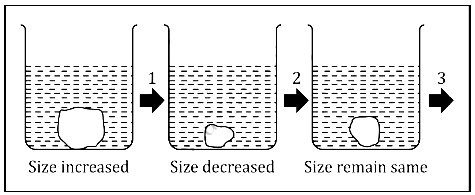
A candidate in order to study the process of osmosis has taken 3 potato cubes and put them in 3 different beakers containing 3 different solutions. After 24 hours, in the first beaker the potato cube increased in size, in the second beaker the potato cube decreased in size and in the third beaker there was no change in the size of the potato cube. The following diagram shows the result of the same experiment:

(i) Give the technical terms of the solutions used in beakers, 1, 2 and 3.
(ii) In beaker 3, the size of the potato cube remains the same. Explain the reason in brief.
(iii) Write the specific feature of the cell sap of root hairs which helps in absorption of water.
(iv) What is osmosis?
(v) How does a cell wall and a cell membrane differ in their permeability?
View full solution
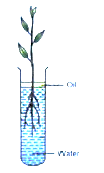
Study the diagram given below and answer the questions that follow :

(a) Name the process being studied in the above experiment.
(b) Explain the process mentioned in (a) above
(c) Why is oil placed over water?
(d) What do we observe with regard to the level of water when this set up is placed in (1) bright sunlight (2) humid conditions (3) windy day?
(e) Mention any three adaptations found in plants to foster the process mentioned in (a) above
View full solution
Q 40Do as Directed.1 Mark
Odd One Out :
(i) Epidermal cell, Cortical cell, Root hair cell, Guard cell
(ii) Imbibition, Root pressure, Osmotic pressure, photosynthesis
(iii) Turgidity, Flaccidity, Plasmolysis, Xylem
(iv) Water absorption, Mineral absorption, Photosynthesis, Ion exchange
View full solution
Q 43Do as Directed.1 Mark
Arrange and Rewrite :
Facilitated Diffusion, Protein channels open, Diffusion down the concentration gradient,  The substrate binds to the protein, Release of substrate on the other side of the membrane
View full solution

Generate a Absorption by roots - The Processes Involved paper free

Pick question groups from the list above, set marks and difficulty, and export a branded PDF with step-by-step answer keys. First 3 chapters free — no signup.

Download App