Question 12 Marks
Draw a cross-section of root showing association of soil particles with root hairs.
20 questions · timed · auto-graded
Bacteria and fungi do not grow in pickles, jams, jellies and squashes.
| PEndosmosis | Exosmosis |
| It occurs when a cell is placed in a hypotonic solution. | It occurs when a cell is placed in a hypertonic solution. |
| Water moves into the cell. | Water moves out of the cell |
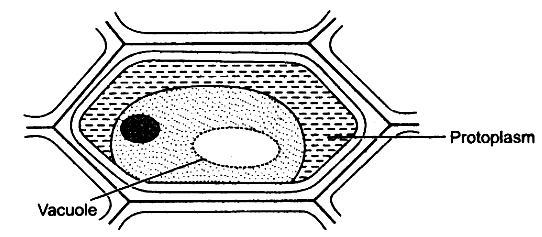
| Plasmolysis | Deplasmolysis |
| In this, the protoplasm of the cell shrinks away from the cell wall. It results in the flaccid condition of the cells and the plant. | In this, the protoplasm of the cell swells up and touches the cell wall. It results in the turgid condition of the cells and the plant. |
| Caused due to exosmosis. | Caused due to endosmosis. |
| Turgor Pressure | Root Pressure |
| t is the pressure of the cell. Contents of a turgid cell on its cell wall. | It is the pressure under which water passes from the living cells into the xylem of root. |
| It is caused when a cell becomes turgid. | It is caused due to alternate turgidity and flaccidity of root cells. |
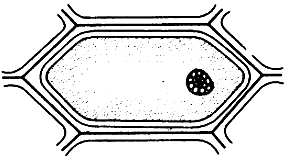
| Turgid | Flaccid |
| (ii) It occurs due to endosmosis. | (i) The cell loses water from the vacuole and cytoplasm under the plasmolytic condition. |
| (ii) It occurs due to endosmosis. | (ii) It occurs due to exosmosis. |
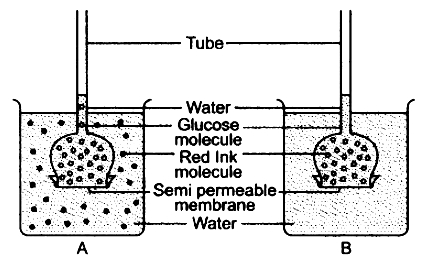
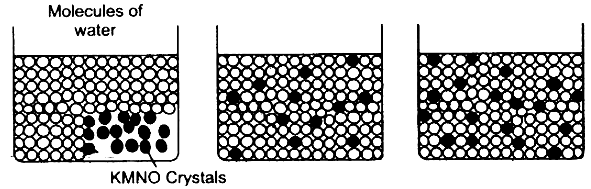
| Osmosis | Diffusion |
| Osmosis is a special type of diffusion which involves the movement of solvent molecules from a region of their higher concentration to a region of their lower concentration through a semi-permeable membrane. | Diffusion is the movement of solute molecules or ions from a region of their higher concentration to a region of their lower concentration without the influence of a semi-permeable membrane. |