Question types

Absorption by Roots question types

116 questions across 7 question groups — pick any mix to generate a Biology paper with step-by-step answer keys.

116
Questions
7
Question groups
5
Question types
Sample Questions

Absorption by Roots questions

One sample from each question group in this chapter. Select any group above to see the full set with answer keys.

Q 1MCQ1 Mark
Water will be absorbed by the root hairs when:
  • Concentration of solutes in the cell sap is high
  • B
    Concentration of solutes in the soil is high
  • C
    The plant is rapidly respiring
  • D
    None of the above

Answer: A.

View full solution
Q 2MCQ1 Mark
Osmosis involves diffusion of $.......$
  • A
    suspended particles from lower concentration to higher concentration.
  • B
    suspended particles from higher concentration to lower concentration.
  • Molecules or ions from the more concentrated solution to the less concentrated solution.
  • D
    water from the less concentrated solution to the more concentrated solution.

Answer: C.

View full solution
Q 3MCQ1 Mark
Marine fish when thrown under tap water bursts because of:
  • Endosmosis
  • B
    Diffusion
  • C
    Exosmosis
  • D
    Plasmolysis

Answer: A.

View full solution
Q 4MCQ1 Mark
Process of endosmosis stops:
  • A
    When equal
  • When solution becomes isotonic
  • C
    When the leaves fall.
  • D
    When there is no light

Answer: B.

View full solution
Q 5MCQ1 Mark
Seeds when soaked in water imbibe in it because:
  • A
    Osmotic pressure inside the seed is low
  • B
    Seed coat contains lot of salts
  • The process of absorption works
  • D
    There are many vacuoles in the endosperm

Answer: C.

View full solution
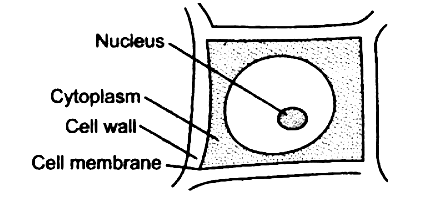
A thin strip of epidermal cells of a leaf was observed in a drop of water. They all looked turgid and normal.
(a) Draw a diagram of such a cell.
(b) Draw a diagram of a cell if this strip is transferred to a strong concentrated solution of sugar. What is term used for the effect on the cells ?
View full solution
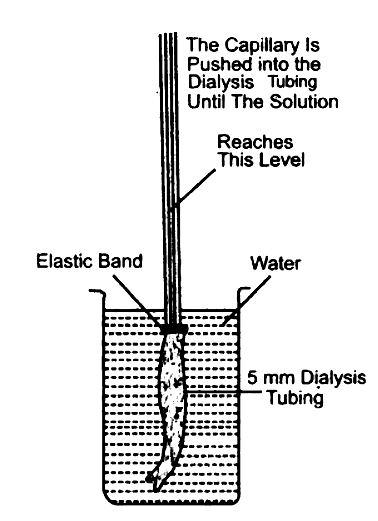
The apparatus arranged here signifies an important process.

(i) Name the process.
(ii) Where does this process occur in plants?
(iii) What solution is placed inside the dialysis tubing?
(iv) What happens to the level of the solution in the capillary tube?
(v) Define the process mentioned in Q. (i) above.
View full solution
A plant cell kept in a drop of water was examined under the low power magnification of a microscope, as shown:

(i) What would you do to bring this cell back to its original condition?
(ii) What scientific term is used for such condition?
(iii) Draw the same cell if it is kept in a strong sugar solution.
View full solution
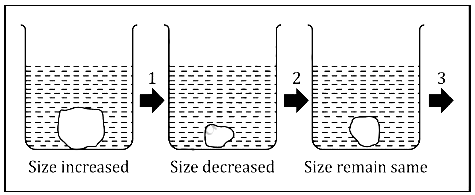
A candidate in order to study the process of osmosis has taken 3 potato cubes and put them in 3 different beakers containing 3 different solutions. After 24 hours, in the first beaker the potato cube increased in size, in the second beaker the potato cube decreased in size and in the third beaker there was no change in the size of the potato cube. The following diagram shows the result of the same experiment:

(i) Give the technical terms of the solutions used in beakers, 1, 2 and 3.
(ii) In beaker 3, the size of the potato cube remains the same. Explain the reason in brief.
(iii) Write the specific feature of the cell sap of root hairs which helps in absorption of water.
(iv) What is osmosis?
(v) How does a cell wall and a cell membrane differ in their permeability?
View full solution
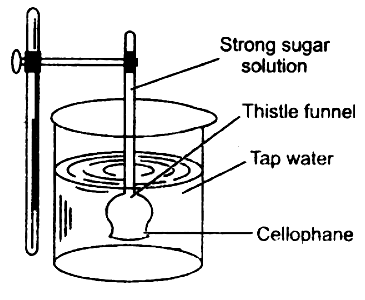
The diagram below represents an experimental set up to demonstrate a vital process. Study the same and then answer the questions that follow:


(i) Name the process.
(ii) Define the above named process.
(iii) What would you observe in the experimental setup after an hour or so?
(iv) What control experiment can be set up for the above experiment?
(v) Keeping in mind the root hair cell and its surrounding name the part that corresponds to (1) Concentrated sugar solution, (2) Parchment paper, (3) Water in the beaker.
(vi) Name any other substance that can be used instead of parchment paper in the above experiment.
(vii) Mention two advantages of this process to the plant.
View full solution

Generate a Absorption by Roots paper free

Pick question groups from the list above, set marks and difficulty, and export a branded PDF with step-by-step answer keys. First 3 chapters free — no signup.

Download App