Questions

[2 Mark Question Answer]

🎯

Test yourself on this topic

13 questions · timed · auto-graded

Question 12 Marks
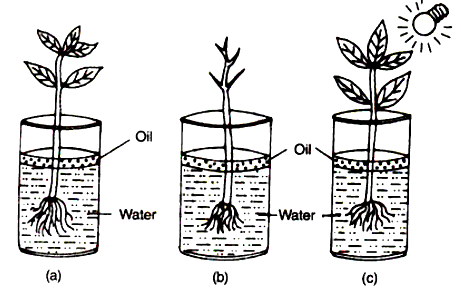
Three plants (a), (b) and (c) were placed in beakers containing coloured water. The water in each beaker was covered with a layer of oil. The leaves were removed from plant (b), while plant (c) was exposed to strong light.
(i) In which plant, (a), (b) or (c) would the water move up the fastest?
(ii) In which plant (a), (b) or (c), would the water move up slowly?
(iii) Why was the water covered with a layer of oil?
(iv) What is being investigated by this experiment?
Answer
(i) In (c), the water would move up the fastest.
(ii) In (b), the water would move up slowly.
(iii) To prevent evaporation of water.
(iv) Absorption of water by the roots.
View full question & answer
Question 22 Marks
Give at least three uses of water to green plants.
Answer
(i) Water is one of the raw materials for photosynthesis.
(ii) Water is important for seed germination.
(iii) Water controls the opening and closing of stomata.
View full question & answer
Question 32 Marks
Explain why:
Bacteria and fungi do not grow in pickles, jams, jellies and squashes.
Answer
Jam, jellies and pickles are kept in hypertonic solution of sugar or salt in which plasmolysis of bacteria and fungi takes place. This kills the bacteria and fungi and hence, pickles, jam and jellies are preserved properly.
View full question & answer
Question 42 Marks
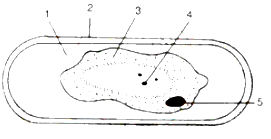
The diagram given below represents a plant cell after being placed in a strong sugar solution. Guidelines 1 to 5 indicate the following:
1. Strong sugar solution
2. Cell wall
3. Protoplasm
4. Large vacuole
5. Nucleus
Study the diagram and answer the questions that follow:
(i) What is the state of the cell shown in the diagram?
(ii) Name the structure which acts as a selectively permeable membrane.
(iii) If the cell had been placed in distilled water instead of strong sugar solution which feature would not have been present?
(iv) If the cell in the diagram possessed chloroplasts where would these be present?
(v) Name any one feature of this plant cell which is not present in animal cells.
Answer
(i) Plasmolysed cell
(ii) Plasma membrane
(iii) Large vacoule
(iv) The chloroplasts would be present in the shrunken protoplast.
(vi) Cell wall
View full question & answer
Question 52 Marks
Explain briefly whydo not root hairs become flaccid when fertilisers are added to the moist soil around them?
Answer
The root hairs become flaccid when fertilisers are added to the moist soil around them because fertilisers with moist soil become hypertonic which causes plasmolysis in the cells of the root hair. The turgidity is lost and the cell becomes flaccid.
View full question & answer
Question 62 Marks
What is the utility of plasmolysis?
Answer
Plasmolysis helps in the preservation of meat and fish by salting. It is also helpful in the preservation of jellies and jams by adding concentrated sugar solution to them. It helps in plasmolysing the spores of bacteria and fungi.
View full question & answer
Question 72 Marks
Distinguish between the following:
Plasmolysis and deplasmolysis
Answer
Plasmolysis deplasmolysi
When a cell is placed in hypertonic solution , water begins to pass out of the cell by osmosis with a consequent shrinkage of protoplasm . This phenomenon is called plasmolysis .When a plasmolysed cell is placed in hypotonic solution or pure water , endosmosis takes place as a result of which water is reabsorbed by the protoplast of the cell and it regains its original position . This phenomenon is called deplasmolysis .
View full question & answer
Question 82 Marks
Distinguish between the following:
Turgor pressure and osmotic pressure
Answer
Turgor pressure osmotic pressure
In a turgid cell , the pressure of the cell contents on the cell wall is called turgor pressure .The pressure by which the water molecules tend to cross the semi-permeable membrance is called the osmotic pressure .
View full question & answer
Question 92 Marks
Distinguish between the following:
Filtration and diffusion
Answer
Filtration and diffusion
Filtrationdiffusion
Filtration is the mechanical separation of a liquid from the undissolved particles floating on it .Diffusion is the movement of substances from an area of higher concentration to an area of lower concentration .
View full question & answer
Question 102 Marks
What is the difference between endosmosis and exosmosis?
Answer
EndosmosisExosmosis
1. The process of diffusion of water into the cell from outside is called endosmosis.1. The diffusion of water from inside to outside of a cell is called exosmosis.
2. It occurs when the cell is placed in a hypotonic solution.2. It occurs when the cell is placed in a hypertonic solution.
View full question & answer
Question 112 Marks
What is the difference between diffusion and osmosis?
Answer
DiffusionOsmosis
It is the movement of molecules of a substance from a region of higher concerntration to a region of lower concentration.It is the process in which water molecules moves through a semi-permeable membrance from a region of higher concentration to a region of lower concentration.
View full question & answer
Question 122 Marks
Mention two ways in which root hairs are suited for absorption of water from the soil?
Answer
(i) The epidermis and endodermis of root hairs are permeable to water.
(ii) Root hairs have a very large surface area.
View full question & answer
Question 132 Marks
Give an account of the importance of turgor pressure in a herbaceous plant.
Answer
Turgor pressure keeps the soft organs like flowers, young shoots, leaves, etc. in stretched form. It is also essential for the growth of the cells. Changes in the turgor pressure causes opening and closing of stomata.
View full question & answer
[2 Mark Question Answer] - Biology STD 10 Questions - Vidyadip