Question types

Absorption by Roots question types

68 questions across 6 question groups — pick any mix to generate a Biology paper with step-by-step answer keys.

68
Questions
6
Question groups
5
Question types
Sample Questions

Absorption by Roots questions

One sample from each question group in this chapter. Select any group above to see the full set with answer keys.

Q 1MCQ1 Mark
Process of ascent of sap in plants occurs ___________
  • A
    by cortex
  • by xylem
  • C
    by phloem
  • D
    by cambium

Answer: B.

View full solution
Q 2MCQ1 Mark
Wilting of plants occurs when ____________
  • A
    phloem is blocked.
  • xylem is blocked.
  • C
    a few old roots are removed.
  • D
    both xylem and phloem are blocked.

Answer: B.

View full solution
Q 3MCQ1 Mark
Exudation or bleeding is associated with ___________
  • A
    capillarity
  • B
    imbibition
  • hydrostatic pressure in the root
  • D
    pulsation in the innermost layer of cortex

Answer: C.

View full solution
Q 4MCQ1 Mark
The water is translocated upwards from the roots through _____________
  • xylem
  • B
    phloem
  • C
    pith
  • D
    endodermis

Answer: A.

View full solution
Q 5MCQ1 Mark
In ascent of sap water reaches upwards ____________
  • A
    In the form of a solid column.
  • B
    in the form of a fragile column.
  • C
    to some places in the form of solid and to some places in liquid form.
  • none of the above.

Answer: D.

View full solution
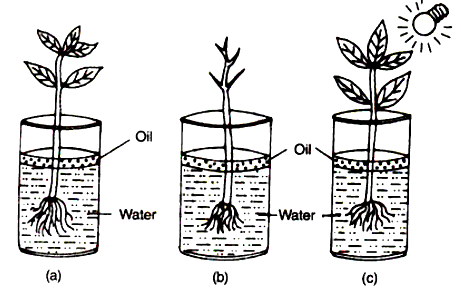
Three plants (a), (b) and (c) were placed in beakers containing coloured water. The water in each beaker was covered with a layer of oil. The leaves were removed from plant (b), while plant (c) was exposed to strong light.
(i) In which plant, (a), (b) or (c) would the water move up the fastest?
(ii) In which plant (a), (b) or (c), would the water move up slowly?
(iii) Why was the water covered with a layer of oil?
(iv) What is being investigated by this experiment?
View full solution
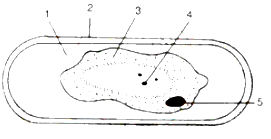
The diagram given below represents a plant cell after being placed in a strong sugar solution. Guidelines 1 to 5 indicate the following:
1. Strong sugar solution
2. Cell wall
3. Protoplasm
4. Large vacuole
5. Nucleus
Study the diagram and answer the questions that follow:
(i) What is the state of the cell shown in the diagram?
(ii) Name the structure which acts as a selectively permeable membrane.
(iii) If the cell had been placed in distilled water instead of strong sugar solution which feature would not have been present?
(iv) If the cell in the diagram possessed chloroplasts where would these be present?
(v) Name any one feature of this plant cell which is not present in animal cells.
View full solution
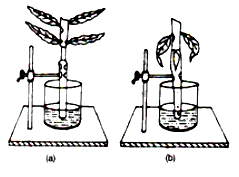
The diagram given below represents the results of an experiment conducted on two freshly taken leafy shoots of a herbaceous plant. The lower ends of the shoots dip in ordinary water.
(i) What is the aim of the experiment?
(ii) Some parts of the stem in both the shoots have been removed. Name the conducting tissue in shoot (a) and in shoot (b) that has been removed.
(iii) What are the results of this experiment?
View full solution
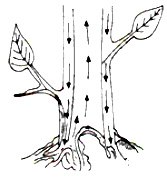
The figure shows a diagrammatic representation of the movement of certain substances inside the stem of a certain plant. Write five sentences on whatever you can explain about the processes or the arrangement of structures indicated in the diagram.
Note: - Each sentence must include one or more of the following four words, and each word can be used several times. Xylem, phloem, roots, leaves.
View full solution
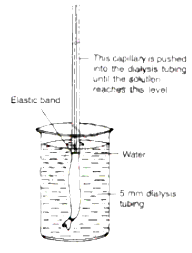
The apparatus arranged alongside signifies an important process.
(i) Name the process.
(ii) Where does this process occur in plants?
(iii) What solution is placed inside the dialysis tubing?
(iv) What happens to the level of the solution in the capillary tube?
View full solution

Generate a Absorption by Roots paper free

Pick question groups from the list above, set marks and difficulty, and export a branded PDF with step-by-step answer keys. First 3 chapters free — no signup.

Download App