Question 13 Marks
Study the picture given below and answer the questions:
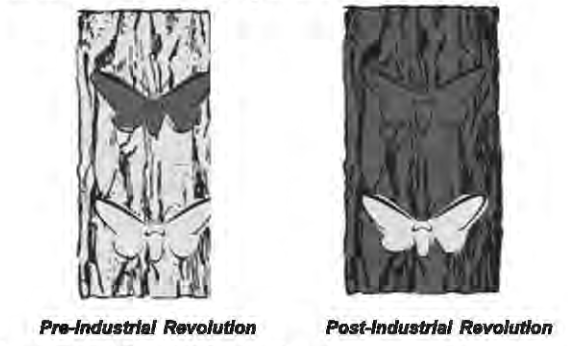
(i) Identify the phenomenon illustrated in the picture.
(ii) Write the scientific name of the insect which was involved in the phenomenon.
(iii) Which moth population was more post-industrialisation, light or dark? Provide an explanation.
(i) Identify the phenomenon illustrated in the picture.
(ii) Write the scientific name of the insect which was involved in the phenomenon.
(iii) Which moth population was more post-industrialisation, light or dark? Provide an explanation.
Answer
View full question & answer→(i) Industrial melanism
(ii) Biston betularia
(iii) The dark moth population was more prevalent after industrialisation. This is because during industrialisation, pollution resulted in widespread darkening of the environment, particularly in areas with high concentrations of soot and other pollutants. This made it more difficult for light-coloured moths to blend in with their surroundings, making them more visible to predators and decreasing their chances of survival. At the same time, the dark-coloured moths were better able to blend in with the darker environment, increasing their chances of survival and reproduction. Over time, this led to a shift in the population towards darker moths, which became more prevalent as a result of natural selection. This phenomenon is known as industrial melanism.
(ii) Biston betularia
(iii) The dark moth population was more prevalent after industrialisation. This is because during industrialisation, pollution resulted in widespread darkening of the environment, particularly in areas with high concentrations of soot and other pollutants. This made it more difficult for light-coloured moths to blend in with their surroundings, making them more visible to predators and decreasing their chances of survival. At the same time, the dark-coloured moths were better able to blend in with the darker environment, increasing their chances of survival and reproduction. Over time, this led to a shift in the population towards darker moths, which became more prevalent as a result of natural selection. This phenomenon is known as industrial melanism.