Question
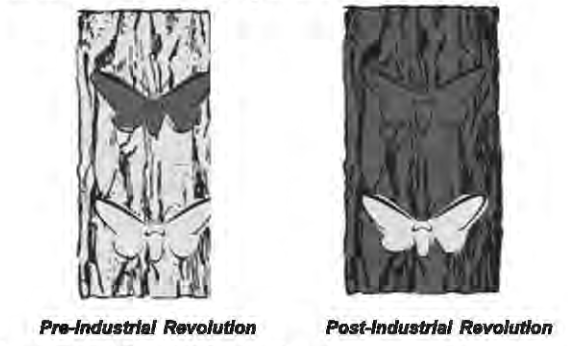
Study the picture given below and answer the questions:
Image

(i) Identify the phenomenon illustrated in the picture.
(ii) Write the scientific name of the insect which was involved in the phenomenon.
(iii) Which moth population was more post-industrialisation, light or dark? Provide an explanation.
Answer

(i) Industrial melanism
(ii) Biston betularia
(iii) The dark moth population was more prevalent after industrialisation. This is because during industrialisation, pollution resulted in widespread darkening of the environment, particularly in areas with high concentrations of soot and other pollutants. This made it more difficult for light-coloured moths to blend in with their surroundings, making them more visible to predators and decreasing their chances of survival. At the same time, the dark-coloured moths were better able to blend in with the darker environment, increasing their chances of survival and reproduction. Over time, this led to a shift in the population towards darker moths, which became more prevalent as a result of natural selection. This phenomenon is known as industrial melanism.

Need a full question paper?

Generate a complete, print-ready paper with questions like this in minutes — across 16+ boards, with answer keys.

Start Generating Free

Similar questions

What are the advantages of having a nervous system?
Name the hormone produced by the following glands giving one function of each:
(i) Thyroid (ii) Pancreas (iii) Adrenal medulla
Explain the following term : Homozygous
Draw the diagram of sectional view of female reproductive system and then label the following parts:
(a) Right ovary,
(b) Uterus,
(c) Cervix
(d) Vagina
(e) Oviductal funnel.
(ii) State the function of:
(a) Placenta (b) Amniotic fluid
A candidate in order to study the importance of certain factors in photosynthesis took a potted plant and kept it in the dark for over 24 hours. Then in the early hours of the morning, she covered one of the leaves with black paper in the center only. She placed the potted plant in the sunlight for a few hours, and then tested the leaf which was covered with black paper for starch.
  1. What aspect of photosynthesis was being investigated?
  2. Is there any control in this experiment? If so, state the same.
  3. Why was the plant kept in the dark before the experiment?
  4. Describe step by step how the candidate proceeded to test the leaf for the presence of starch.
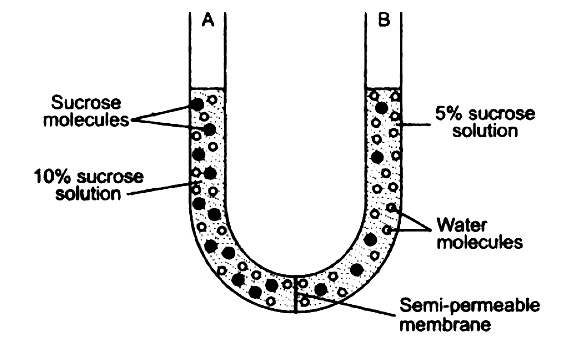
The diagram given below is of an experiment just at the start. Study the diagram carefully and answer the following questions :

(i) What does the experiment demonstrate?
(ii) Define, the process demonstrated in the experiment.
(iii) What changes are observed after a few hours?
(iv) Give two examples of a semi-permeable membrane.
(v) Which limb of the U-tube contains a more concentrated sucrose solution, A or B?
(vi) Why is the membrane separating the two solutions labeled as semi-permeable membrane?
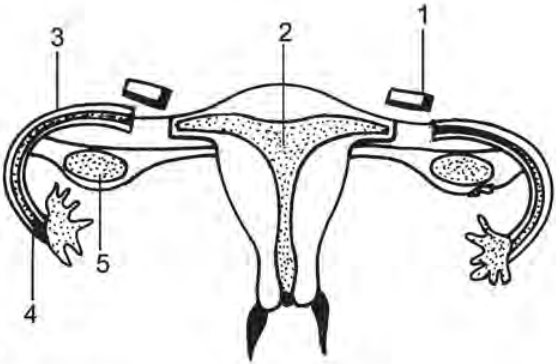
The figure given below is a technique. Look at it carefully and answer the questions that follow :

Image
(i) Name the technique.
(ii) Give the purpose of this technique.
(iii) Name the similar technique adopted in men.
Draw a neat diagram of the stomatal apparatus found in the epidermis of leaves and label the Stoma, Guard cells, Chloroplast, Epidermal cells, Cell wall and Nucleus.
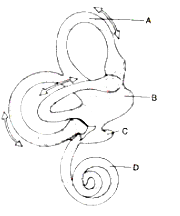
The diagram alongside represents the structure found in the inner ear. Study the same and then answer the questions that follow:
(i) Name the parts labelled A, B, C and D.
(ii) Name the parts of the ear responsible for transmitting impulses to the brain.
(iii) Name the part labelled above which is responsible for:
1. Static equilibrium. 2. Dynamic equilibrium. 3. Hearing
(iv) Name the audio receptor cells which pick up vibrations.
(v) Name the fluid present in the inner ear.
Give reason for the following:
The blood groups of both the donor and recipient must be known before transfusing blood.