Questions

[2 Mark Question Answer]

🎯

Test yourself on this topic

10 questions · timed · auto-graded

Question 12 Marks
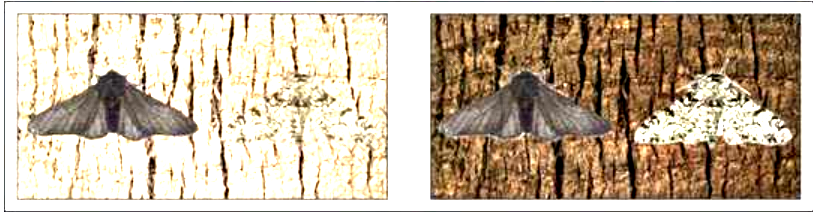
Given alongside are two figures (A and B) showing a phenomenon that was first observed in Manchester before and after the year 1850.
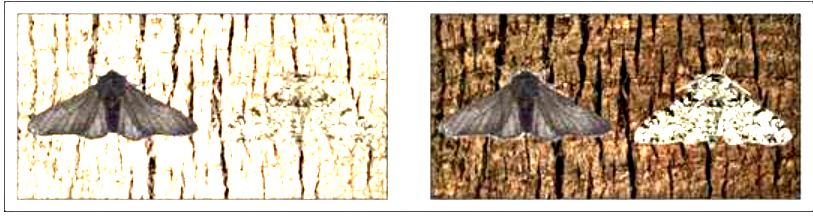
The following phenomenon provides a classical explanation of a scientific theory given by a certain scientist.
(i) Name and explain the said theory.
(ii) Give the name of the scientist who gave this theory.
Answer
(i) Natural selection
During the struggle for existence, only those individuals which have advantageous variations survive while the ones which lack these variations are wiped out. Nature selects only those variations which are suitable for existence. This process is called natural selection.
(ii) Charles Darwin
View full question & answer
Question 22 Marks
Given alongside are two figures (A and B) showing a phenomenon that was first observed in Manchester before and after the year 1850.

Give the common name and the scientific name of the insect involved in this phenomenon.
Answer
Common name: Peppered moth
Scientific name: Biston betularia
View full question & answer
Question 32 Marks
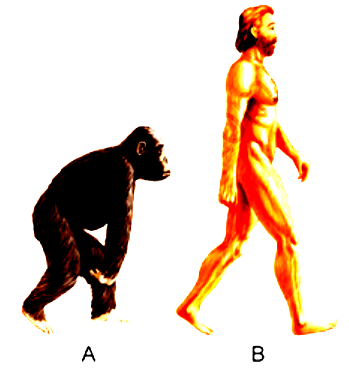
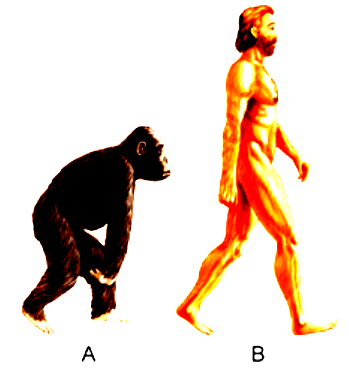
Given alongside are two figures (A and B) representing the two stages of evolution of humanbeings.
Answer the following:

State any two characteristic features of stage B.
Answer
Stage A: Australopithecus
Stage B: Homo sapiens sapiens Characteristic features of stage B (Homo sapiens sapiens):
  • Bipedal locomotion with four reversed curves in the spine
  • Forehead steep, reduced brow ridges
  • View full question & answer
    Question 42 Marks
    Given alongside are two figures (A and B) representing the two stages of evolution of human beings. Answer the following

    Write all the stages of human evolution in their correct sequence.
    Answer
    Stage A: Australopithecus
    Stage B: Homo sapiens sapiens
    Stages of human evolution in their correct sequence:
    Australopithecus → Homo habilis → Homo erectus → Neanderthal man → Cro-Magnon man → Homo sapiens sapiens
    View full question & answer
    Question 52 Marks
    Mention the two principles through which Lamarck explained his ideas.
    Answer
    (a) Use and disuse:
    Parts of the body which are used extensively become larger and stronger, while those which are not used deteriorate.
    (b) Inheritance of acquired characters:
    An organism could pass its modifications to its offspring.
    View full question & answer
    Question 62 Marks
    Explain the Term :
    Industrial melanism
    Answer
    Industrial melanism : This term refers to the phenomenon where the frequency of dark-colored varieties of animals, particularly moths,increases in industrial areas. This is an example of natural selection, where darker moths had a survival advantage in polluted environments due to their better camouflage against soot-covered surfaces.
    View full question & answer
    Question 72 Marks
    Explain the Term :
    Adaptive characters
    Answer
    Adaptive characters: These are traits or features in an organism that have evolved as a response to specific environmental pressures, enhancing the organism's chances of survival and reproduction. Examples include the long necks of giraffes for feeding on tall trees or the camouflage in chameleons.
    View full question & answer
    Question 82 Marks
    Explain the Term :
    Vestigial organs
    Answer
    Vestigial organs: These are organs or structures in an organism that have lost much or all of their original function through the course of evolution. Examples include the human appendix or the hind limb bones in whales. They are considered evidence of an organism's evolutionary history.
    View full question & answer
    Question 92 Marks
    Explain the Term :
    Natural selection or survival of the fittest
    Answer
    Natural selection or Survival of fittest : This is a key mechanism of evolution proposed by Charles Darwin. It suggests that individuals best adapted to their environment are more likely to survive and reproduce. Over time, this leads to the evolution of species as advantageous traits become more common in the population.
    View full question & answer
    Question 102 Marks
    Explain the Term :
    Biological evolution
    Answer
    Biological evolution : This refers to the process through which different species of organisms develop and diversify from earlier forms during the history of the earth. This process is driven by factors like genetic variation, reproduction, and natural selection, leading to changes in the traits and characteristics of organisms over generations.
    View full question & answer