Questions

[3 marks Question Answer]

🎯

Test yourself on this topic

6 questions · timed · auto-graded

Question 13 Marks
Given alongside are two figures (A and B) showing a phenomenon that was first observed in Manchester before and after the year 1850.
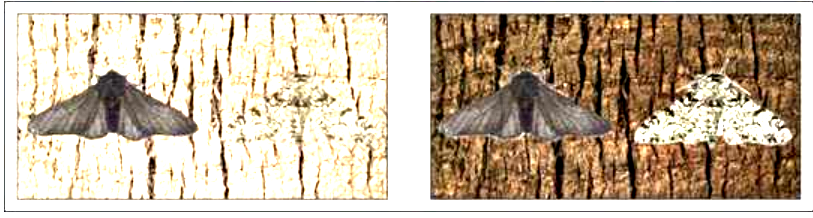
Briefly mention why the changes shown in the two figures appeared.
Answer
Reasons for changes in the two figures:
  • Before the Industrial Revolution, a thick growth of white-colouredlichen covered the trees. As a result, the light-coloured moths were camouflaged and survived under this cover, while the dark-coloured moths were easily spotted by predators.
  • After the Industrial Revolution, pollution resulted in a decline in the growth of lichens. The tree bark got exposed due to the absence of lichens. As a result, dark-colouredmoths now got an advantage of a dark background, were camouflaged and survived, while the light-coloured moths were easily picked by predators.
  • This showed that in a mixed population, those moths which could adapt to the changing environment after the Industrial Revolution survived and increased in number,while the ones which could not adapt were slowly wiped out from the population.
View full question & answer
Question 23 Marks
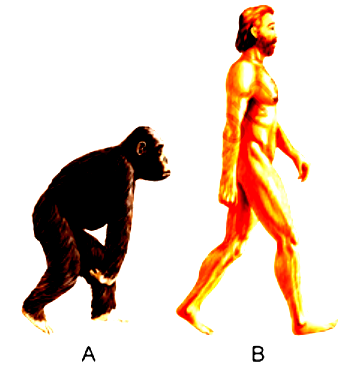
Given alongside are two figures (A and B) representing the two stages of evolution of human beings. Answer the following:

Mention any two contrasting characters between the two stages.
Answer
Stage A: Australopithecus
Stage B: Homo sapiens sapiens
Contrasting characters between Australopithecus and  Homo sapiens sapiens:
Characters Australopithecus Homo sapiens sapiens
Cranial capacity $450$ to $600 cm^3$ $1450$ to $1600 cm^3​​​​​​​$​​​​​​​
Development of chin Lack of chin, prognathous face Prominent chin, snout disappeared
View full question & answer
Question 33 Marks
Explain the occurrence of vestigial organs on the basis of Lamarck's theory of use and disuse.
Answer
Organs which are found in reduced or rudimentary condition and do not perform any function in the possessor are called vestigial organs or non-functional organs. They help in understanding the history of evolution and continuity of life.
  1. Wisdom teeth: They are the last molars which appear last at the age of 17-20 years.
  2. Vermiform appendix: It projects from the blind end of the caecum and is a functionless organ in humans. It is helpful in herbivorous mammals.
  3. Pinna: It is the lobe-like part of the external ear which humans cannot move as in other mammals. As it is poorly developed, it is a vestigial organ.
View full question & answer
Question 43 Marks
Name the six ancestral forms in their correct sequence through which modern man has evolved.
Answer
Correct sequence through which modern man evolved:
  1. Australopithecus
  2. Homohabilis
  3. Homo erectus
  4. Neanderthal man
  5. Cro-Magnon
  6. Homo sapiens
View full question & answer
Question 53 Marks
How would you justify that Australopithecus was a human ancestor?
Answer
Australopithecus averaged about $120 \ cm$ tall, and the cranial capacity ranged from $450-600 cm^3$​​​​​​​.It had a low forehead, protruding face, lack of chin and low brain capacity. Teeth resembled man because the dental arc was a smoothly rounded parabola, and a simian gap was absent which justifies a human ancestor.
View full question & answer
Question 63 Marks
Industrial melanism provides a good example of natural selection. Discuss.
Answer
  • The best example is industrial melanism showing the effect of industrial pollution on the moth population on a nearby tree.
  • Before industrialisation, light-coloured lichen used to grow on trees and moth predators could not spot white moths easily, while dark moths were lesser in the moth population. However, due to industrial pollution, lichens could not grow on trees and it became difficult for predators to spot dark moths on the dark background of the stem bark, and thus, the population of white moths became less than that of dark moths.
  • This process is termed industrial melanism. Before industrialisation, white moths were better adapted towards nature, but after industrialisation, dark-coloured moths were more fit towards the changed environmental conditions.
View full question & answer