Question 15 Marks
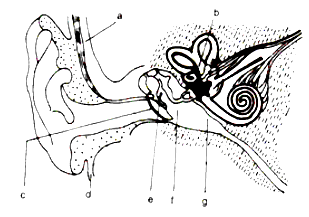
The diagram alongside represents the structure of the human ear.
(i) Write the names of the parts labelled a to g.
(ii) State briefly the functions of the parts b, d, and g.
(iii) Name the main division of the ear.
(iv) Which is the smallest bone in the human body?
(v) What is labyrinth?
(i) Write the names of the parts labelled a to g.
(ii) State briefly the functions of the parts b, d, and g.
(iii) Name the main division of the ear.
(iv) Which is the smallest bone in the human body?
(v) What is labyrinth?
Answer
View full question & answer→(i) (a) Bone of skull
(b) Inner ear
(c) Eardrum
(d) Bone of skull
(e) Bone of middle ear
(f) Middle ear
(g) Air filled
(ii) (b) Inner ear - It transmits the impulse to brain.
(d) Bone of skull - It helps in fixing the position of the ears to help the brain use auditory cues to judge direction and distance of sounds.
(g) Air filled - It keeps the pressure in the middle ear equalized with pressure in the outside.
(iii) The main division of the ear are: outer ear, middle ear and inner ear.
(iv) Stirrup
(v) The labyrinth is the inner ear which consists of utriculus, sacculus, cochlea and three semicircular canals.
(b) Inner ear
(c) Eardrum
(d) Bone of skull
(e) Bone of middle ear
(f) Middle ear
(g) Air filled
(ii) (b) Inner ear - It transmits the impulse to brain.
(d) Bone of skull - It helps in fixing the position of the ears to help the brain use auditory cues to judge direction and distance of sounds.
(g) Air filled - It keeps the pressure in the middle ear equalized with pressure in the outside.
(iii) The main division of the ear are: outer ear, middle ear and inner ear.
(iv) Stirrup
(v) The labyrinth is the inner ear which consists of utriculus, sacculus, cochlea and three semicircular canals.