Question types

Nervous System question types

115 questions across 7 question groups — pick any mix to generate a Biology paper with step-by-step answer keys.

115
Questions
7
Question groups
5
Question types
Sample Questions

Nervous System questions

One sample from each question group in this chapter. Select any group above to see the full set with answer keys.

Q 1MCQ1 Mark
Which one is the photoreceptor $.........$
  • A
    organ of corti
  • B
    organ of sylvious
  • C
    cristae
  • macula

Answer: D.

View full solution
Q 2MCQ1 Mark
Rods are receptor of $.........$
  • twilight vision
  • B
    colour vision
  • C
    sound wave
  • D
    odour

Answer: A.

View full solution
Q 3MCQ1 Mark
In the chemistry of vision, the photosensitive substance is $.........$
  • A
    melanin
  • B
    sclerotin
  • rhodopsin
  • D
    none

Answer: C.

View full solution
Q 5MCQ1 Mark
Outermost covering of the brain is $.........$
  • dura mater
  • B
    pia mater
  • C
    arachnoid
  • D
    pericardium

Answer: A.

View full solution
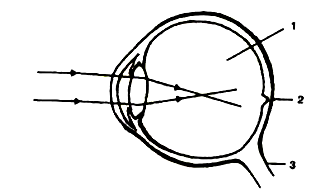
Given alongside is a diagram depicting a defect of the human eye. Study the same and then answer the questions that follow:
(i) Identify the defect.
(ii) Name the parts labelled 1, 2 and 3.
(iii) Give labelled two possible reasons for this eye defect.
(iv) Draw a labelled diagram to show how the above mentioned defect is rectified.
View full solution
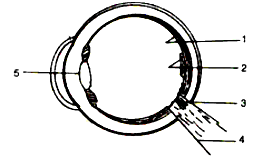
The diagram alongside represents a section of a mammalian eye.
(i) Label the parts 1 to 5 of the diagram.
(ii) State the function of the parts labelled 4 and 5.
(iii) With the help of a diagram show the short sightedness.
View full solution
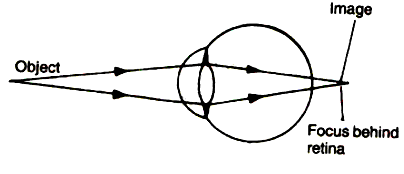
The diagram alongside represents a certain defect of vision of the human eye.
(i) Name the defect.
(ii) Describe briefly the condition in the eye responsible for the defect.
(iii) Redraw the figure by adding a suitable lens correcting the defect. Label the parts through which light-rays pass.
(iv) What special advantage do human beings derive in having both eyes facing forward?
View full solution
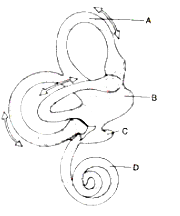
The diagram alongside represents the structure found in the inner ear. Study the same and then answer the questions that follow:
(i) Name the parts labelled A, B, C and D.
(ii) Name the parts of the ear responsible for transmitting impulses to the brain.
(iii) Name the part labelled above which is responsible for:
1. Static equilibrium. 2. Dynamic equilibrium. 3. Hearing
(iv) Name the audio receptor cells which pick up vibrations.
(v) Name the fluid present in the inner ear.
View full solution
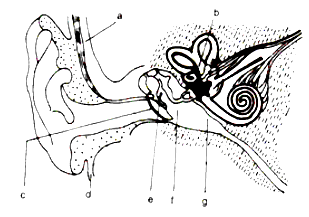
The diagram alongside represents the structure of the human ear.
(i) Write the names of the parts labelled a to g.
(ii) State briefly the functions of the parts b, d, and g.
(iii) Name the main division of the ear.
(iv) Which is the smallest bone in the human body?
(v) What is labyrinth?
View full solution
Match the terms of column I with those of column ll
Column lColumn ll
(i) Lens(a) Adjustment of light rays
(ii) Lachrymal gland(b) Vision
(iii) Olfactory epithelium(c) Secretion of tear
(iv) Cochlea(d) Balance of the body
(v) Semicircular canal(e) Hearing
(vi) Eyes(f) Smell
View full solution

Generate a Nervous System paper free

Pick question groups from the list above, set marks and difficulty, and export a branded PDF with step-by-step answer keys. First 3 chapters free — no signup.

Download App