Questions

[3 marks Question Answer]

🎯

Test yourself on this topic

11 questions · timed · auto-graded

Question 13 Marks
The diagram alongside refers to an experiment in which the apparatus was set up with the light source 10 cm away from the plant. After 15 minutes the number of bubbles evolved per minute from the cut stem was recorded. The light source was moved to 20 cm away from the plant, left for 15 minutes and the number of bubbles evolved per minute was again recorded. The experiment was repeated with the light source at distances of 40, 60, 80 and 100 cm away from the plant. Plot a graph for the results obtained and answer the following questions.
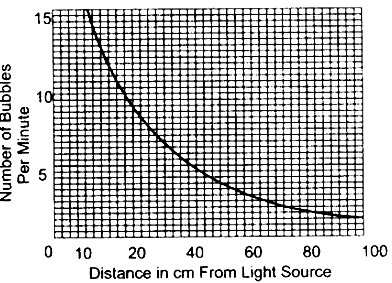
(i) From the graph it seems likely that the rate of bubbling per minute at 50 cm would have been
(a) 2.0 (b) 2.5 (c) 3.0 (d) 3.5
(ii) The gas produced by the plant during the experiment was
(a) air (b) oxygen (c) carbon dioxide (d) nitrogen (e) hydrogen
(iii) The gas collected comes due to the breakdown of
(a) glucose (b) starch (c) water (d) air (e) ATP
(iv) If ice cubes were added to the water, the rate of bubble formation would
(a) Stay the same.
(b) Increase because more water is added.
(c) Decrease because the temperature drops.
(d) Decrease because water freezes.
(e) Cannot tell from the information given.
(v) If some sodium bicarbonate is added to the water the rate of bubble formation
(a) Increases because more respiration occurs.
(b) Increases because more photosynthesis occurs.
(c) Increases because the gas becomes less soluble.
(d) Decreases because carbon dioxide acts as a limiting factor.
(e) Decreases because respiration decreases.
Answer
(i) (d) 3.5
(ii) (b) Oxygen
(iii) (c) Water
(iv) (c) Decrease because the temperature drops.
(v) (b) Increases because more photosynthesis occurs.
View full question & answer
Question 23 Marks
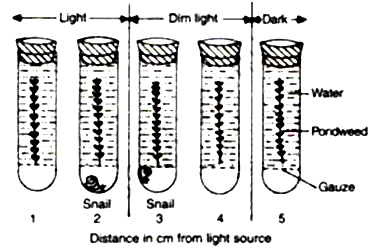
The diagram is set up to demonstrate an experiment. Pond weed was placed in five water-filled tubes. The experiment was set up as shown in the diagram. The tubes were then left for 24 hours. Write the correct answer out of the five available choices:
(i) In which tube would you except to find the plant with the least amount of starch?
(a ) 1 (b) 2 (c) 3 (d) 4 (e ) 5
(ii) The tube in which most oxygen would be found is
(a ) 1 (b) 2 (c) 3 (d) 4 (e ) 5
(iii) The tube in which least carbon dioxide would be found is
(a ) 1 (b) 2 (c) 3 (d) 4 (e ) 5
(iv) The tube in which the plant would survive for the shortest length of time is
(a ) 1 (b) 2 (c) 3 (d) 4 (e) 5
Answer
(i) (e) 5
(ii) (a) 1
(iii) (b) 2
(iv) (e) 5
View full question & answer
Question 33 Marks
Mention any three adaptations found in plants to favour the process of photosynthesis.
Answer
(i) Large surface area of leaves.
(ii) Presence of more stomata.
(iii) The thinness of leaves.
View full question & answer
Question 43 Marks
A potted destarched plant was taken in order to prove that light is necessary for photosynthesis.
(i) What is meant by 'destarched plant'? How can it be destarched?
(ii) Using the destarched plant describe step by step how you would proceed to prove that in the absence of light the leaf cannot manufacture starch.
Answer
(i) Destarched plant is the plant which lacks starch. Destarching is done by keeping the plant in dark for 2-3 days or covering a part of a leaf with a black paper by clip.
(ii) (a) The leaf is plucked and is boiled in water and decolourized with alcohol.
(b) The portion of leaf which received light turns blue with iodine because photosynthesis took place in that part of leaf.
(c) The part of leaf which was covered with black paper remains colourless because photosynthesis could not take place in the absence of sunlight.

This shows that starch is not manufactured in the absence of light.
View full question & answer
Question 53 Marks
Difference between an autotroph and a heterptroph. Give one example of each organism.
Answer
Difference between autotroph and heterotroph:
Autotroph Heterotroph
AutotrophHeterotroph
(i) They can prepare their own food.(i) They cannot prepare their own food.
(ii) They contain chlorophyll.(ii) They do not contain chlorophyll.
(iii) Examole - Green olants.(iii) Examole - Animals.
View full question & answer
Question 63 Marks
Explain why respiration is said to be a reversal of photosynthesis?
Answer
Respiration is said to be the reverse of photosynthesis due to the following reasons:
(1) In respiration, the organic food is broken down into its inorganic compounds, i.e., $CO _2$ and $H _2 O$, while in photosynthesis the organic food is synthesized from its inorganic components, i.e., $CO _2$ and $H _2 O$.
(2) In respiration, $CO _2$ is given out, while in photosynthesis $CO _2$ is consumed.
(3) In respiration, $O _2$ is consumed, while in photosynthesis $O _2$ is released or evolved.
(4) In respiration, energy is liberated, while in photosynthesis energy is absorbed.
View full question & answer
Question 73 Marks
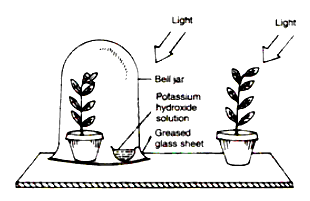
Two healthy green plants were placed in the dark for $24$ hours. They were then set up, as shown in the figure, for $4$ hours. Then a leaf was taken from each plant and
the chlorophyll was removed from the leaves:
( i) What is the next and final step in this experiment?
( ii ) What would be the results of the final step?
( iii ) Why was it necessary to grease the glass sheet?
( iv ) What hypothesis is being tested in this experiment?
Answer
(i) The leaf is then treated with iodine solution.
(ii) The leaf from first plant will not show starch test while the leaf from second plant will become blue-black showing the presence of starch.
(iii) It is necessary to grease the glass sheet to prevent the entry of air containing $CO _2$
(iv) The hypothesis that $CO _2$ is necessary for photosynthesis is being tested in this experiment.
View full question & answer
Question 83 Marks
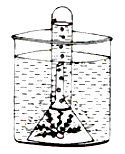
An experiment was set up as shown in the figure alongside. Look at the figure and answer the following questions:
( i) What is the objective of this experiment?
( ii ) Which plant is used in this experiment?
( iii ) Which gas is evolved in this process?
( iv ) What will happen to the rate of evolution of this gas if a pinch of sodium
bicarbonate is added?
(v ) What will happen if the apparatus is kept in dark?
Answer
(i) The objective of this experiment is to prove that oxygen is released during photosynthesis.
(ii) Hydrilla
(iii) Oxygen
(iv) The rate of photosynthesis will increase and the rate of bubbling also increases when sodium bicarbonate is added.
(v) Photosynthesis will not take place.
View full question & answer
Question 93 Marks
Give any four differences between photosynthesis and respiration.
Answer
Difference between photosynthesis and respiration:
PhotosynthesisRespiration
(ii) Photosynthesis occurs only in cells containing chlorophyll in the presence of sunlight.(i) Respiration is the process in which oxygen is absorbed and energy and carbon dioxide is released.
(ii) Photosynthesis occurs only in cells containing chlorophyll in the presence of sunlight.(ii) Respiration is a process which occurs at all times in all living cells.
(iii) It is an anabolic orocess.(iii) It is a catabolic orocess.
(iv) It results in a gain in dry mass.(iv) It results in a loss in dry mass.
View full question & answer
Question 103 Marks
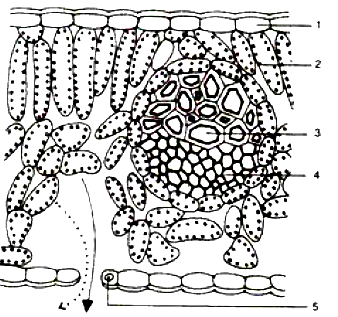
The figure given below represents the vertical section of a leaf.
( i) Name the parts labeled 1 to 5.
( ii ) What do the two arrows (dotted and solid) indicate in the daytime and at night?
( iii) Could you add one more arrow in the figure? If yes, what for?
( iv) How many leaf veins have been shown in this section?
Answer
(i) 1 - Upper Epidermis; 2 - Palisade layer / chloroplast; 3 - Xylem; 4 - Phloem; 5 - Guard cell
(ii) The two arrows show the release of oxygen and water vapours during the daytime and carbon dioxide and very less amount of oxygen is released during the night.
(iii) Yes, one more arrow can be added to show the absorption of carbon dioxide by the leaf.
(iv) One vein has been shown in this section.
View full question & answer
Question 113 Marks
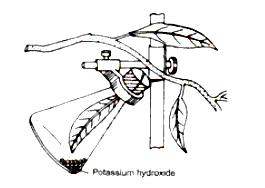
An experiment was set up as shown in the figure given below . The twig in the diagram was intact on the plant and it was as such in sunlight for a few hours .

(i) What is the aim of the above experiment ?
(ii) Why was potassium hydroxide placed inside the conical flask ?
(iii) What test would you perform on the leaf inside the flask?
(iv) What is the expected result of the above test ?
(v) Is it necessary to similarly test on outer leaf also ? Giva a reason .
Answer
(i) The aim of the experiment is to prove that $CO _2$ is necessary for photosynthesis.
(ii) Potassium hydroxide absorbs $CO _2$​​​​​​​ from the surrounding. It is placed to remove $CO _2$​​​​​​​ within the conical flask.
(iii) The leaf inside the conical flask would be tested for the presence of starch by the application of iodine.
(iv) The expected result of the above test is - No change in the colour will be observed.
(v) Yes, it is necessary to similarly test on the outer leaf also to show that leaves present in $CO _2$​​​​​​​ show photosynthesis.
View full question & answer
[3 marks Question Answer] - Biology STD 10 Questions - Vidyadip