Question types

Photosynthesis question types

80 questions across 7 question groups — pick any mix to generate a Biology paper with step-by-step answer keys.

80
Questions
7
Question groups
5
Question types
Sample Questions

Photosynthesis questions

One sample from each question group in this chapter. Select any group above to see the full set with answer keys.

Q 1MCQ1 Mark
The process of photosynthesis occurs by _________
  • A
    carbon dioxide and water
  • B
    carbon dioxide, chlorophyll and water
  • C
    water, chlorophyll, sunlight
  • water, carbon dioxide, chlorophyll and sunlight

Answer: D.

View full solution
Q 2MCQ1 Mark
Which of the following gas is used in photosynthesis?
  • A
    Oxygen
  • B
    Hydrogen
  • C
    Nitrogen
  • Carbon dioxide

Answer: D.

View full solution
Q 3MCQ1 Mark
Photosynthesis is more active in ___________
  • A
    green light
  • red light
  • C
    Yellow light
  • D
    violet light

Answer: B.

View full solution
Q 4MCQ1 Mark
Light reaction takes place in ____________
  • Grana
  • B
    stroma
  • C
    Chloroplast membrane
  • D
    endoplasmic reticulum

Answer: A.

View full solution
Q 5MCQ1 Mark
A cell that lacks chloroplast does not ______________
  • A
    Evolve $CO _2$
  • liberate $O _2$
  • C
    Require water
  • D
    utilize carbohydrates

Answer: B.

View full solution
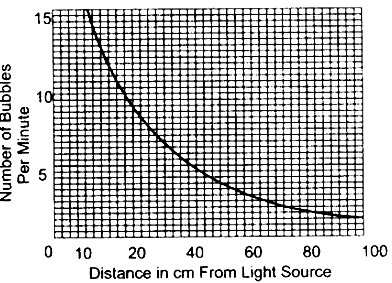
The diagram alongside refers to an experiment in which the apparatus was set up with the light source 10 cm away from the plant. After 15 minutes the number of bubbles evolved per minute from the cut stem was recorded. The light source was moved to 20 cm away from the plant, left for 15 minutes and the number of bubbles evolved per minute was again recorded. The experiment was repeated with the light source at distances of 40, 60, 80 and 100 cm away from the plant. Plot a graph for the results obtained and answer the following questions.

(i) From the graph it seems likely that the rate of bubbling per minute at 50 cm would have been
(a) 2.0 (b) 2.5 (c) 3.0 (d) 3.5
(ii) The gas produced by the plant during the experiment was
(a) air (b) oxygen (c) carbon dioxide (d) nitrogen (e) hydrogen
(iii) The gas collected comes due to the breakdown of
(a) glucose (b) starch (c) water (d) air (e) ATP
(iv) If ice cubes were added to the water, the rate of bubble formation would
(a) Stay the same.
(b) Increase because more water is added.
(c) Decrease because the temperature drops.
(d) Decrease because water freezes.
(e) Cannot tell from the information given.
(v) If some sodium bicarbonate is added to the water the rate of bubble formation
(a) Increases because more respiration occurs.
(b) Increases because more photosynthesis occurs.
(c) Increases because the gas becomes less soluble.
(d) Decreases because carbon dioxide acts as a limiting factor.
(e) Decreases because respiration decreases.
View full solution
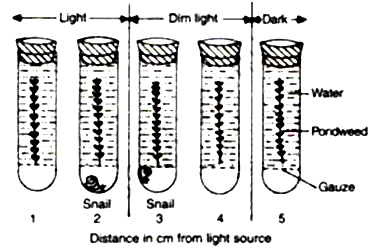
The diagram is set up to demonstrate an experiment. Pond weed was placed in five water-filled tubes. The experiment was set up as shown in the diagram. The tubes were then left for 24 hours. Write the correct answer out of the five available choices:
(i) In which tube would you except to find the plant with the least amount of starch?
(a ) 1 (b) 2 (c) 3 (d) 4 (e ) 5
(ii) The tube in which most oxygen would be found is
(a ) 1 (b) 2 (c) 3 (d) 4 (e ) 5
(iii) The tube in which least carbon dioxide would be found is
(a ) 1 (b) 2 (c) 3 (d) 4 (e ) 5
(iv) The tube in which the plant would survive for the shortest length of time is
(a ) 1 (b) 2 (c) 3 (d) 4 (e) 5
View full solution
A potted destarched plant was taken in order to prove that light is necessary for photosynthesis.
(i) What is meant by 'destarched plant'? How can it be destarched?
(ii) Using the destarched plant describe step by step how you would proceed to prove that in the absence of light the leaf cannot manufacture starch.
View full solution
The diagram alongside represents an experiment conducted to prove the importance of a factor in photosynthesis.

Study the same and then answer the questions that follow:
(i) Name the factor being studied in his experiment.
(ii) Why was the plant kept in a dark room before conducting the experiment?
(iii}Why was the experimental leaf then kept in
1. boiling water 2. methylated spirit?
(iv) Name the solution used to test for the presence of starch in the leaf.
(v) What will we observe in the experimental leaf at the end of the starch test?
(vi) Give a balanced chemical equation to represent the process of photosynthesis.
View full solution
Complete the following by filling in the blanks numbered 1 to 10 with the appropriate word/term:
Photosynthesis involves light reaction and dark reaction. During light reaction, the chlorophyll present in the (1) ______ gets activated by absorbing light energy. This energy splits (2) ______ molecules to (3) ______ and oxygen and releases two electrons. This process is called (4) ______. The (5) ______ ions are picked up by NADP to form (6) ______. The ADP is converted to (7) ______. This process is called (8) ______. During the dark phase, the compound produced at the end of the light reaction reacts with carbon dioxide to form (9) ______. This product is converted to starch. The process is called (10) ______.
View full solution
How does carbon dioxide return to the atmosphere? Explain.
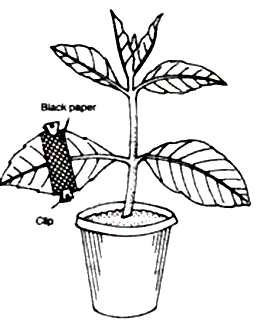
A student in order to study the importance of certain factors of photosynthesis took a potted plant and kept it in the dark for over 24 hours. Then in the early hours of the morning the student covered one of the leaves with black paper in the centre only. Student placed the potted plant in the sunlight for a few hours, and then tested the leaf which was covered with black paper for starch.
(i) What aspect of photosynthesis was being investigated?
(ii) Is there any control in this experiment? If so, state the name.
(iii) Why was the plant kept in the dark before the experiment?
(iv) Describe step by step how the candidate proceeded to test the leaf for the presence of starch.
View full solution
Match the terms of column I with those in column II:
Column IColumn II
(i) Stomata closed(a) decomposers
(ii) Autotrophs(b) light reaction
(iii) By-products of photosynthesis(c) animals
(iv) Photolysis(d) during night
(v) Bacteria and fungi(e) green plants
(f) oxygen
View full solution
(i) Fill in the blanks in the following equations of two chemical reactions:
(a) $\ce{---+12H2O->[Light energy]C6H12O6 + --- + ----}$
(b) $\ce{--- 6O2->[Chlorophyll] 6 --- +6 ---- + Energy}$
(ii) Name the two processes represented by the above two reactions.
(iii) State any two differences in these processes other than those already indicated in the reactions.
(iv) Which one of these two reactions is the supporter of all life on earth?
View full solution
Q 31TRUE / FALSE1 Mark
The following statement is about photosynthesis in a green plant. Write whether it is True or False.
Photosynthesis produces oxygen.
View full solution
Q 32TRUE / FALSE1 Mark
The following statement is about photosynthesis in a green plant. Write whether it is True or False.
The growing tips of stems and roots will be photosynthesizing actively compared with the rest of the plant.
View full solution
Q 33TRUE / FALSE1 Mark
The following statement is about photosynthesis in a green plant. Write whether it is True or False.
Green light is more effective than any other colour.
View full solution
Q 34TRUE / FALSE1 Mark
The following statement is about photosynthesis in a green plant. Write whether it is True or False.
The source of energy is light.
View full solution
Q 35TRUE / FALSE1 Mark
The following statement is about photosynthesis in a green plant. Write whether it is True or False.
A variegated leaf (one that has white as well as green patches) will only photosynthesize in the green areas.
View full solution

Generate a Photosynthesis paper free

Pick question groups from the list above, set marks and difficulty, and export a branded PDF with step-by-step answer keys. First 3 chapters free — no signup.

Download App