Questions

[2 Mark Question Answer]

🎯

Test yourself on this topic

23 questions · timed · auto-graded

Question 12 Marks
Name the blood vessels entering the heart and leaving the heart.
Answer
Blood Vessels entering the heart: The right atrium receives two large vessels :
(i) Anterior vena cava
(ii) Posterior vena cava

Blood Vessels leaving the heart: Arising from the ventricle are two large blood vessels :
(i) The pulmonary artery
(ii) The aorta
The coronary arteries arising from the base of the aorta.
View full question & answer
Question 22 Marks
The table below is designed to indicate the transport of certain substances in our body. Fill in the blanks with suitable answers:
Substance From To
(i) Lungs Whole Body
(ii) Carbon Dioxide
(iii) Urea
(iv) Digested Carbohydrates Intestines
(v) Target Organs
(vi) Heat Whole Body
Answer
(i) Oxygen,
(ii). Whole body, Lungs,
(iii) Liver, Kidney
(iv) Liver,
(v) Hormones, Endocrine glands,
(vi) Tissues.
View full question & answer
Question 32 Marks
Write about origin and functions of Red Blood Corpuscles
Answer
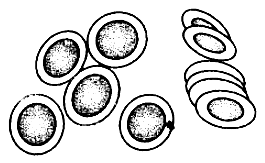
Origin: R.B.Cs. or erythrocytes are minute biconcave disc-like structures, flat in the center and thick and round at periphery in the blood formed in the red bone marrow of the long bones and bregot bone.
Function: They help in the transportation of oxygen and carbon dioxide to the different parts of the body.
View full question & answer
Question 42 Marks
What is the Rh-factor?
Answer
The Rh-factor was first discovered in the Rhesus monkey. It was found that Rh (rhesus) antigens were causing many of the transfusion failures that were unexplained by the A-B-O system. There are at least eight different Rh antigens so far. The person bearing Rhfactor is $Rh ^{+ ve }$ and a person who does not possess this factor is $Rh ^{- ve }$.
View full question & answer
Question 52 Marks
Describe in brief die cardiac cycle.
Answer
Cardiac Cycle:
It is the sequential phenomenon of contraction and relaxation of the heart. The action potential causes atria and then ventricles to undergo contraction (systole) followed by their relaxation (diastole). Systole forces blood to move from the atria to the ventricles and to the pulmonary artery and the aorta, then. The heart beats 72 times in a minute. So several cardiac cycles are done per minute. The duration of the cardiac cycle is 0-8 seconds. Two heart sounds are heard by a stethoscope during each cardiac cycle.
View full question & answer
Question 62 Marks
In what ways does the blood entering the kidney differ from that leaving the kidney?
Answer
The blood entering the kidneys contains excretory substances such as urea, uric acid, etc. These substances are removed from the blood in the kidneys and the blood is free from the waste: products of metabolism when it leaves the kidneys.
View full question & answer
Question 72 Marks
What does the term ‘double circulation’ mean?
Answer
Double circulation means that the blood flows twice in the heart before it completes one full round-the short pulmonary (lung) circulation and the long systemic (general body) circulation.
For this reason, blood circulation in the human body is also called double circulation.
View full question & answer
Question 82 Marks
Name the Blood vessels entering liver and kidney and Blood vessels leaving liver and kidney.
Answer
(a) Blood vessels entering the liver:
(i) Hepatic artery (from the aorta into the liver).
(ii) Hepatic portal vein (from stomach and intestine into the liver).
(b) Blood vessel entering the kidney: Renal artery (from the aorta into the kidney).
(c) Blood vessel leaving liver: Hepatic vein (from the liver into posterior vena cava)
(d) Blood vessel leaving kidney: Renal vein (from the kidney into posterior vena cava).
View full question & answer
Question 92 Marks
Why is circulatory system also known as transport system?
Answer
Circulatory system is also called transport system because it transports food, water, hormones, enzymes, electrolytes, antibodies and respiratory gases to or away from the body tissues.
View full question & answer
Question 102 Marks
Veins have valves at intervals in their inner lining whereas the arteries do not have valves. Explain.
Answer
In arteries blood flows with pressure but in veins the pressure falls considerably and the back flow of blood is prevented by the semilunar valves.
View full question & answer
Question 112 Marks
Why do people have a common belief that the heart is located on the left side of the chest?
Answer
People have a common belief that the heart is located on the left side of the chest because the narrow end of the roughly triangular heart is pointed to the left side and during its working, the contraction of the heart is more powerful on the left side which can be felt.
View full question & answer
Question 122 Marks
Why is circulatory system also known as transport system?
Answer
Circulatory system is also called transport system because it transports food, water, hormones, enzymes, electrolytes, antibodies and respiratory gases to or away from the body tissues.
View full question & answer
Question 132 Marks
Explain the Term
Haemopoiesis
Answer
Formation of blood corpuscles like WBC and RBC by the bone marrow and lymph nodes is called haemopoiesis. Bone marrow and lymph nodes are called haemopoietic tissues.
View full question & answer
Question 142 Marks
Explain the Term
Diapedesis
Answer
The passage of White Blood Corpuscles through an unruptured wall of blood vessels is known as diapedesis. It also helps in engulfing the germs and also protects the body from getting infected.
View full question & answer
Question 152 Marks
Explain the Term
Hepatic Portal System
Answer
Systems of veins carrying blood capillaries of the intestine to the liver in mammals is called the hepatic portal system. The blood from the intestine carries digested carbohydrates and proteins, i.e., glucose and amino acids to the liver which converts them into glycogen and urea respectively.
View full question & answer
Question 162 Marks
Explain the Term
Double Circulation
Answer
In mammals the heart produces two separate circulations, the pulmonary to the lungs and systemic to the rest of the body. These two separate circulations are jointly called double circulation. From the right ventricle deoxygenated blood goes to the lung for purification and
comes back to left auricle through pulmonary vein after purification which is known as pulmonary circulation,. Distribution of blood from the left ventricle to different parts of the body and back to hearts as deoxygenated blood is known as systemic circulation.
View full question & answer
Question 172 Marks
Explain the Term
Pulse rate
Answer
Pulse rate indicates the rate at which the heart beats. Each heartbeat results from the contraction (systole) and relaxation (diastole) of the heart. Both the auricles contract at a time and pour the blood into the main artery (dorsal aorta). The systole and diastole take 0.8 secs., which is 75 beats per minute.
View full question & answer
Question 182 Marks
Explain the Term
Blood Pressure
Answer
When the blood flows in the artery it exerts pressure on the elastic wall of the artery which is called blood pressure. It is greater during systole (contraction) than during diastole (relaxation) of the heart. In a normal adult, the blood pressure is 120/80 where systolic is 120 and diastolic pressure is 80 mm of Hg (mercury).
View full question & answer
Question 192 Marks
Differentiate between:
Diastole and Systole.
Answer
Diastole Systole
It is the condition of the heart when the chambers relax. It is the condition of the heart when the chambers of the heart contract.
It is the condition when the blood enters the chamber, e,g., when left atrium relaxes, blood enters from the pulmonary vein under low pressure. It is the condition when the blood is pumped out of the heart, e.g., when the left ventricle contracts, the blood is pumped to the body under high pressure.
View full question & answer
Question 202 Marks
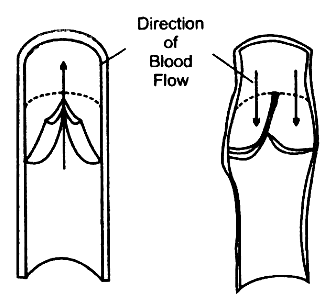
The diagram below represents a certain category of blood vessels showing the role of a special structure in their walls :

(i) Name the kind of blood vessels shown.
(ii) What is the structure shown inside the blood vessels?
(iii) What is the role of these structures?
(iv) Are these structures present in any other kind of blood vessel? If so, name it.
(v) Towards which side of the figure (Top or Bottom) is the heart located?
Answer
(i) Veins.
(ii) Pocket valves.
(iii) These structures maintain the flow of blood in one direction only by preventing its back¬flow.
(iv) Yes. These are present in lymph vessels.
(v) The heart is located towards the top side of the figure.
View full question & answer
Question 212 Marks
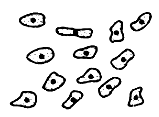
The diagram shows different types of blood cells, Name them.

A __________

B ______________

C ____________

D _______________


E ____________


F ____________

G ______________

H ______________
Answer
(A) Red blood cells
(B) RBC in section
(C) Basophil
(D) Neutrophil
(E) Lymphocyte
(F) Monocyte
(G) Eosinophil
(H) Platelets.
View full question & answer
Question 222 Marks
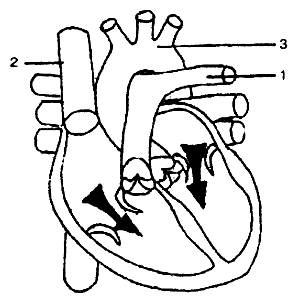
The diagram given below represents the human heart in one phase of its functional activities. Study the same and answer the questions that follow:

(i) Name the phase.
(ii) Label the parts 1, 2 and 3
(iii) Which part of the heart is contracting in this phase ? Give a reason to support your answer.
Answer
(i) Atrial systole.
(ii)
(1) Left pulmonary artery
(2) Superior vena cava
(3) Aorta.
(iii) Simultaneous contraction of both the auricles. Because the cuspid valves are open, allowing blood to flow into ventricles.
View full question & answer
Question 232 Marks
Differentiate between:
Red blood cells and White blood cells
Answer
Red blood cells White blood cells.
These are minute biconcave disc like structures, flat in centre, thick and round at the periphery and nuclei are absent in mature RBCs. These collect blood from different organs of the body.
These contain a respiratory pigment haemoglobin. Haemoglobin is not present.
RBCs help in the transport of oxygen and CO2. WBCs help in the protection of the body against infections from the germs.
The number of RBCs in an adult male is 5 million per cu. millimeter. Their number is usually about 4000-8000 per cubic millimeter.
Their average life span is about 120 days. Their average life span is about two weeks.
View full question & answer
[2 Mark Question Answer] - Biology STD 10 Questions - Vidyadip