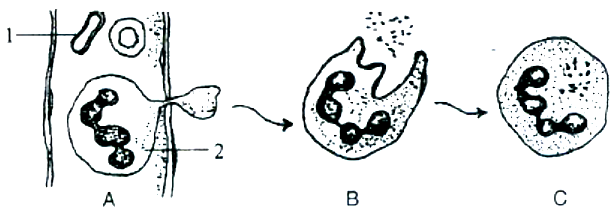
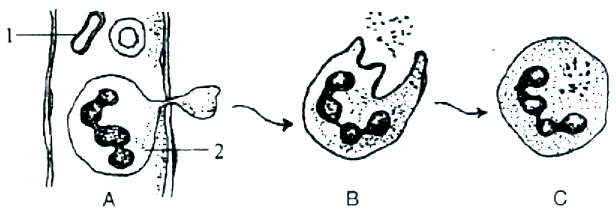
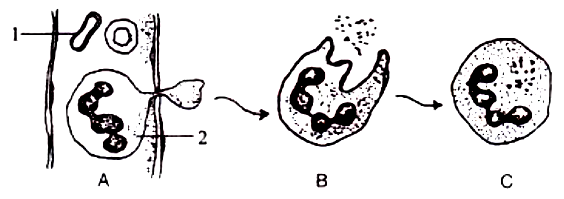
Study the following diagram carefully and then answer the question that follow : Name the process occurring in B and C and state the importance of this process in the human body.
Answer
The process which occurs in B and C is phagocytosis. In this process, the WBCs engulf the foreign particles and destroy them, thus preventing the occurrence of disease.
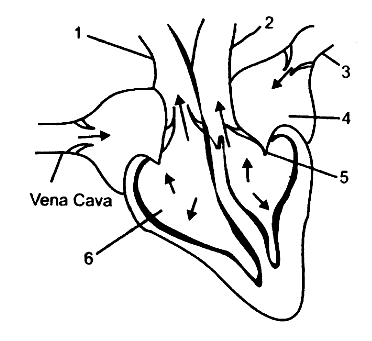
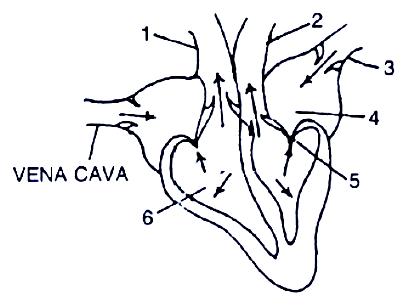
>he diagram given below represents the human heart in one phase of its activity. Study the same and then answer the question that follow: How many valves are closed in this phase?
Answer
Two i.e., bicuspid and tricuspid valves are closed in this phase.
The diagram given alongside represents the human heart in one phase of its activity. Study the same and then answer the question that follow: Name the phase.
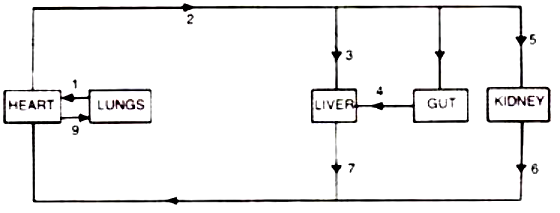
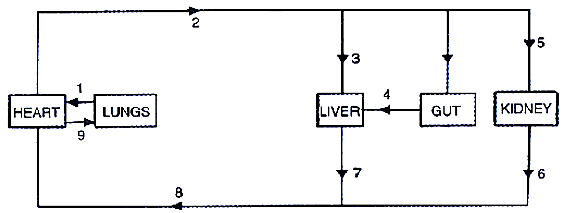
The following simplified diagram refers to the outline plan of the circulation of blood in a mammal. Study the diagram and write the number and name of the blood vessel in each case as mentioned ahead. Which vessel would contain the highest concentration of amino acids and glucose soon after a meal?
The following simplified diagram refers to the outline plan of the circulation of blood in a mammal. Study the diagram and write the number and the name of the blood vessel in each case as mentioned ahead. Several hours after a meal containing a lot of protein, which vessel will contain the highest concentration of urea?
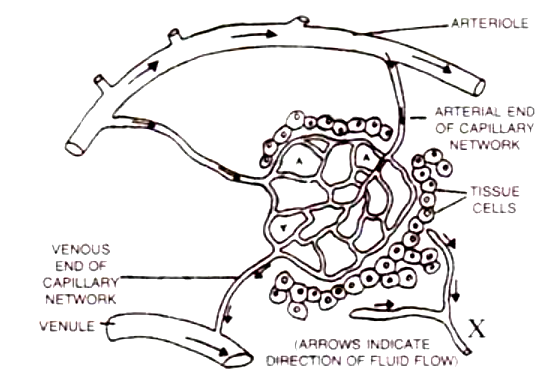
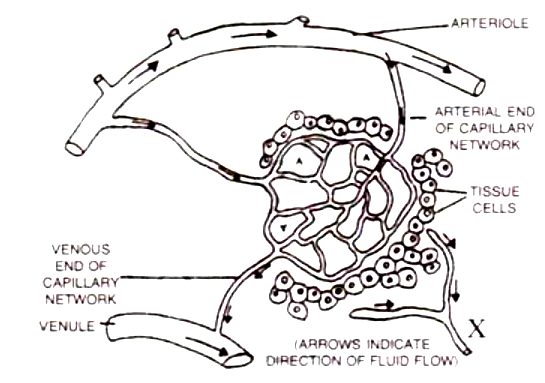
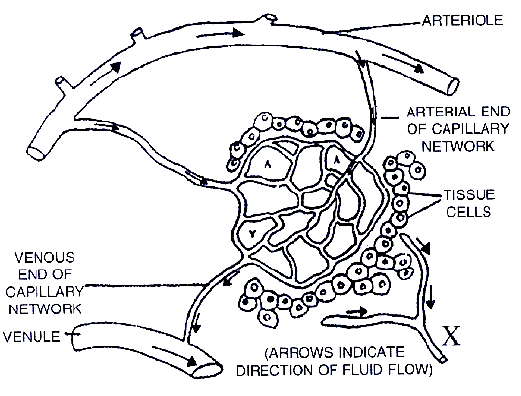
The diagram below shows part of the capillary bed in an organ of the human body. Some of the blood arriving at the capillaries at points labeled A, moves out into the spaces between the tissue cells. Study the diagram and answer the questions that follow: Some of the liquid surrounding the cells does not pass directly back into the blood but eventually reaches it by another route through vessel X. name the fluid present in vessel X.
The diagram below shows part of the capillary bed in an organ of the human body. Some of the blood arriving at the capillaries at points labeled A, moves out into the spaces between the tissue cells. Study the diagram and answer the questions that follow: Name any one important component of the blood which remains inside the capillaries and fails to move out into the spaces.
The diagram below shows part of the capillary bed in an organ of the human body. Some of the blood arriving at the capillaries at points labelled A, moves out into the spaces between the tissue cells. Study the diagram and answer the questions that follow: When the liquid from the blood surrounds the cells, what is it called?
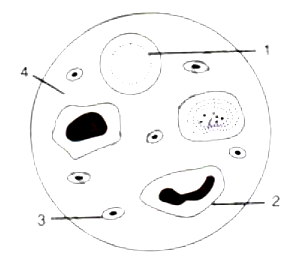
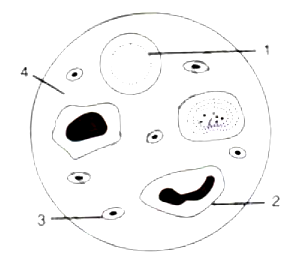
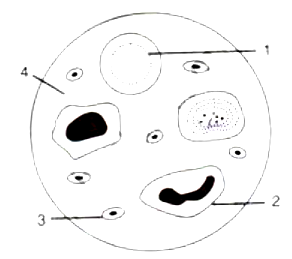
Given below is a diagram of a smear of human blood. Study the same and answer the question that follow: Name a soluble protein found in "4" which helps in clotting of blood.
Answer
Fibrinogen is the soluble plasma protein that helps in blood clotting.
Given below is a diagram of a smear of human blood. Study the same and answer the question that follow: Mention two structural differences between the parts labeled 1 and 2.
Answer
The red blood cells are minute biconcave disc-like structures whereas the white blood cells are amoeboid.
Tonsils: Tonsils are lymph glands located on the sides of the neck. They tend to localize the infection and prevent it from spreading it in the body as a whole.
Universal donor - The person with blood group O is a universal donor as this type of blood can be given to persons with any blood group i.e. O, A, B, AB.
Papillary muscles: Papillary muscles are cone-shaped muscles in the heart ventricles that attach to the valves via chordae tendineae. They prevent valve inversion during heart contraction, ensuring proper blood flow direction. Malfunction can lead to heart failure.
Electrocardiogram (ECG): A test that records the electrical activity (report of an electrocardiograph which is produced by the heart muscles during the cardiac cycle of contraction and relaxation) over a period of time. It's used to detect heart problems and monitor heart health.
Pacemaker : A small device implanted in the chest to help control abnormal heart rhythms. In a biological context, it refers to the sinoatrial node of the heart that naturally sets the pace of heartbeats.
Pulse rate : Indicates the rate at which the heart beats. Each heart beat results from the contraction (systole) and relaxation (diastole) of the heart. On an average, the systole and diastole take 0.8 seconds., which makes 75 beats per minute.
Phagocytosis: A cellular process where cells, usually white blood cells, engulf and digest foreign particles, bacteria, and other microorganisms. It's an essential part of the immune system.
Hematopoiesis: Formation of new blood corpuscles like WBC, RBC and platelats is called hematopoiesis. Bone marrow and lymph nodes are called haemopoietic tissues.
Diapedesis: Diapedesis is the process by which the leucocytes or white blood cells squeeze out through the walls of blood capillaries at the site of injury to fight against pathogens.