Question types

The circulatory system question types

259 questions across 9 question groups — pick any mix to generate a Biology paper with step-by-step answer keys.

259
Questions
9
Question groups
5
Question types
Sample Questions

The circulatory system questions

One sample from each question group in this chapter. Select any group above to see the full set with answer keys.

Q 1MCQ1 Mark
Heart sounds are produced due to ________ .
  • closure of tricuspid and bicuspid valves
  • B
    rushing of blood through valves producing turbulence
  • C
    closure of atrioventricular and semilunar valves
  • D
    entry of blood into auricles

Answer: A.

View full solution
Q 2MCQ1 Mark
The chief function of lymph nodes is to ________ .
  • A
    produce WBCs
  • B
    produce hormones
  • C
    destroy old RBCs
  • destroy pathogens

Answer: D.

View full solution
Q 3MCQ1 Mark
Angina pectoris is due to $.......$
  • A
    defective nutrition
  • chest pain due to inadequate supply of oxygen to the heart muscle
  • C
    defective functioning of mitral valve
  • D
    infection by a virus

Answer: B.

View full solution
Q 4MCQ1 Mark
The blood vessel supplying blood to the kidney is the$.......$
  • A
    renal vein
  • renal artery
  • C
    dorsal aorta
  • D
    hepatic vein

Answer: B.

View full solution
Q 5MCQ1 Mark
When a doctor is recording your pulse, he is pressing on your wrist exactly on a $.......$
  • A
    vein
  • B
    capillary
  • artery
  • D
    arteriole

Answer: C.

View full solution
Note the relationship between the first two words and suggest the suitable word/ word for the
fourth place:
Coronary artery: Heart :: Hepatic artery : ……………
View full solution
Note the relationship between the first two words and suggest the suitable word/ word for the
fourth place:
Lubb: Atrioventricualr valves :: dup: …………………
View full solution
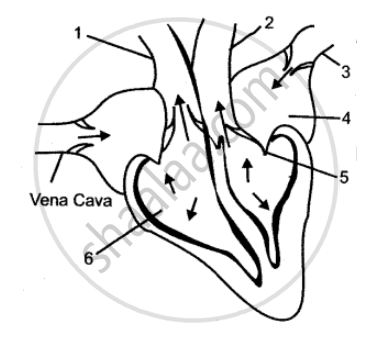
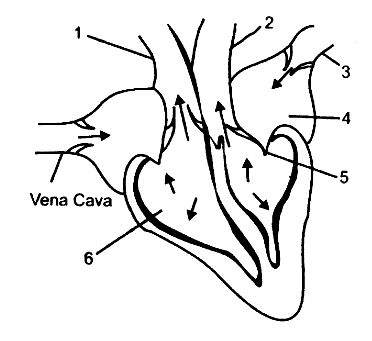
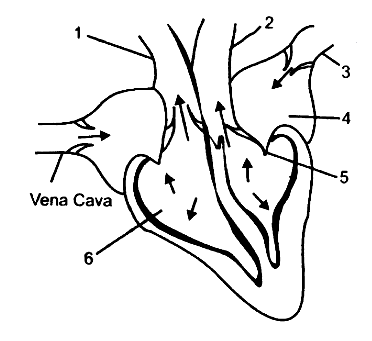
The diagram given below represents the human heart in one phase of its activity. Study the same and then answer the question that follow:
What type of blood flows through the parts marked '1' and '2'?
View full solution
The diagram given below represents the human heart in one phase of its activity. Study the same and then answer the question that follow:
Which part of the heart is contracting in this phase? Give a reason to support your answer.
View full solution
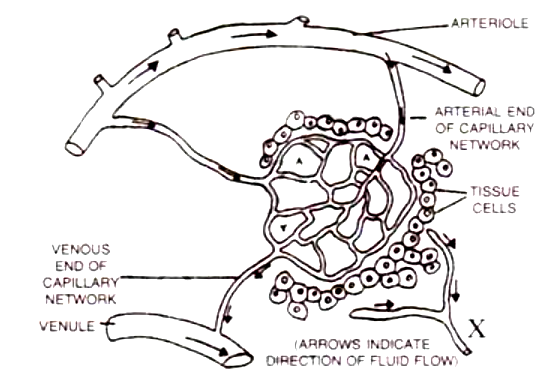
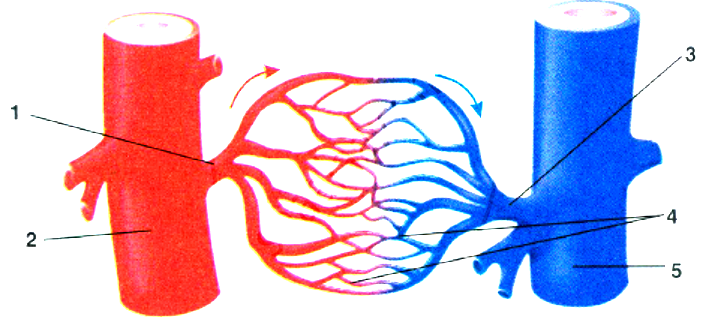
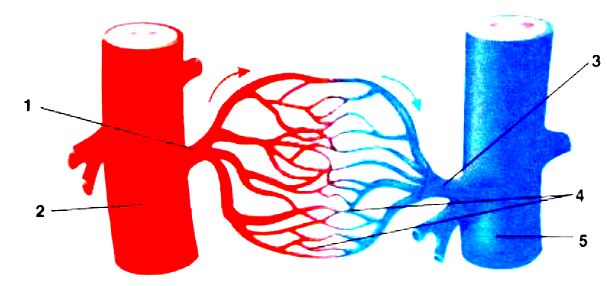
The diagram below shows part of the capillary bed in an organ of the human body. Some of the blood arriving at the capillaries at points labeled A, moves out into the spaces between the tissue cells. Study the diagram and answer the questions that follow:

State two important functions performed in our body by the fluid present in vessel X.
View full solution
Column IColumn II
(viii) Blood pressure(a) Allows blood flow from right auricle to right ventricle.
(ix) Tricuspid valve(b) Cardiac cycle.
(x) Bicuspid valve(c) Largest vein
(xi) Contraction and relaxation of heart(d) Sphygmomanometer
(e) Allows blood flow from left auricle to left ventricle.
View full solution
Column IColumn II
(i) Coronary artery(a) Largest artery
(ii) Aorta(b) Blocking of coronary arteries.
(iii) Heart attack(c) Sphygmomanometer
(iv) Blood pressure(d) Largest vein
 (e) Carry oxygenated blood to heart muscles.
View full solution
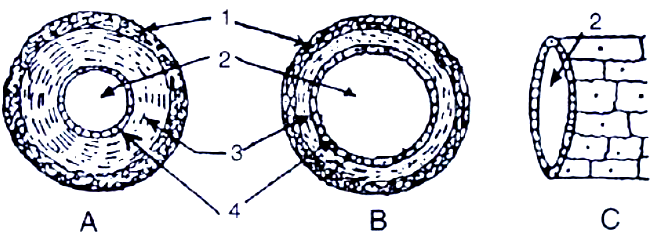
The figures given below show diagrammatic cross-sections of three kinds of blood vessels.

(a) Identify the blood vessels A, B and C
(b) Name the parts labelled 1-4
(c) Mention two structural differences between A and B.
(d) Name the kinds of blood that flow through A and through B respectively.
(e) In which one of the above vessels referred to in (a) above does the exchange of gases actually take place?
View full solution

Generate a The circulatory system paper free

Pick question groups from the list above, set marks and difficulty, and export a branded PDF with step-by-step answer keys. First 3 chapters free — no signup.

Download App