Questions

[2 Mark Question Answer]

🎯

Test yourself on this topic

29 questions · timed · auto-graded

Question 12 Marks
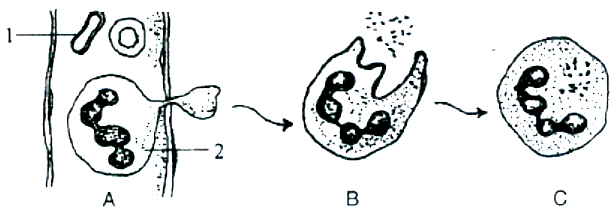
Study the following diagram carefully and then answer the question that follow:
Mention two structural differences between 1 and 2.
Answer

RBC

WBC


They lack a nucleus.

They have a nucleus.


They are biconcave and disc-shaped.

They are spherical and have different sizes.

View full question & answer
Question 22 Marks
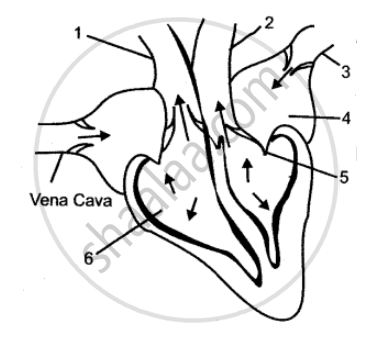
The diagram given below represents the human heart in one phase of its activity. Study the same and then answer the question that follow:
What type of blood flows through the parts marked '1' and '2'?
Answer
Part 1 (Pulmonary artery) → Deoxygenated blood

Part 2 (Aorta) → Oxygenated Blood
View full question & answer
Question 32 Marks
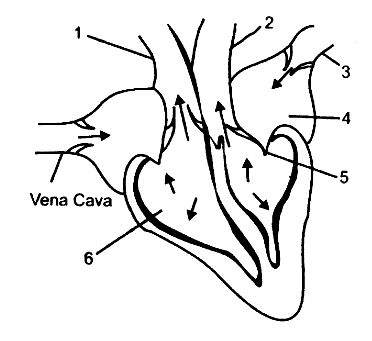
The diagram given below represents the human heart in one phase of its activity. Study the same and then answer the question that follow:
Which part of the heart is contracting in this phase? Give a reason to support your answer.
Answer
Ventricular muscles are contracting during this phase because the valves between the two ventricles and pulmonary artery and aorta are open while the atrio-ventricular valves are closed.
View full question & answer
Question 42 Marks
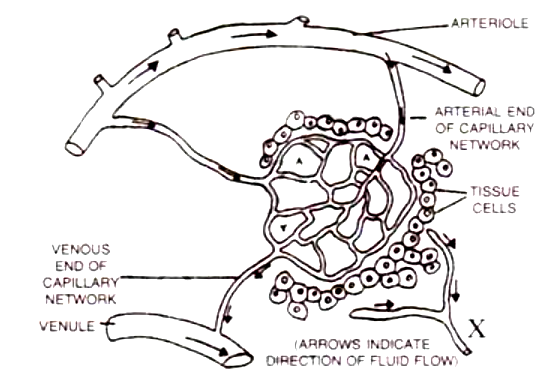
The diagram below shows part of the capillary bed in an organ of the human body. Some of the blood arriving at the capillaries at points labeled A, moves out into the spaces between the tissue cells. Study the diagram and answer the questions that follow:

State two important functions performed in our body by the fluid present in vessel X.
Answer
The lymph supplies nutrition and oxygen to those parts where blood cannot reach. The lymph drains away excess tissue fluids and metabolites and returns proteins to the blood from tissue spaces.
View full question & answer
Question 52 Marks
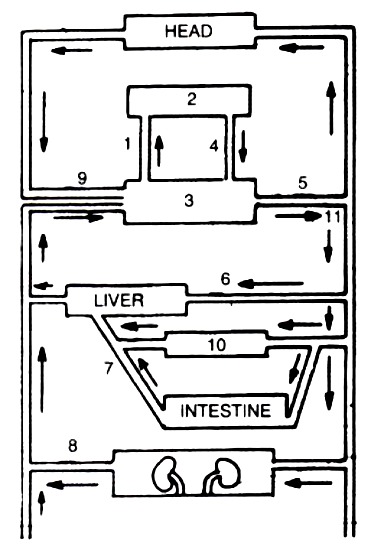
Given below is a highly schematic diagram of the human blood circulatory sytem.
Which part (state the number) represents the heart? Give reason in support of your answer.

Answer
The structure 3 represents the heart. It forms the centre of double circulation and is located between the liver and the head (as per the diagram). Also the blood circulation (indicated by 1) begins from heart to lungs.
View full question & answer
Question 62 Marks
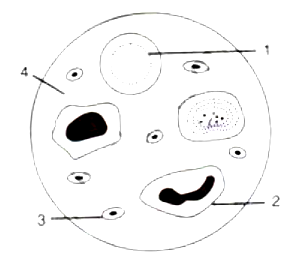
Given below is a diagram of a smear of human blood. Study the same and answer the question that follow:
Name the parts 1, 2, 3 and 4 indicated by guidelines.
Answer
1 → Red Blood Cell (RBC),

2 → White Blood Cell (WBC),

3 → Blood Platelet

4 →Blood Plasma.
View full question & answer
Question 72 Marks
Why do people have a common belief that the heart is located on the left side of the chest?
Answer
People have a common belief that the heart is located on the left side of the chest because the narrow end of the roughly triangular heart is pointed to the left side and during its working, the contraction of the heart is more powerful on the left side which can be felt.
View full question & answer
Question 82 Marks
When are the sounds “LUBB” and “DUP” produced respectively during heart beat?
Answer
The first sound LUBB is produced when the atrio-ventricular valves i.e. tricuspid and bicuspid
valves close at the start of ventricular systole.
The second sound DUP is produced at the beginning of ventricular diastole, when the pulmonary
and aortic semilunar valves close.
View full question & answer
Question 92 Marks
Differentiate between members of the following pairs with reference to the aspect asked within bracket:
Tricuspid and bicuspid values (location)
Answer

Tricuspid valve

Bicuspid valve


It is located between the right atrium and right ventricle of the heart.

It is located between the left atrium and left ventricle of the heart.
View full question & answer
Question 102 Marks
Differentiate between members of the following pairs with reference to the aspect asked within bracket:
artery and vein (type of blood primarily flowing through)
Answer

Artery

Vein


It generally contains oxygenated blood.

It generally carries deoxygenated blood.
View full question & answer
Question 112 Marks
Differentiate between members of the following pairs with reference to the aspect asked within bracket:
Artery and vein (direction of blood flow)
Answer

Artery

Vein


It carries blood away from the heart.

It brings blood towards the heart.
View full question & answer
Question 122 Marks
Differentiate between members of the following pairs with reference to the aspect asked
within bracket:
Erythrocytes and leucocytes (function)
Answer
ErythrocytesLeucocytes
They function in the transport of
oxygen throughout the body and
in the removal of carbon dioxide
from the body.
They help in the defense of the
body against disease-causing
pathogens.
View full question & answer
Question 132 Marks
Differentiate between members of the following pair with reference to phrase in bracket:
serum and vaccine (Composition)
Answer

Serum

Vaccine


The plasma from which the protein fibrinogen has been removed is called serum.

Vaccine is killed or living weakened germs which are introduced in the body to stimulate the production of antibodies against pathogens for a particular disease.
View full question & answer
Question 142 Marks
Differentiate between members of the following pair with reference to phrase in bracket:
Answer

RBC

WBC


It is enucleated, biconcave, disc-like structure, flat in the centre while thick and rounded at the periphery.

It is nucleated and amoeboid in shape.
View full question & answer
Question 152 Marks
Differentiate between members of the following pair with reference to phrase in bracket:
Antibodies and antibiotics (Source)
Answer

Antibodies

Antibiotics


They are produced by lymphocytes in response to the entry of pathogens in the bloodstream.

They are the medicines extracted from some bacteria and fungi. Antibiotics destroy or inhibit the growth of pathogens.
View full question & answer
Question 162 Marks
Why is it necessary to know the blood groups before giving transfusion?
Answer
During blood transfusion, it is necessary to know the blood groups before transfusion because it is important that the blood groups of the donor and the recipient are compatible. In case of an
incompatible blood transfusion, the recipient develops antibodies that attack the antigens present on the RBCs of the donor causing the blood cells to clump together which may result in death.
View full question & answer
Question 172 Marks
How do you account for the following difference?
The walls of the right ventricle are thicker than those of the right auricle.
Answer
The right ventricle pumps blood to the lungs for oxygenation whereas the right auricle
receives the blood from vena cavae and passes it to the right ventricle. Therefore, walls of
the right ventricle are thicker than those of the right auricle.
View full question & answer
Question 182 Marks
How do you account for the following difference?
The left ventricle has thicker walls than the right ventricle.
Answer
The left ventricle pumps blood to the farthest points in the body such as the feet, the toes and
the brain against the gravity while the right ventricle pumps the blood only up to the lungs.
Therefore, the left ventricle has thicker walls than the right ventricle.
View full question & answer
Question 192 Marks
What is the function of spleen?
Answer
Spleen: The spleen is a large lymphatic organ. The spleen acts as a blood reservoir in case of
emergency such as haemorrhage, stress or poisoning. It produces lymphocytes and destroys
worn out RBCs.
View full question & answer
Question 202 Marks
Is it possible for the blood to clot under the skin? Give reason in support of your answer.
Answer
Blood clotting is not dependent on the exposure of blood to air. In fact, clotting can be caused
by the movement of blood over a rough surface such as on cholesterol deposit inside of a blood
vessel of the skin.
View full question & answer
Question 212 Marks
What is Rh factor?
Answer
Rh factor - It is an inherited antigen often found on the blood cells. Some individuals
have these antigens and are thus Rh positive (Rh+) while others who do not have this antigen
are Rh negative (Rh-).
View full question & answer
Question 222 Marks
What are the functions of blood plasma?
Answer
The functions of blood plasma are:
(a) Transports of digested food from the alimentary canal to tissues.
(b) Transports excretory materials from tissues to excretory organs.
(c) Distributes hormones from the glands to their target site.
(d) Distributes heat in the body to maintain the body temperature.
View full question & answer
Question 232 Marks
What is meant by the term 'double circulation' of blood in mammals? What is diastole?
Answer

Blood flows twice in the heart before it completes one full cycle. This process of blood circulation in the human body is called double circulation.

The expansion or relaxation phase of the atria is called a diastole.

View full question & answer
Question 242 Marks
Give reason for the following:
The arteries are deep seated in the body
Answer
Arteries are responsible to carry oxygenated blood from the heart to the tissues. The blood
flows in the artery under high pressure and in spurts. If arteries are located superficially then
there is a high possibility of their damage which could lead to a lot of blood loss. To prevent
this damage and blood loss, the arteries are deep seated in the body.
View full question & answer
Question 252 Marks
Give reason for the following:
Atrial wall is less muscular than the ventricular wall.
Answer
Atrial wall is less muscular than the ventricular wall because the major function of atria is
to receive blood from the body and pump in into very next ventricles. While the ventricles
pump the blood out of the heart. Right ventricle to the lungs and the left ventricle to all the
body parts.
View full question & answer
Question 262 Marks
Give reason for the following:
Only the veins and not the arteries are provided with valves.
Answer
Veins carry the blood from the body part towards the heart while the arteries carry the blood
from the heart. Veins carry the blood against the force of gravity. Therefore, only the veins
and not the arteries are provided with valves.
View full question & answer
Question 272 Marks
Give reason for the following:
Blood flowing away from the stomach and intestines is put into circulation via the liver and
not directly.
Answer
The blood from stomach and intestines enters the liver via hepatic portal vein because the
liver monitors all the substances that have to be circulated in body. The excess nutrients such
as glucose, fats are stores in the liver. Excess amino acids are broken down by the process
deamination. Toxic substances are detoxified.
View full question & answer
Question 282 Marks
Give reason for the following:
The walls of the left ventricle are thicker than the walls of all other chambers.
Answer
The left ventricle pumps blood to the farthest points in the body such as the feet, the toes and
the brain against the gravity. Thus, it requires greater force to push the blood. In order to
with stand with the force applied the walls of the left ventricle are thicker than the walls of
all the chambers.
View full question & answer
Question 292 Marks
Explain the Term :
Hepatic portal system
Answer
Hepatic portal system : This system is a network of veins that carries blood from the gastrointestinal organs and spleen to the liver. This system includes the portal vein and its tributaries. It's essential for transporting nutrients absorbed from the digestive tract to the liver, where they can be processed, stored, detoxified, or passed into general circulation.
View full question & answer