Questions

[2 Mark Question Answer]

🎯

Test yourself on this topic

17 questions · timed · auto-graded

Question 12 Marks
How does hydrostatic pressure develop in the glomerulus?
Answer
The efferent arteriole is narrower than the afferent arteriole. These are further divided into many narrow capillaries thereby increasing the pressure of the blood flowing in it which is also known as hydrostatic pressure.
View full question & answer
Question 22 Marks
Describe about physical properties of urine
Answer
Physical properties of urine:
(a) Colour: Straw-yellow colour (due to presence of urochrome).
(b) Volume: 1 -1-5 litre per day but varies.
(c) pH: 5 to 8, i.e., it is slightly acidic (pH = 6).
(d) Odour: On standing, the smell of urine becomes strong, ammonia-like due to bacterial activity otherwise faint smell.
(e) Specific gravity: 1003 to 1035.
View full question & answer
Question 32 Marks
Think of the following: Tears, sweat, saliva, milk, Insulin, urine.
What are these excretion or secretion ? Why ?
Answer
Except urine, all others listed are secretions, because secretion is giving out by a cell or gland some substances that have some utility for the body. While excretion is the passing out of substances that have no further use in the body or are harmful.
View full question & answer
Question 42 Marks
“Kidneys are the master chemist of the body”. Comment.
Answer
The kidneys purify the blood by excreting toxic and waste products from the blood. They maintain the proper concentration of salts in the body and also regulate the proper amount of water in the body. In this way the kidneys eliminate only the wastes and extra substances from the body. Hence, we can say that kidneys are the master chemist of the body.
View full question & answer
Question 52 Marks
Urine is formed from alkaline blood, but it is acidic in nature”. Comment.
Answer
Blood is alkaline in nature but urine formed from blood is acidic. It is due to the reason that acidic products are continuously added to blood, but at the same time kidneys perform important service by selectively filtering out substances from blood into urine, thus it is acidic in nature.
View full question & answer
Question 62 Marks
How is urea produced?
Answer
Amino acids are broken down in the liver to form the amino group $(NH_2)$ compounds and keto acids like pyruvic acid and other acids.
​​​​​​​ Urea is formed from the amino group and other ammonium compounds during deamination by combination with $CO_2$​​​​​​​. It takes place by the ornithine cycle.
View full question & answer
Question 72 Marks
Write about the excretory role of the lungs.
Answer
Lungs possess blood capillaries which absorb $O_2$_ and pass on $CO_2$​​​​​​​​​​​​​​ to the alveoli, by the simple process of diffusion, which is finally removed from the body.
If retained inside the body, it may prove fatal. So lungs act as excretory organs.
View full question & answer
Question 82 Marks
Give biological reasons for the following statements: There is frequent urination in winter than in summer
Answer
In winter, our body does not need to store much water because the outside temperatures are low. Also, very less amount of water is lost through perspiration during winter. Hence, urination is more frequent in winter than in summer.
View full question & answer
Question 92 Marks
In summer the urine is slightly thicker than in winter explain the reason.
Answer
During summer, a considerable part of water is lost through perspiration so the kidneys have to reabsorb more water from the urine. This makes the urine thicker in summer than in winters.
View full question & answer
Question 102 Marks
Explain the Term: Tubular reabsorption
Answer

The nephrons have a tubular structure consisting of proximal and distal tubules which reabsorbs all the useful products present in the glomerular filtrate, and the process is called Tubular reabsorption.

View full question & answer
Question 112 Marks
Differentiate between the following pairs of term :

Urea and urine

Answer
Urea is the chief excretory product which is excreted in the form of urine whereas urine is the filtrate left after reabsorption and tubular secretion which contains 95% water and 5% solid wastes.
View full question & answer
Question 122 Marks
Differentiate between:
Excretion and Egestion
Answer
Excretion Egestion
It is the removal of metabolic wastes from the body. It is the removal of undigested food material from the body.
It is related with the kidney. It is related with the alimentary canal.
View full question & answer
Question 132 Marks
Differentiate between:
Ureter and Urethra.
Answer
Ureter Urethra
It transports urine from kidneys to the urinary bladder. It transports urine from the urinary bladder to the exterior.
The sphincter muscle is absent. It is guarded by a sphincter muscle.
View full question & answer
Question 142 Marks
Differentiate between:
Renal cortex and Renal medulla.
Answer
Renal cortex Renal medulla
It is dark red in colour. It is light red.
It forms the outer layer of the kidney. It forms the inner layer of the kidney.
It contains the Malpighian corpuscles, the proximal and distal parts of the renal tubule. It contains elements of Henle’s loop and the collecting tubules.
View full question & answer
Question 152 Marks
Differentiate between:
The Renal artery and the Renal vein.
Answer
Renal Artery Renal Vein
Blood is rich in urea. Blood is nearly free from urea.
Blood has more salts of $Na^+, K^+, NH_4^+.$ The blood has less salts of $Na^+, K^+,$ and $NH_4^+$
Blood is rich in oxygen. Blood is rich in $CO_2^–$
View full question & answer
Question 162 Marks
The diagram below represents a mammalian kidney tubule (nephron) and its blood supply. Parts indicated by the guidelines 1 to 8 are as follows:
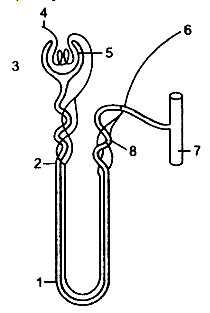
1. U-shaped loop of Henle
2. Proximal convoluted tubule with blood capillaries
3. Bowman’s capsule
4. Afferent arteriole from the renal artery
5. Glomerulus
6. Venule to the renal vein
7. Collecting tubule
8. Distal convoluted tubule with blood capillaries Study the diagram and answer the following questions in each case:
(i) Where does ultrafiltration take place?
(ii) Which structure contains the lowest concentration of urea?
(iii) Which structure contains the highest concentration of urea?
(iv) Which structure contains the lowest concentration of glucose?
(v) Where is the most water reabsorbed?
Answer
(i) 3. Bowman’s capsule.
(ii) 6. Renal vein.
(iii) 8. Distal convoluted tubule with blood capillaries.
(iv) 7. Collecting tubule.
(v) 2. Proximal convoluted tubule with blood capillaries.
View full question & answer
Question 172 Marks
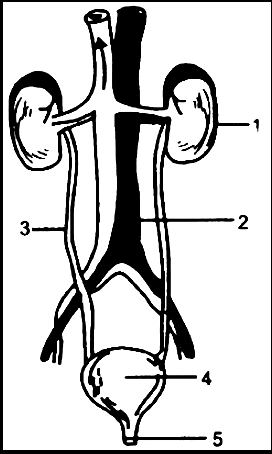
Given below is the figure of certain organs and associated parts in the human body. Study the same and answer the question that follow:
Name the parts numbered 1 to 5.
Answer
1-kidney,

2-renal artery,

3-ureter,

4-urinary bladder,

5-urethera

View full question & answer
[2 Mark Question Answer] - Biology STD 10 Questions - Vidyadip