Question types

The Excretory System question types

150 questions across 7 question groups — pick any mix to generate a Biology paper with step-by-step answer keys.

150
Questions
7
Question groups
5
Question types
Sample Questions

The Excretory System questions

One sample from each question group in this chapter. Select any group above to see the full set with answer keys.

Q 1MCQ1 Mark
In the Bowman’s capsule:
  • A
    Afferent arteriole is narrower whereas efferent arteriole is wider
  • Afferent arteriole is wider whereas efferent arteriole is narrower
  • C
    Afferent capillary is wider and efferent capillary is narrower
  • D
    Afferent capillary is narrow and efferent capillary is wide

Answer: B.

View full solution
Q 2MCQ1 Mark
 Ultrafiltration occurs in:
  • Bowman’s capsule 
  • B
    Proximal convoluted tubule
  • C
    Henle’s loop
  • D
    Distal convoluted tubule

Answer: A.

View full solution
Q 3MCQ1 Mark
Profuse sweating take place during heavy muscular exercise. The reason is:
  • A
    To excrete excessive amount of sodium chloride
  • B
    To eliminate excessive lactic acid produced due to anaerobic metabolism
  • C
    To regulate the temperature of the body
  • All of these

Answer: D.

View full solution
Q 4MCQ1 Mark
 What is the chief nitrogenous waste in mammals?
  • A
    Amino acid
  • B
    Ammonia
  • C
    Uric acid
  • Urea

Answer: D.

View full solution
Q 5MCQ1 Mark
Urea is synthesized from extra amino acids in:
  • A
    Kidney
  • Liver
  • C
    Uriniferous tubules
  • D
    Blood

Answer: B.

View full solution
Column 2 is a list of items related to ideas in Column 1. Match the term in Column 2 with the suitable idea given in Column 1.
Column 1 Column 2
i Liver a basic unit of the brain
ii Ova b stimulated by light
iii Alveoli c deoxygenated blood
iv Cochlea d part of the sclera
v Vein e haploid cell
vi Neuron f blind sacs
vii Stomata g found in the kidney
viii Grana h audio receptors
i diffusion of gases
j breakdown of proteins
k diploid cell
View full solution
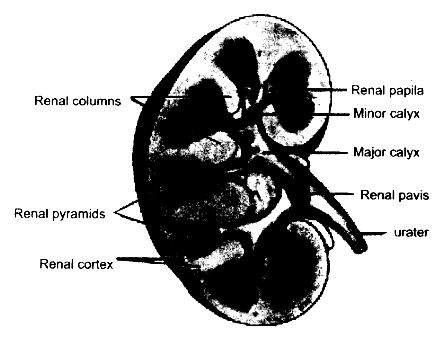
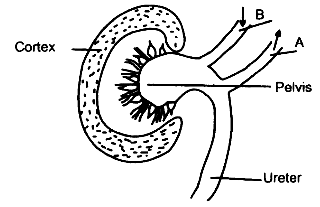
Given below is a simple diagram of the human kidney cut open longitudinally. Answer the following questions:
c
(v) Write two differences in the composition of the blood flowing through blood vessels A and B.
View full solution
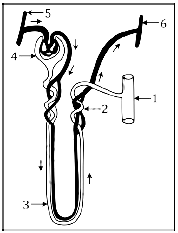
The given diagram represents a nephron and its blood supply. Study the diagram and answer the following questions:
(i) Label parts 1, 2, 3 and 4.
(ii) State the reason for the high hydrostatic pressure in the glomerulus.
(iii) Name the blood vessel which contains the least amount of urea in this diagram.
(iv) Name the two main stages of urine formation.
(v) Name the part of the nephron which lies in the renal medulla.
View full solution

Generate a The Excretory System paper free

Pick question groups from the list above, set marks and difficulty, and export a branded PDF with step-by-step answer keys. First 3 chapters free — no signup.

Download App