Question types

The Reproductive System question types

57 questions across 5 question groups — pick any mix to generate a Biology paper with step-by-step answer keys.

57
Questions
5
Question groups
5
Question types
Sample Questions

The Reproductive System questions

One sample from each question group in this chapter. Select any group above to see the full set with answer keys.

Q 1MCQ1 Mark
A group of students is studying different types of reproduction in biology class. They come across a species of plant that can reproduce both sexually and asexually. The students are curious about the advantages and disadvantages of each type of reproduction for this plant species. Which of the following is an example of asexual reproduction?
  • A
    Fertilisation of an egg by a sperm cell.
  • B
    Formation of a zygote.
  • Budding in yeast.
  • D
    Pollination of a flower.

Answer: C.

View full solution
Q 2MCQ1 Mark
The correct sequence of organs in the male reproductive system for transport of sperms is -
  • Testis $\longrightarrow$ Vas deferens $\longrightarrow$ Urethra
  • B
    Testis $\rightarrow$ Ureter $\longrightarrow$ Urethra
  • C
    Testis $\longrightarrow$ Urethra $\longrightarrow$ Ureter
  • D
    Testis $\longrightarrow$ Vas deferens $\longrightarrow$ Ureter

Answer: A.

View full solution
Q 3MCQ1 Mark
In human males, the testes lie in the scrotum because it helps in the
  • A
    process of mating
  • formation of sperm
  • C
    easy transfer of gametes
  • D
    all of these

Answer: B.

View full solution
Q 4MCQ1 Mark
In human females, an event that reflects onset of reproductive phase is
  • A
    growth of body
  • B
    changes in voice
  • C
    changes in hair pattern
  • menstruation

Answer: D.

View full solution
Q 5MCQ1 Mark
Reproduction is essential for living organisms in order to
  • A
    Keep the individual organisms alive
  • B
    Fulfill their energy requirement
  • C
    Maintain growth
  • Continue the species generation after generation

Answer: D.

View full solution
Given below are two statements which are incorrect. Rewrite the correct statements:
(i) Ovulation is the release of a mature egg from the uterus.
(ii) Fertilisation of the egg usually occurs in the fallopian tube.
View full solution
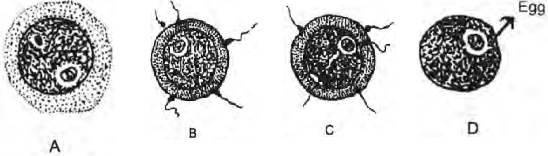
Given below are diagrams showing different stages in the process of fertilisation of an egg in the female reproductive tract :

Image
(i) Use the alphabets given below each diagram to show the correct order in the process of fertilisation.
(ii) Where in the female reproductive system does this process normally take place?
(iii) What is the biological term for the product of fusion?
View full solution
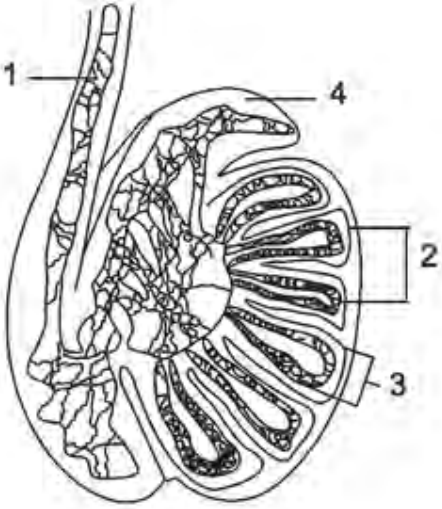
The diagram shown below is the lateral section of a testis of man.
Study it carefully and answer the questions that follow:
(i) Label the parts 1 to 4 of the diagram.
(ii) State the functions of the parts labelled 1 .
(iii) State the functions of the parts labelled 2.

Image
View full solution
Draw the diagram of sectional view of female reproductive system and then label the following parts:
(a) Right ovary,
(b) Uterus,
(c) Cervix
(d) Vagina
(e) Oviductal funnel.
(ii) State the function of:
(a) Placenta (b) Amniotic fluid
View full solution
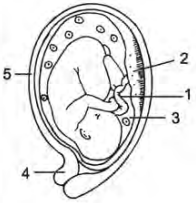
The diagram represents a developing human foetus in the womb. Study the same and then answer the questions that follow:
(i) Name the parts '1' to '5' indicated by guidelines.
(ii) What term is given to the period of development of the foetus in the womb?
(iii) Mention two functions of the part labelled as '2' other than its endocrine function.

Image
View full solution
Q 21Do as Directed.1 Mark
Choose the odd one out from the following terms and name the category to which the others belong:
Urethra, Uterus, Urinary bladder, Ureter.
View full solution
Q 22Do as Directed.1 Mark
Choose the odd one out from the following terms and name the category to which the others belong:
Prostate gland, Cowper's gland, Seminal vesicle, Seminiferous tubules.
View full solution

Generate a The Reproductive System paper free

Pick question groups from the list above, set marks and difficulty, and export a branded PDF with step-by-step answer keys. First 3 chapters free — no signup.

Download App