Questions

[3 marks Question Answer]

🎯

Test yourself on this topic

12 questions · timed · auto-graded

Question 13 Marks
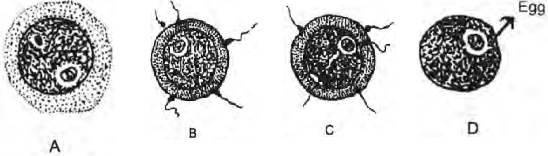
Given below are diagrams showing different stages in the process of fertilisation of an egg in the female reproductive tract :
Image
(i) Use the alphabets given below each diagram to show the correct order in the process of fertilisation.
(ii) Where in the female reproductive system does this process normally take place?
(iii) What is the biological term for the product of fusion?
Answer
(i) The correct order in the process of fertilisation :- $D \rightarrow B \rightarrow C \rightarrow A$
(ii) In fallopian tube
(iii) Zygote
View full question & answer
Question 23 Marks
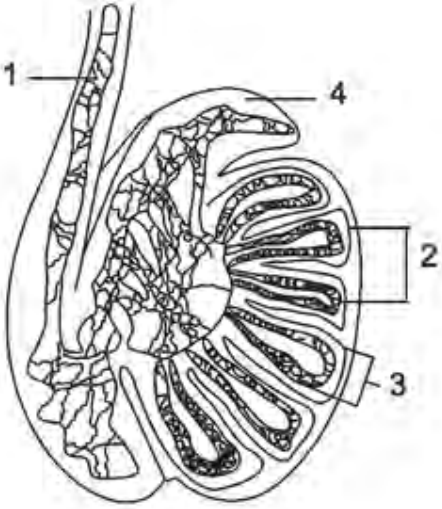
The diagram shown below is the lateral section of a testis of man.
Study it carefully and answer the questions that follow:
(i) Label the parts 1 to 4 of the diagram.
(ii) State the functions of the parts labelled 1 .
(iii) State the functions of the parts labelled 2.

Image
Answer
(i) (1) Sperm Duct (Vas deferens)
(2) Seminiferous Tubule
(3) Lobes of Testis (lobule)
(4) Epididymis
(ii) The function of Sperm Duct (1): It carries sperms from testis to urethra.
(iii) The function of Seminiferous tubule (2) : Sperms are produced here. The process is called spermatogenesis.
View full question & answer
Question 33 Marks
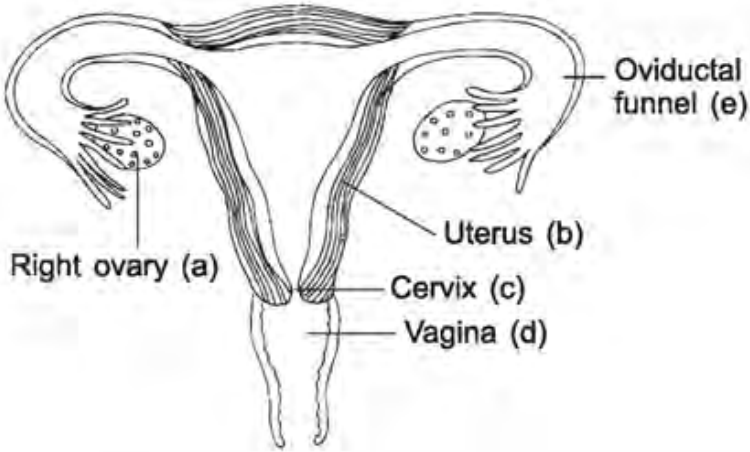
Draw the diagram of sectional view of female reproductive system and then label the following parts:
(a) Right ovary,
(b) Uterus,
(c) Cervix
(d) Vagina
(e) Oviductal funnel.
(ii) State the function of:
(a) Placenta (b) Amniotic fluid
Answer
(i) Female reproductive system:

Image

(ii) Functions of:
(a) Placenta:
• It provides nutrition to foetus.
• It provides oxygen and removes carbon dioxide from the foetus to the mother's blood through diffusion.
• It prevents the entry of germs into the foetus and gives protection from infection.
• It secretes hormones.
(b) Amniotic fluid:
• It acts as a cushion for the embryo and protects it from jerks or mechanical shocks.
• It prevents sticking of the foetus to the amnion.
View full question & answer
Question 43 Marks
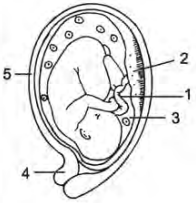
The diagram represents a developing human foetus in the womb. Study the same and then answer the questions that follow:
(i) Name the parts '1' to '5' indicated by guidelines.
(ii) What term is given to the period of development of the foetus in the womb?
(iii) Mention two functions of the part labelled as '2' other than its endocrine function.

Image
Answer
(i) 1. Umbilical Cord
2. Placenta
3. Amniotic fluid
4. Cervix/Mouth of Uterus
5. Uterine wall
(ii) Gestation Period
(iii) The part labelled as 2 provides nutrition and exchange of respiratory gases by diffusion.
View full question & answer
Question 63 Marks
(i) What is meant by artificial insemination?
(ii) What are test-tube babies?
Answer
(i) Artificial insemination: When sperms of mature male are transferred to the female body by means other than the natural process. The procedure is called artificial insemination.
This method is usually adopted to improve cattle breed. It involves collection of sperms of good quality bull, proper storage of sperms and their transfer into the vagina of a cow having desirable qualities.
(ii) Test-tube babies : In some women, normal conception is not possible. In such cases, ovum from the female and sperm from the male is collected and fertilisation is carried out in a test tube under controlled conditions. When the zygote reaches the 32 -cell stage, it is implanted inside the uterus of the mother, where the foetus grows to full term.
View full question & answer
Question 73 Marks
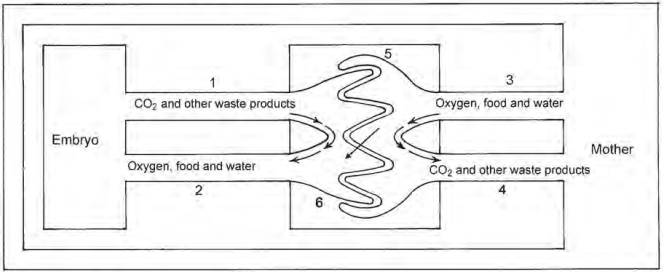
The diagram shows the structure of part of a human placenta.
(i) Name the structures labelled $1-6$.
(ii) What substances diffuse into the placenta and what diffuse out of it?
(iii) What are the functions of placenta?

Image
Answer
(i)1 - Umbilical artery
2 - Umbilical vein
3 - Uterine artery
4 - Uterine vein
5 - Maternal portion of placenta
6 - Foetal portion of placenta
(ii) Substances diffusing across placenta:
Into the placenta  Out of the placenta
 Oxygen Glucose, amino acids, salts and   minerals.   Hormones Carbon dioxide
  Nitrogenous metabolic wastes
(iii) Functions of placenta:
• Transfers oxygen, water, nutrients and hormones from the mother to the foetus.
• Transfers wastes from the foetus to the mother's blood.
• Provides protection to the foetus as it does not allow microorganisms in mother's blood to pass through it to the foetus.
• Produces hormones such as oestrogen, progesterone and relaxin which are necessary to maintain pregnancy.
• It supplies nutrition, oxygen and other requirements to the foetus. It acts as an endocrine organ as it secretes oestrogen and progesterone during the last six months of pregnancy.
View full question & answer
Question 83 Marks
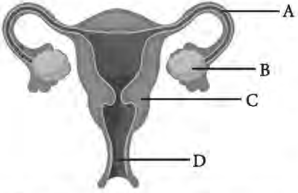
Given below is a structure of female reproductive system. Match the structures marked $A-d$ with their correct names:
FEMALE REPRODUCTIVE SYSTEMNAMES
  Image  (a) Ovary
 (b) Vagina
 (c) Uterus
 (d) Oviduct
Answer
(A - d), (B - a), (C - c), (D - b)
View full question & answer
Question 93 Marks
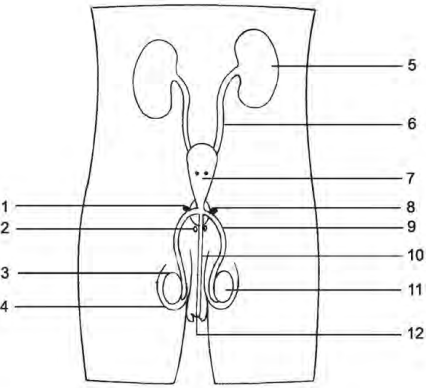
Refer to the given diagram of male reproductive system.
(i) Label the diagram.
(ii) Name the major ducts.
(iii) Name the accessory glands.

Image
Answer
 (i) 1 -Seminal vesicle $\quad$2 - Cowper's glands $\quad$3 -Epididymis
$\quad$ 4 - Scrotum  $\quad$ $\quad$ $\quad$5 - Kidney $\quad$ $\quad$ $\quad$ $\quad$6 - Ureter
$\quad$ 7 - Urinary bladder $\quad$8 - Prostate gland $\quad$9 - Vas deferens
$\quad$ 10 - Urethra  $\quad$$\quad$ $\quad$11 - Testis $\quad$ $\quad$ $\quad$12 - Glans penis.
(ii) Vas efferentia, Epididymis, Vas deferens, Ejaculatory ducts
(iii) • Seminal vesicles
• Prostate gland
• Cowper's glands
View full question & answer
Question 103 Marks
Menarche and menopause.
Answer
MENARCHEMENOPAUSE
 It is the onset of menstruation in the female. It is term used when menstruation cycle stop in
 females.
 It occurs between the age of 11-15 years. It occurs at the age of 45-50 years.
View full question & answer
Question 113 Marks
Corpus callosum and Corpus luteum (Function).
Answer
CORPUS CALLOSUMCORPUS LUTEUM
 It connects the two cerebral hemispheres (of brain)
 internally.
 Corpus luteum produces the hormone,   progesterone
 (female sex hormone).
 It enables the communication between two   hemispheres. It prepares the inner lining of the uterus for
 implantation of zygote.
 
View full question & answer
Question 123 Marks
Implantation and Gestation (Definition).
Answer
 
IMPLANTATIONGESTATION
Implantation is the attachment of the blastocyst to the uterine wall.It is time period of developmental events from conception till birth of the young one.
View full question & answer