Questions · Page 1 of 2

[1 Mark Question Answer]

🎯

Test yourself on this topic

50 questions · timed · auto-graded

Question 91 Mark
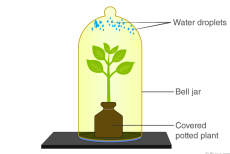
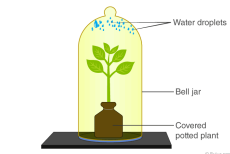
An apparatus as shown below was set up to investigate a physiological process in plants. The setup was kept in sunlight for two hours. Droplets of water were then seen inside the bell jar. Answer the questions that follow :
Image

Suggest a suitable control for this experiment.
Answer
A control for this experiment will be an empty polythene bag with its mouth tied.
View full question & answer
Question 101 Mark
An apparatus as shown below was set up to investigate a physiological process in plants. The setup was kept in sunlight for two hours. Droplets of water were then seen inside the bell jar. Answer the questions that follow :
Image
Why was the pot covered with a plastic sheet?
Answer
The pot is covered with a plastic sheet to prevent evaporation of water from the soil.
View full question & answer
Question 111 Mark
An apparatus as shown below was set up to investigate a physiological process in plants. The setup was kept in sunlight for two hours. Droplets of water were then seen inside the bell jar. Answer the questions that follow :
Image
Explain the process named above in 7.1.
Answer
Transpiration is a process during which water is lost in the form of water vapour through aerial parts of the plant.
View full question & answer
Question 121 Mark
An apparatus as shown below was set up to investigate a physiological process in plants. The setup was kept in sunlight for two hours. Droplets of water were then seen inside the bell jar. Answer the questions that follow :
Image
Name the process being studied.
Answer
Transpiration
View full question & answer
Question 131 Mark
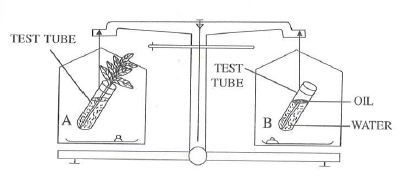
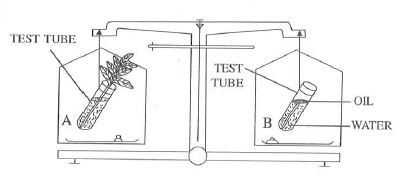
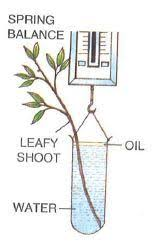
The figure given below represents an experimental setup with a weighing machine to demonstrate a particular process in plants. The experimental setup was placed in bright sunlight. Study the diagram and answer the following questions.Image
What is the purpose of keeping the test tube B in the experimental setup?
Answer
Test tube B is used here as a control. This makes the observation of the change in test tube A easy.
View full question & answer
Question 141 Mark
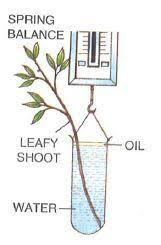
The figure given below represents an experimental setup with a weighing machine to demonstrate a particular process in plants. The experimental setup was placed in bright sunlight. Study the diagram and answer the following questionsImage
When the weight of the test tubes A and B is taken before and after the experiment, what change is observed? Justify.
Answer

Weight of test tube A before the experiment was more than its weight after the experiment. This is because water from test tube A has evaporated due to transpiration.

Weight of test tube B remains the same before and after the experiment, because no loss of water occurs in test tube B.
View full question & answer
Question 151 Mark
The figure given below represents an experimental setup with a weighing machine to demonstrate a particular process in plants. The experimental setup was placed in bright sunlight. Study the diagram and answer the following questions.Image
Name the process intended for study.
Answer
Transpiration
View full question & answer
Question 161 Mark
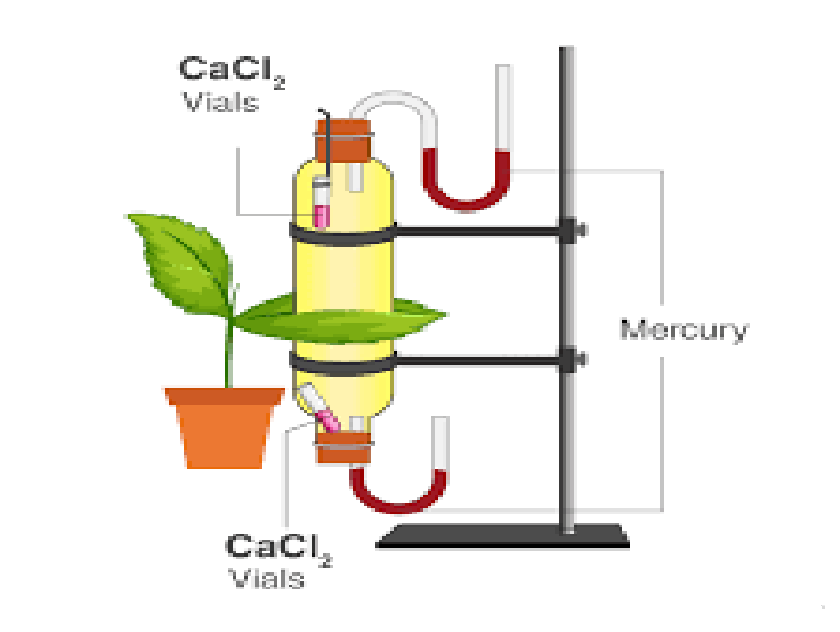
The apparatus shown in the following diagram is Garreau’s potometer designed to demonstrate unequal transpiration from the two surfaces of a dorsiventral leaf. Before keeping the leaf in between the cups, anhydrous calcium chloride $(CaCl_2)$ contained in two small vials were weighed and placed in both the cups. The ends of the cups were closed with corks through which two mercury manometers were connected. After few hours, $CaCl_2$ vials were taken out and weighed again.
Image
What do you mean by transpiration?
Answer
Transpiration is the loss of water in the form of water vapour from the aerial parts (leaves and stem) of the plant.
View full question & answer
Question 171 Mark
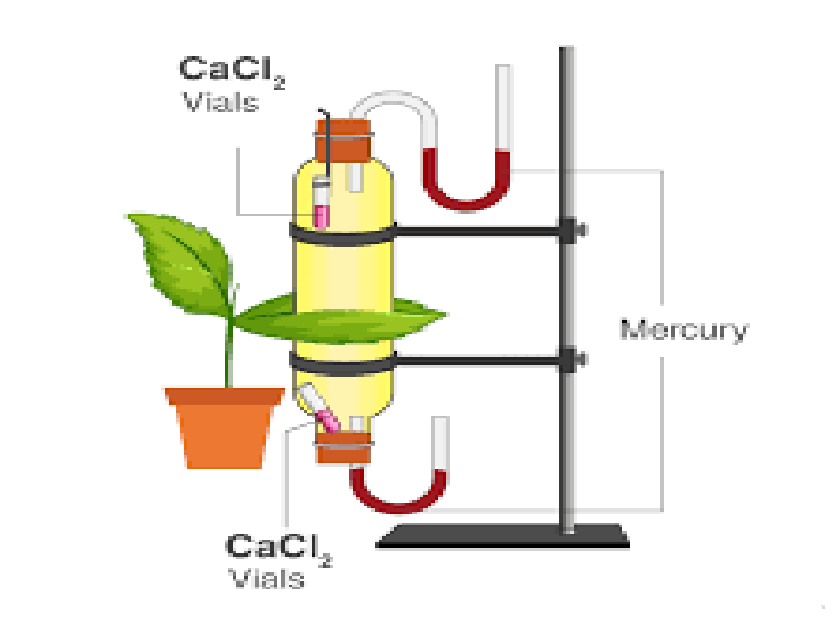
The apparatus shown in the following diagram is Garreau’s potometer designed to demonstrate unequal transpiration from the two surfaces of a dorsiventral leaf. Before keeping the leaf in between the cups, anhydrous calcium chloride ($CaCl_2$) contained in two small vials were weighed and placed in both the cups. The ends of the cups were closed with corks through which two mercury manometers were connected. After few hours, $CaCl_2$​​​​​​​ vials were taken out and weighed again.Image
After few hours $CaCl_2​​​​​​​$​​​​​​​ vials were taken out and weighed again. Will you expect any difference in weight? If so, give reason.
Answer
Yes, after few hours the weight of the $CaCl_2$ vials will increase because they will absorb water lost by the leaf of the plant due to transpiration.
View full question & answer
Question 181 Mark
The apparatus shown in the following diagram is Garreau’s potometer designed to demonstrate unequal transpiration from the two surfaces of a dorsiventral leaf Before keeping the leaf in between the cups, anhydrous calcium chloride ($CaCl_2$) contained in two small vials were weighed and placed in both the cups. The ends of the cups were closed with corks through which two mercury manometers were connected. After few hours, $CaCl_2$ vials were taken out and weighed again.Image
What is the purpose of keeping $CaCl_2​​​​​​​$​​​​​​​​​​​​​​ vials inside the cup?
Answer
$CaCl_2$ is a hygroscopic compound that absorbs moisture/water without changing its state. $CaCl_2$​​​​​​​vials inside the cup to absorb water.
View full question & answer
Question 191 Mark
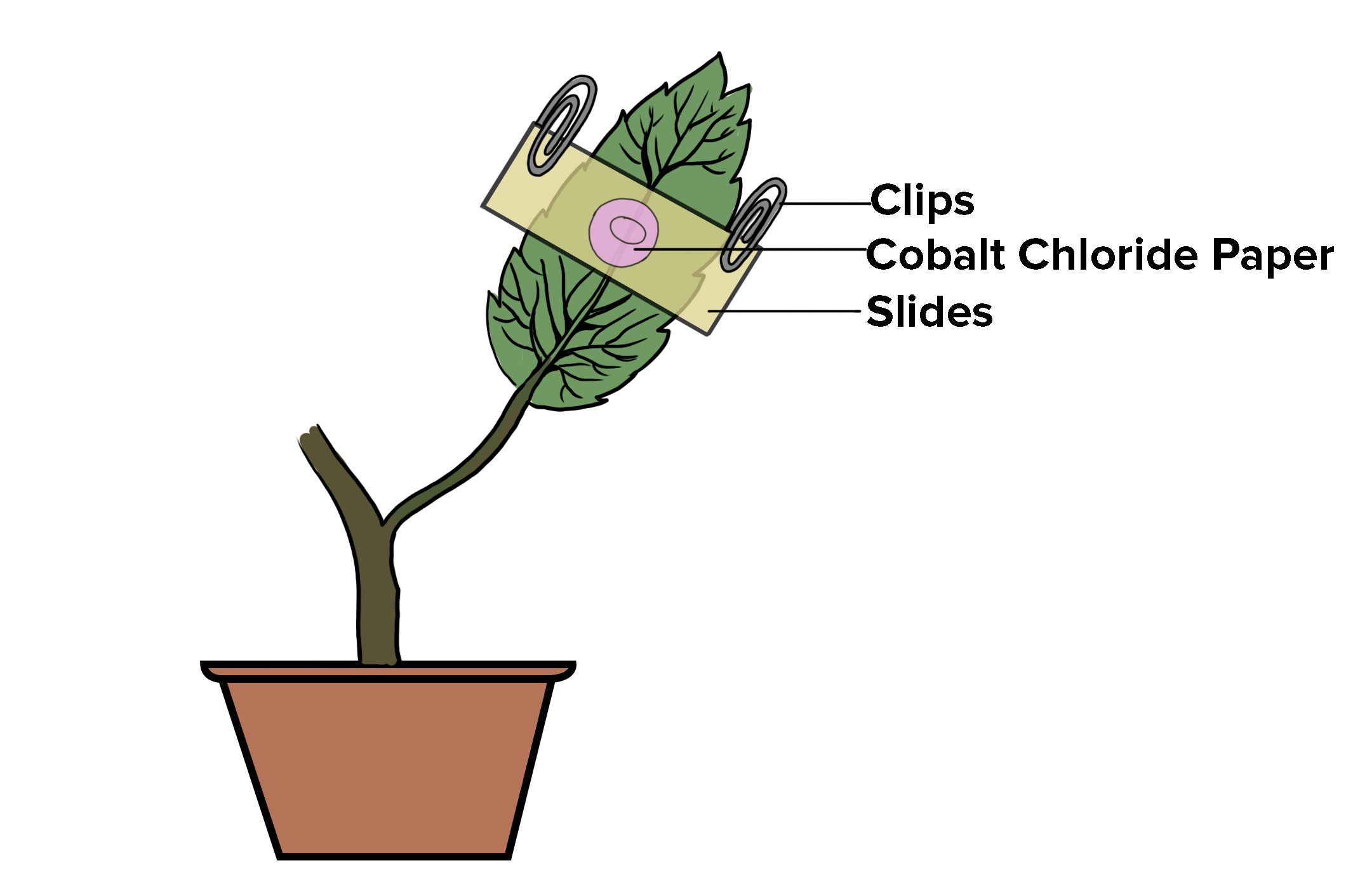
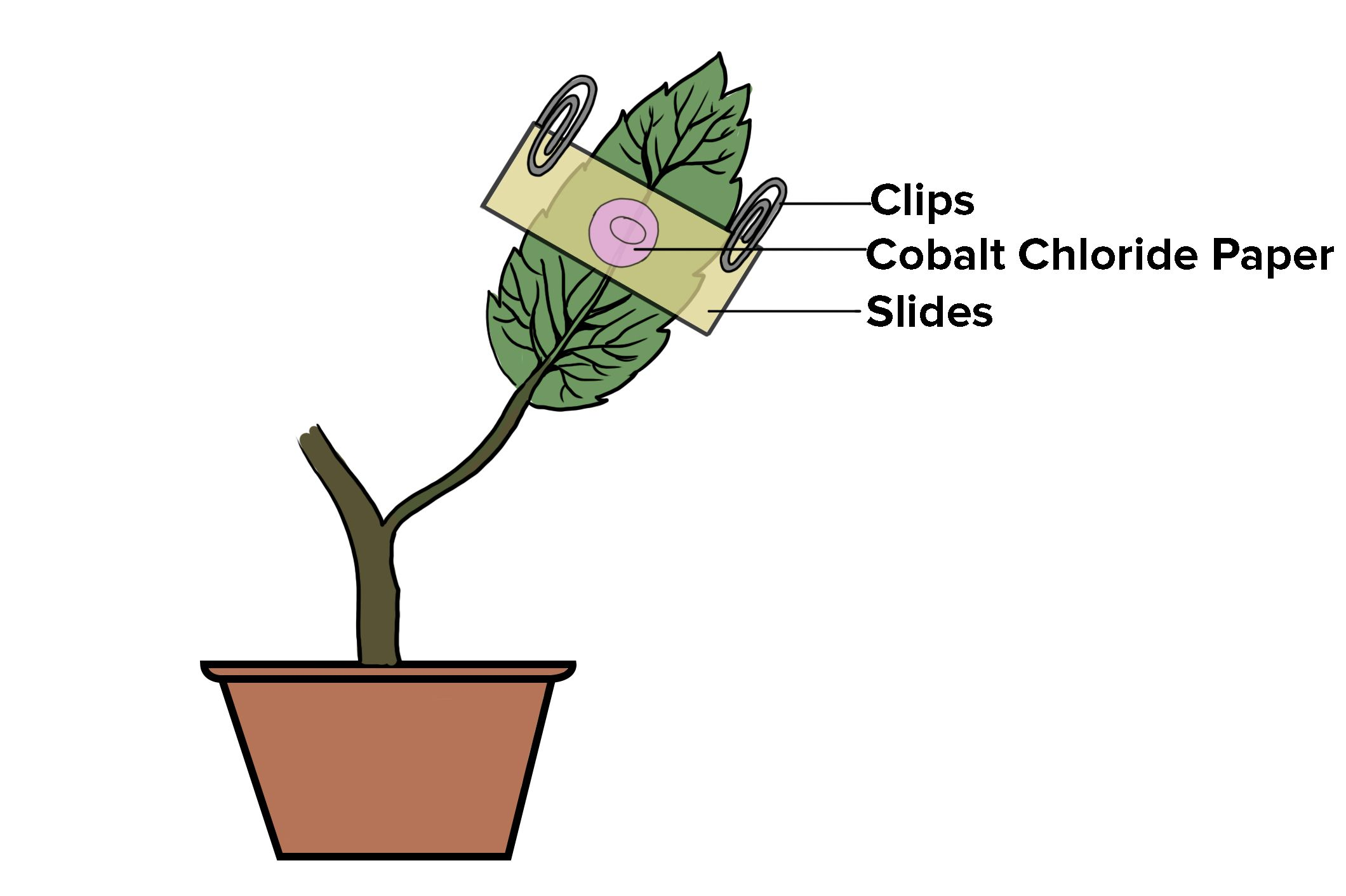
Given ahead is the diagram of an experimental set up to study the process of transpiration in plants. Study the same and then answer the question that follow:
Image
After about half an hour what change, if any, would you expect to find in the cobalt chloride paper placed on the dorsal and ventral sides of the leaf? Give a reason to support your answer.
Answer
The cobalt chloride paper placed on the lower surface of the leaf will show more pink dots as there are more stomata. The upper surface has less stomata than the lower surface.
View full question & answer
Question 201 Mark
Given ahead is the diagram of an experimental set up to study the process of transpiration in plants. Study the same and then answer the question that follow:
Image
Why are glass slides placed over the dry cobalt chloride papers?
Answer
Glass slides are placed over the dry cobalt chloride papers so as to retain the strips in their position.
View full question & answer
Question 211 Mark
Given ahead is the diagram of an experimental set up to study the process of transpiration in plants. Study the same and then answer the question that follow:
Image
Name the colour of dry cobalt chloride paper.
Answer
Blue.
View full question & answer
Question 221 Mark
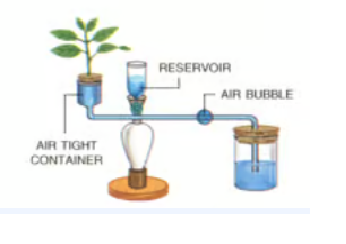
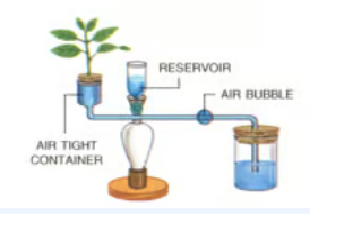
Given below is the diagram of an apparatus used to study a particular phenomenon in plants:Image
What is the use of the reservoir?
Answer
The water in the reservoir can be released into the capillary tube by opening the stop cock. This allows the air bubble to restore back to its original position.
View full question & answer
Question 231 Mark
Given below is the diagram of an apparatus used to study a particular phenomenon in plants:Image
What is the role played by the air-bubble in this experiment?
Answer
The movement of the air bubble and its position in the capillary tube indicates the volume of water lost through transpiration in a given time.
View full question & answer
Question 241 Mark
Given below is the diagram of an apparatus used to study a particular phenomenon in plants:Image
What is it used for?
Answer
Ganong’s potometer is used to measure the water intake of a plant which is almost equal to the water lost through transpiration.
View full question & answer
Question 251 Mark
Given below is the diagram of an apparatus used to study a particular phenomenon in plants:Image
Name the apparatus.
Answer
Ganong’s potometer
View full question & answer
Question 261 Mark
Given alongside is the diagram of an experimental set-up to demonstrate a certain phenomenon in plants.Image
Would it make a difference if the experimental set-up is kept in bright sunshine?
Answer
Yes, the transpiration rate will increase. Transpiration would occur faster. The observable changes will occur in less time.
View full question & answer
Question 271 Mark
Given alongside is the diagram of an experimental set-up to demonstrate a certain phenomenon in plants.Image
What is the purpose of putting oil in the test tube?
Answer
Oil is put on the surface of water to prevent loss of water by evaporation.
View full question & answer
Question 281 Mark
Given alongside is the diagram of an experimental set-up to demonstrate a certain phenomenon in plants.
Name the phenomenon being demonstrated.
Image
Answer
Transpiration
View full question & answer
Question 291 Mark
Give suitable explanation for the following:
Excessive transpiration results in the wilting of the leaves.
Answer
When the rate of transpiration far exceeds the rate of absorption of water by roots, the cells lose their turgidity. Hence, excessive transpiration results in wilting of the leaves.
View full question & answer
Question 301 Mark
Given below is an example of a certain structure and its special functional activity:

chloroplasts and photosynthesis

In a similar way, write the functional activity against each of the following:

Xylem and ...................................

Answer
Xylem and conduction of water and mineral salts
View full question & answer
Question 311 Mark
Given below is an example of a certain structure and its special functional activity:
Chloroplasts and Photosynthesis.
In a similar way, write the functional activity against each of the following:
Lenticels and ……………………………
Answer
Lenticels and transpiration
View full question & answer
Question 321 Mark
Given below is an example of a certain structure and its special functional activity:
Chloroplasts and Photosynthesis.
In a similar way, write the functional activity against each of the following:
Leaf spines and …………………………
Answer
Leaf spines and protection and reduced transpiration
View full question & answer
Question 331 Mark
Given below is an example of a certain structure and its special functional activity:
Chloroplasts and Photosynthesis.
In a similar way, write the functional activity against each of the following:
Hydathodes and ……………………….
Answer
Hydathodes and guttation
View full question & answer
Question 341 Mark
Explain the term :
Transpiration
Answer
Transpiration : Transpiration is the process where plants absorb water through the roots and then release it as water vapor from their leaves, stems, and flowers. It helps in nutrient transport, temperature regulation, and contributes to the water cycle.
View full question & answer
Question 351 Mark
Name the Following :
The openings on the barks of trees through which transpiration occurs.
Answer
Lenticels
View full question & answer
Question 361 Mark
Explain the term :
Wilting
Answer
Wilting : The collapsing of plant cells due to unfavorable water relations is called wilting.It may be due to excessive transpiration as compared to absorption of water by roots.It may also be due to blocking of the xylem elements, pathogens or parasites.
View full question & answer
Question 371 Mark
Explain the term :
Hydathode
Answer
Hydathode : A water secreting gland found on the edges and tips of leaves of many plants.
View full question & answer
Question 381 Mark
Explain the term :
Lenticel
Answer
Lenticel : It is a pore in the periderm of a woody stem. It acts as an organ of gaseous exchange and transpiration.
View full question & answer
Question 391 Mark
Explain the term :
Bleeding
Answer
Bleeding : Exudation of cell sap or watery solution from the injured parts of a plant.
View full question & answer
Question 401 Mark
Explain the term :
Guttation
Answer
Guttation: The exudation of water in the form of water droplets along with sugar and mineral salts through specialised openings i.e., hydathodes, present along the margins of a leaf is called guttation.
View full question & answer
Question 411 Mark
Explain the term :
Stomatal transpiration
Answer
Stomatal transpiration : Transpiration that takes place through the stomata of the leaves is called stomatal transpiration.
View full question & answer
Question 421 Mark
Explain the term :
Lenticular transpiration
Answer
Lenticular transpiration : Transpiration that takes place through the small openings in the cork tissue covering the stem is called lenticular transpiration.
View full question & answer
Question 431 Mark
Explain the term :
Cuticular transpiration
Answer
Cuticular transpiration : Transpiration that takes place through the cuticle (waxy layer) covering the leaves is called cuticular transpiration.
View full question & answer
Question 441 Mark
Name the Following :
Type of transpiration that takes place from the minute openings on the surface of the old stems.
Answer
Lenticular transpiration
View full question & answer
Question 451 Mark
Name the Following :
Type of transpiration that takes place directly from the surface of the leaf.
Answer
Cuticular transpiration
View full question & answer
Question 461 Mark
Name the Following :
The process by which excess of water is forced out directly from the tips of veins in the leaf.
Answer
Guttation
View full question & answer
[1 Mark Question Answer] - Biology STD 10 Questions - Vidyadip