Question types

Transpiration question types

189 questions across 9 question groups — pick any mix to generate a Biology paper with step-by-step answer keys.

189
Questions
9
Question groups
5
Question types
Sample Questions

Transpiration questions

One sample from each question group in this chapter. Select any group above to see the full set with answer keys.

Q 1MCQ1 Mark
Transpiration is best defined as $.......$
  • A
    loss of water by the plant
  • evaporation of water from the aerial surfaces of a plant
  • C
    loss of water, as water vapour, by a plant
  • D
    release of water by a plant into the atmosphere

Answer: B.

View full solution
Q 2MCQ1 Mark
Most of the transpiration in tall trees occurs through $.......$
  • A
    Stomata
  • Lenticels
  • C
    Cuticle
  • D
    Bark

Answer: B.

View full solution
Q 3MCQ1 Mark
Transpiration will be fastest when the day is $.......$
  • A
    cool, humid and windy
  • B
    hot, humid and still
  • C
    hot, humid and still
  • hot, dry and windy

Answer: D.

View full solution
Q 4MCQ1 Mark
The loss of water as water vapour from the acrial parts of a plant is known as $.......$
  • A
    evaporation
  • B
    perspiration
  • C
    guttation
  • transpiration

Answer: D.

View full solution
Q 5MCQ1 Mark
Guttation takes place through $.......$
  • A
    stomata
  • B
    lenticels
  • C
    lower epidermis of leaves
  • hydathodes

Answer: D.

View full solution
Ganong's potometer is designed to measure the rate of water ___________ (i) ___________ by a plant, which indicates the rate of ___________ (ii) ___________ . However, it has limitations, including the inability to measure transpiration under ___________ (iii) ___________ environmental conditions. The rate of transpiration is affected by several factors such as ___________ (iv) ___________, ___________ (v) ___________ , and light intensity, all of which can alter water loss in plants.
View full solution
Transpiration plays a vital role in plants by (i) ___________ heat, aiding in (ii) ___________ uptake through the roots, and maintaining (iii) ___________ within the plant tissues. This process is crucial for (iv) ___________ , as it helps transport water and nutrients. Moreover, transpiration is essential for (v) ___________ regulation within the plant.
View full solution
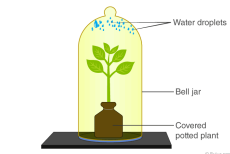
An apparatus as shown below was set up to investigate a physiological process in plants. The setup was kept in sunlight for two hours. Droplets of water were then seen inside the bell jar. Answer the questions that follow:Image
List three adaptations in plants to reduce the above mentioned process.
View full solution
An apparatus as shown below was set up to investigate a physiological process in plants. The setup was kept in sunlight for two hours. Droplets of water were then seen inside the bell jar. Answer the questions that follow:Image

Mention two ways in which this process is beneficial to plants.
View full solution
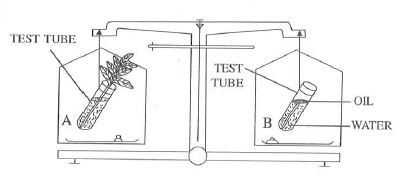
The figure given below represents an experimental setup with a weighing machine to demonstrate a particular process in plants. The experimental setup was placed in bright sunlight. Study the diagram and answer the following questions.Image

Define the above mentioned process.
View full solution
The apparatus shown in the following diagram is Garreau’s potometer designed to demonstrate unequal transpiration from the two surfaces of a dorsiventral leaf. Before keeping the leaf in between the cups, anhydrous calcium chloride ($CaCl_2$​​​​​​​​​​​​​​) contained in two small vials were weighed and placed in both the cups. The ends of the cups were closed with corks through which two mercury manometers were connected. After few hours, $CaCl_2​​​​​​​$​​​​​​​​​​​​​​ vials were taken out and weighed again.Image

What is the purpose of using a manometer?
View full solution
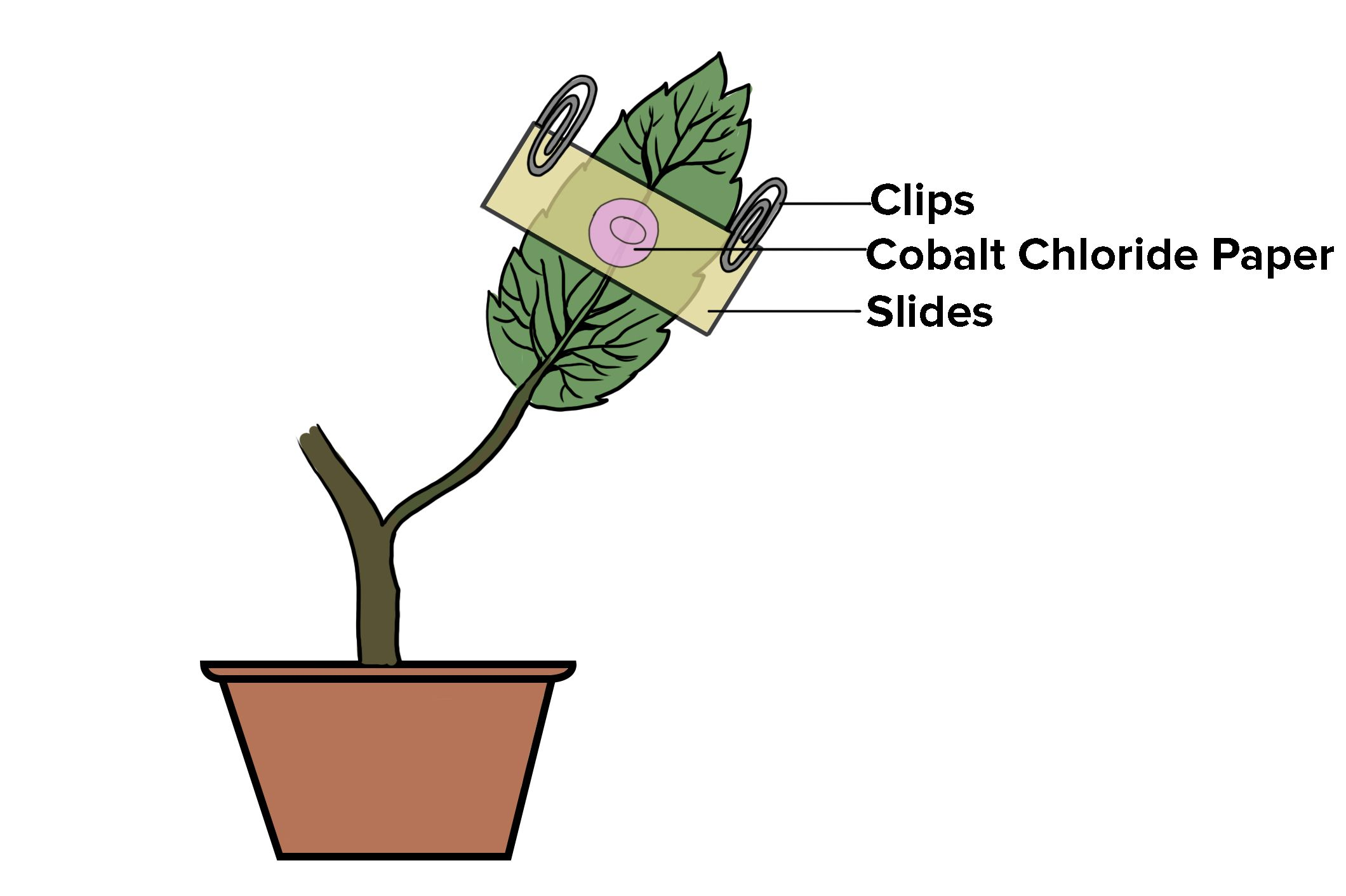
Given ahead is the diagram of an experimental set up to study the process of transpiration in plants. Study the same and then answer the questions that follow:
Image

Is the experimental leaf a monocot or a dicot? Give a reason to support your answer.
View full solution
Column IColumn II
A. Lenticels(i) An indicator of moisture
B. Cobalt chloride(ii) Sunken stomata plant
C. Nerium(iii) Minute openings on the woody stems
D. Guard cells(iv) Kidney shaped cells that surround the stoma
 
View full solution
Column IColumn II
(i) Transpiration(a) Cacti plants
(ii) Movement of water(b) Stomata
(iii) Guttation(c) Maize plant
(iv) Low rate of transpiration(d) Xylem
 (e) Hydathodes
View full solution
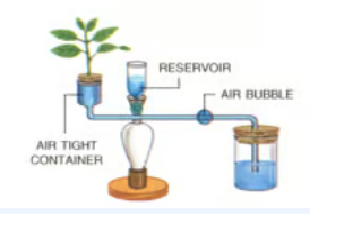
Given below is the diagram of an apparatus used to study a particular phenomenon in plants:Image
What happens to the movement of the air-bubble if the apparatus is kept:
(i) In the dark
(ii) In sunlight
(iii) In front of a fan
Give a reason in each case.
View full solution

Generate a Transpiration paper free

Pick question groups from the list above, set marks and difficulty, and export a branded PDF with step-by-step answer keys. First 3 chapters free — no signup.

Download App