Questions

[2 Mark Question Answer]

🎯

Test yourself on this topic

16 questions · timed · auto-graded

Question 12 Marks
An apparatus as shown below was set up to investigate a physiological process in plants. The setup was kept in sunlight for two hours. Droplets of water were then seen inside the bell jar. Answer the questions that follow:Image
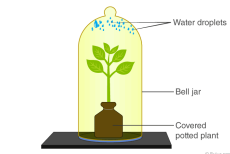
List three adaptations in plants to reduce the above mentioned process.
Answer
Adaptations in plants to reduce transpiration are
  • Leaves may be modified into spines as in cactus or into needles as in pines.
  • The number of stomata is reduced and they may be sunken in pits.
  • Leaves may be folded or rolled up.
  • View full question & answer
    Question 22 Marks
    An apparatus as shown below was set up to investigate a physiological process in plants. The setup was kept in sunlight for two hours. Droplets of water were then seen inside the bell jar. Answer the questions that follow:Image

    Mention two ways in which this process is beneficial to plants.
    Answer
    Transpiration is beneficial to plants in the following ways:
  • It creates a suction force in the stem which enables the roots to absorb water and minerals.
  • It helps in cooling the plant in hot weather.
  • View full question & answer
    Question 32 Marks
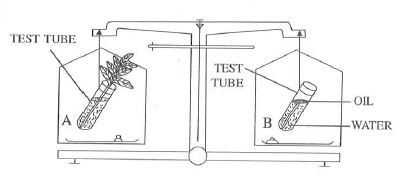
    The figure given below represents an experimental setup with a weighing machine to demonstrate a particular process in plants. The experimental setup was placed in bright sunlight. Study the diagram and answer the following questions.Image

    Define the above mentioned process.
    Answer
    Transpiration is a process by which water is lost in the form of water vapour from aerial parts of the plant.
    View full question & answer
    Question 42 Marks
    The apparatus shown in the following diagram is Garreau’s potometer designed to demonstrate unequal transpiration from the two surfaces of a dorsiventral leaf. Before keeping the leaf in between the cups, anhydrous calcium chloride ($CaCl_2$​​​​​​​​​​​​​​) contained in two small vials were weighed and placed in both the cups. The ends of the cups were closed with corks through which two mercury manometers were connected. After few hours, $CaCl_2​​​​​​​$​​​​​​​​​​​​​​ vials were taken out and weighed again.Image

    What is the purpose of using a manometer?
    Answer
    Manometer is used to measure the pressure. In order to measure the pressure exerted by the fluid, the fluid is allowed to exert pressure on one of the closed ends of the tube. Under the effect of the pressure, the liquid inside the manometer tube gets displaced and the amount of displaced liquid is measured.
    View full question & answer
    Question 52 Marks
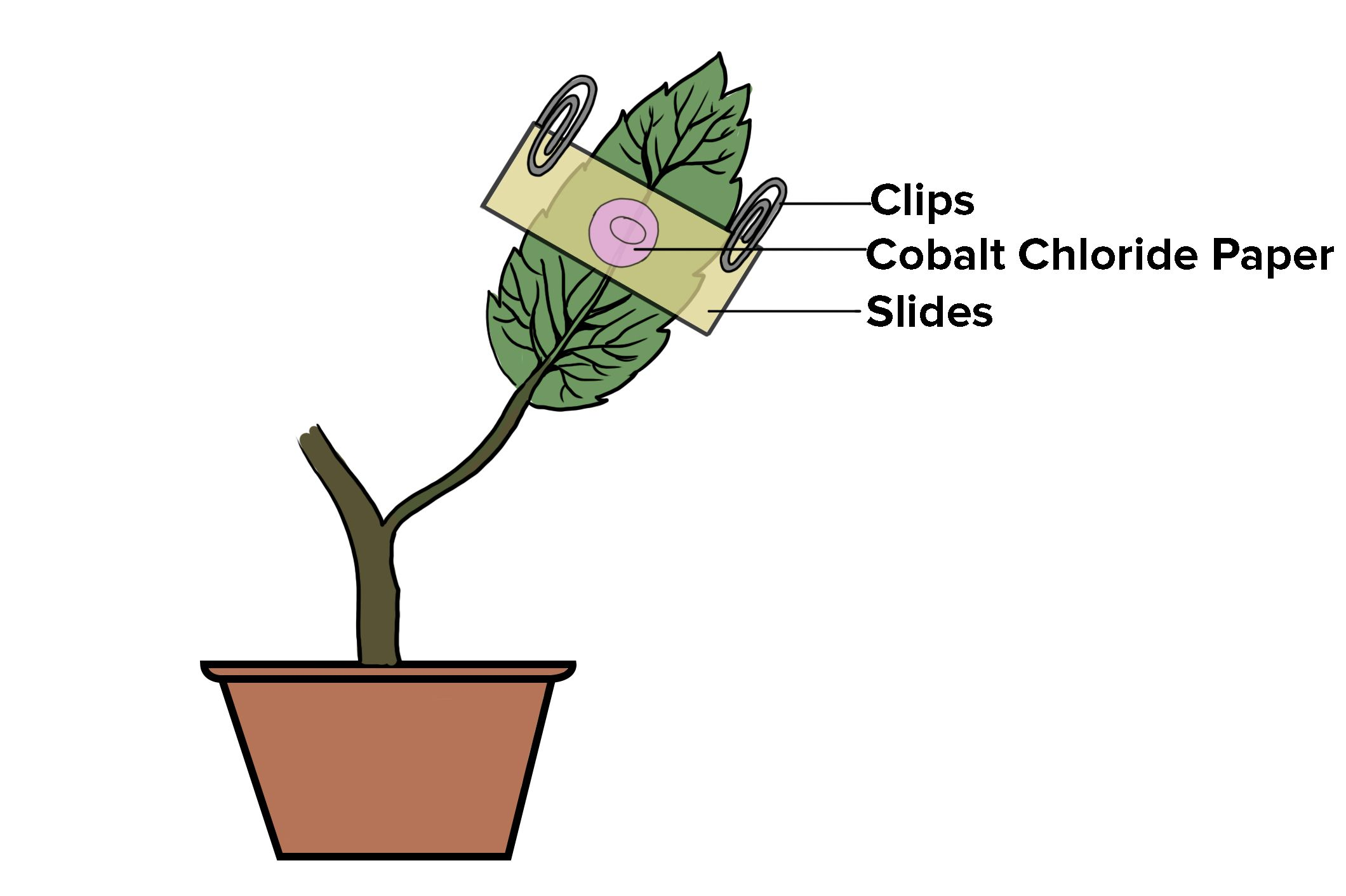
    Given ahead is the diagram of an experimental set up to study the process of transpiration in plants. Study the same and then answer the questions that follow:
    Image

    Is the experimental leaf a monocot or a dicot? Give a reason to support your answer.
    Answer
    The experimental leaf is a dicot leaf as it shows reticulate venation and there are more number of stomatal openings on the undersurface of a dicot leaf. Hence, transpiration is more and can be easily observed.
    View full question & answer
    Question 62 Marks
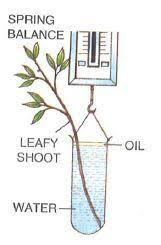
    Given alongside is the diagram of an experimental set-up to demonstrate a certain phenomenon in plants.Image

    What is the purpose of the spring balance in the set-up?
    Answer
    The spring balance progressively measures the change in weight of the set-up. This is because as the plant transpires, it creates a suction force in the plant which allows roots to absorb more water from the test tube. Hence, the water in the test will get reduced. Thus, the weight of the entire set will decrease.
    View full question & answer
    Question 72 Marks
    In an experiment, four freshly plucked leaves (A-D) of a plant, such as those of china – rose, were treated as follows:
    (a) Coated with Vaseline on its upper surface.
    (b) coated on the lower surface.
    (c) coated on both surface
    (d) left uncoated.
    All the four leaves A, B, C & D were left in a room for about 24 hours.
    (i) which leaf would become most limp? Why?
    (ii) which leaf would show least limping? Why?
    Answer
    (i) The leaf D would become most limp. This is because water would be lost through transpiration from upper as well as the lower surface of leaf D since it is uncoated.
    (ii) The least limping would be shown by leaf C since its upper and lower surfaces have been coated with vaseline. So no water is lost from the leaf through transpiration since the stomatal openings get blocked by vaseline.
    View full question & answer
    Question 82 Marks
    Give suitable explanation for the following:
    On a bright sunny day, the leaves of certain plants roll up.
    Answer
    On a bright sunny day, the rate of transpiration is much higher than any other days. The leaves of certain plants roll up on a bright sunny day to reduce the exposed surface and thus reduce the rate of transpiration.
    View full question & answer
    Question 92 Marks
    Give suitable explanation for the following:
    Perspiration and transpiration help to cool the body temperature of the organism.
    Answer
    In both perspiration and transpiration, water is lost by evaporation from the body of the organism as water vapour. This evaporation reduces the temperature of the body surface and brings about cooling in the body of the organism.
    View full question & answer
    Question 102 Marks
    Give suitable explanation for the following:
    Cork and bark of trees help in preventing loss of water
    Answer
    Cork and Bark of trees are tissues of old woody stems. Bark is thick with outermost layer made of dead cells and the cork is hydrophobic in nature. These properties make them water-proof and hence they prevent transpiration.
    View full question & answer
    Question 112 Marks
    Give suitable explanation for the following:
    More transpiration occurs from the lower surface of a dorsiventral leaf.
    Answer
    There are more stomatal openings on the lower surface of a dorsiventral leaf. More the number of stomata, higher is the rate of transpiration. Hence more transpiration occurs from the lower surface.
    View full question & answer
    Question 122 Marks
    Give suitable explanation for the following:
    Water transpired is the water absorbed.
    Answer
    Plants absorb water continuously through their roots, which is then conducted upwards to all the aerial parts of the plant, including the leaves. Only a small quantity of this water i.e. about 0.02% is used for the photosynthesis and other activities. The rest of the water is transpired as water vapour. Hence water transpired is the water absorbed.
    View full question & answer
    Question 132 Marks
    Give suitable explanation for the following:
    A higher rate of transpiration is recorded on a windy day rather than on a calm day.
    Answer
    Transpiration increases with the velocity of wind. If the wind blows faster, the water vapours released during transpiration are removed faster and the area surrounding the transpiring leaf does not get saturated with water vapour.
    View full question & answer
    Question 142 Marks
    Briefly explain how the rate of transpiration is affected by:
    Humidity of the atmosphere
    Answer
    When the air is humid; it can receive very less water vapour. Thus, high humidity in the air reduces the rate of outward diffusion of the internal water vapour across stomata, thereby reducing the rate of transpiration.
    View full question & answer
    Question 152 Marks
    There is a general belief that forests tend to bring more frequent rains. Can you explain it scientifically?
    Answer
    Forests have large number of plants especially trees. Each plant loses water in the form of water vapour everyday into the atmosphere through transpiration. A large apple tree loses as much as 30 litres of water per day. So huge amount of water is escaped into the atmosphere by forests. This increases the moisture in the atmosphere and brings more frequent rains.
    View full question & answer
    Question 162 Marks
    List any three major factors that accelerate the rate of transpiration.
    Answer
    The factors that accelerate the rate of transpiration are:
    (i) High intensity of sunlight
    (ii) High temperature
    (iii) Higher wind velocity
    (iv) Decrease in atmospheric pressure
    View full question & answer
    [2 Mark Question Answer] - Biology STD 10 Questions - Vidyadip