Questions

[3 marks Question Answer]

🎯

Test yourself on this topic

7 questions · timed · auto-graded

Question 13 Marks
Given below is the diagram of an apparatus used to study a particular phenomenon in plants:Image
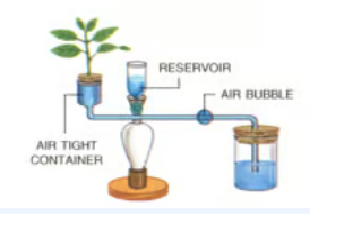
What happens to the movement of the air-bubble if the apparatus is kept:
(i) In the dark
(ii) In sunlight
(iii) In front of a fan
Give a reason in each case.
Answer
(i) If the apparatus is kept in the dark, there will be no transpiration as the stomata would be closed. As a result, there would be no movement of the air bubble and it would remain stable.
(ii) If the apparatus is kept in bright sunlight, the rate of transpiration will be more. As a result, the movement of the air bubble would be larger since there would be more loss of water due to transpiration.
(iii) If the apparatus is kept in front of a fan, the rate of transpiration will be more. As a result, the movement of the air bubble would be larger since there would be more loss of water due to transpiration as the velocity of wind/air increases.
View full question & answer
Question 23 Marks
Differentiate between guttation and bleeding in plants.
Answer

Guttation

Bleeding


It is the removal of excess water from the plants because of excess water buildup in the plant.

It is the removal of water from the plant because of injury.

Water escapes from specialised structures called hydathodes.

Water escapes in the form of sap from the injured part of the plant.

It occurs from edges of leaves.

It occurs from cuts found in plants.

It happens due to the pressure presents in the xylem.
It happens due to pressure in sieve tubes.
View full question & answer
Question 33 Marks
Briefly explain how the rate of transpiration is affected by
Intensity of light
Answer
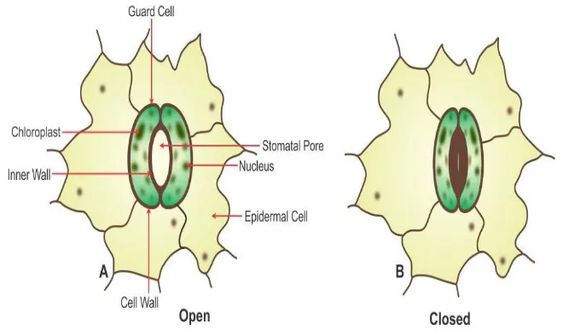
During the day, the stomata are open to facilitate the inward diffusion of carbon dioxide for photosynthesis. At night they are closed. Hence more transpiration occurs during the day. During cloudy days, the stomata are partially closed and the transpiration is reduced.
Image
View full question & answer
Question 43 Marks
Droplets of water may sometimes be seen along the margins of the leaves of a banana plant, growing in wet soil, in the mornings. Are these dew drops? Comment upon your answer.
Answer
No, they are not dew drops.
This is water given out by the plant body through guttation. Since the banana plant is growing in humid environment, transpiration is hampered. But the roots continue to absorb water from the soil. This builds up a huge hydrostatic pressure within the plant and forces out the excess water from the hydathodes, which are pores present at the tips of veins in the leaf. This is observed especially during the mornings.
View full question & answer
Question 53 Marks
What is lenticular transpiration? Mention one major difference between lenticular transpiration and stomatal transpiration.
Answer
Transpiration occurring through lenticels i.e. minute openings on the surface of old stems is called lenticular transpiration.
Stomatal transpiration is controlled by the plant by altering the size of the stoma, where as this does not happen in case of lenticular transpiration. This is because the lenticels never close, but remain open all the time.
The amount of stomatal transpiration is much more than the amount of lenticular transpiration.
View full question & answer
Question 63 Marks
Why are the stomata in most plants more numerous on the lower surface of a leaf instead of being on the upper surface?
Answer
The lower surface of leaf is sheltered from direct sunlight. If more stomata are on the upper surface of a leaf, then excessive transpiration would occur, resulting in quick wilting of the plant. Hence most plants have more numerous stomata on the lower surface of a leaf to control the rate of transpiration.
View full question & answer
Question 73 Marks
What is wilting? Some plants show wilting of their leaves at noon even when the soil is well watered, Why is it so?
Answer
Wilting refers to the loss of cellular turgidity in plants which results in the drooping of leaves or plant as a whole because of lack of water.
During noon the rate of transpiration exceeds the rate of absorption of water by roots. Due to the excessive transpiration, the cells of leaves lose their turgidity and wilt.
View full question & answer
[3 marks Question Answer] - Biology STD 10 Questions - Vidyadip