Questions

MCQ

🎯

Test yourself on this topic

41 questions · timed · auto-graded

MCQ 11 Mark
Transpiration is best defined as $.......$
  • A
    loss of water by the plant
  • evaporation of water from the aerial surfaces of a plant
  • C
    loss of water, as water vapour, by a plant
  • D
    release of water by a plant into the atmosphere
Answer
Correct option: B.
evaporation of water from the aerial surfaces of a plant
View full question & answer
MCQ 21 Mark
Most of the transpiration in tall trees occurs through $.......$
  • A
    Stomata
  • Lenticels
  • C
    Cuticle
  • D
    Bark
Answer
Correct option: B.
Lenticels
View full question & answer
MCQ 31 Mark
Transpiration will be fastest when the day is $.......$
  • A
    cool, humid and windy
  • B
    hot, humid and still
  • C
    hot, humid and still
  • hot, dry and windy
Answer
Correct option: D.
hot, dry and windy
View full question & answer
MCQ 41 Mark
The loss of water as water vapour from the acrial parts of a plant is known as $.......$
  • A
    evaporation
  • B
    perspiration
  • C
    guttation
  • transpiration
Answer
Correct option: D.
transpiration
View full question & answer
MCQ 51 Mark
Guttation takes place through $.......$
  • A
    stomata
  • B
    lenticels
  • C
    lower epidermis of leaves
  • hydathodes
Answer
Correct option: D.
hydathodes
View full question & answer
MCQ 61 Mark
One of the internal factors which affect the rate of transpiration is $.......$
  • A
    big size of the leaf
  • B
    Colour of the leaf
  • sunken stomata
  • D
    sunny day
Answer
Correct option: C.
sunken stomata
View full question & answer
MCQ 71 Mark
The rate of transpiration is more when $.......$
  • A
    atmosphere is dry
  • temperature is high
  • C
    humidity is high
  • D
    atmosphere is dry and temperature is high
Answer
Correct option: B.
temperature is high
View full question & answer
MCQ 81 Mark
With decrease in atmospheric pressure, the rate of transpiration will $.......$
  • increase
  • B
    decrease rapidly
  • C
    decrease slowly
  • D
    remain the same
Answer
Correct option: A.
increase
View full question & answer
MCQ 91 Mark
Transpiration pull will be maximum under which set of the following conditions?
  • Open stomata, dry atmosphere and moist soil
  • B
    Open stomata, high humid atmosphere and well irrigated soil
  • C
    Open stomata, high humid atmosphere and dry soil
  • D
    Closed stomata, dry atmosphere and dry soil
Answer
Correct option: A.
Open stomata, dry atmosphere and moist soil
View full question & answer
MCQ 101 Mark
The paper used to demonstrate unequal transpiration in a dicot leaf is:
  • A
    Filterpaper
  • B
    Litmus paper
  • C
    Starch paper
  • Cobalt chloride paper
Answer
Correct option: D.
Cobalt chloride paper
(d) Cobalt chloride paper
Explanation:
Cobalt chloride paper is used to demonstrate unequal transpiration in a dicot leaf. This paper is sensitive to moisture and changes colour when it absorbs water, which makes it useful for showing the areas of the leaf where transpiration is occurring more intensely.
View full question & answer
MCQ 111 Mark
Which one of the following does not affect the rate of transpiration ?*
  • A
    Light
  • B
    Humidity
  • C
    Wind
  • Age of the plant
Answer
Correct option: D.
Age of the plant
(d) Age of the plant
Explanation:
The factors that significantly affect the rate of transpiration include light, humidity, and wind, but the age of the plant generally does not directly influence transpiration rates.
View full question & answer
MCQ 121 Mark
Guttation is the elimination of excess of water from plants through:
  • A
    Stomata
  • Hydathodes
  • C
    Lenticels
  • D
    Wounds
Answer
Correct option: B.
Hydathodes
(b) Hydathodes
Explanation:
Guttation is the process where plants exude drops of xylem sap on the tips or edges of leaves during the night. This occurs through structures called hydathodes, not through stomata.
View full question & answer
MCQ 131 Mark
Transpiration pull will be maximum under which of the following conditions?
  • Open stomata, dry atmosphere and moist soil
  • B
    Open stomata, high humid atmosphere and well irrigated soil
  • C
    Open stomata, high humid atmosphere and dry soil
  • D
    Close stomata, dry atmosphere and dry soil
Answer
Correct option: A.
Open stomata, dry atmosphere and moist soil
(a) Open stomata, dry atmosphere and moist soil
Explanation:
Transpiration pull, which helps draw water up through a plant, is maximized under conditions of open stomata (for maximum water loss), a dry atmosphere (which increases the gradient for water evaporation), and moist soil (ensuring water availability).
View full question & answer
MCQ 141 Mark
Stomata open during the day and close at night because :
  • Photosynthesis occurs during day time only
  • B
    Enzymes convert starch into sugar at elevated pH in night
  • C
    Loss of sugar increases osmotic concentration of the cell sap
  • D
    Loss of starch in day time raises OP of subsidiary cells
Answer
Correct option: A.
Photosynthesis occurs during day time only
(a) Photosynthesis occurs during day time only
Explanation:
Stomata open during the day to allow $CO _2$ to enter for photosynthesis and close at night to conserve water, as photosynthesis (which uses $CO _2$ ) does not occur without sunlight.
View full question & answer
MCQ 151 Mark
In the mechanism of opening and closing of stomata, the important factor is:
  • A
    The presence of chloroplast in the guard cells
  • The turgid and flaccid state of the guard cells
  • C
    The protein content of the cells
  • D
    The starch content of the cells
Answer
Correct option: B.
The turgid and flaccid state of the guard cells
(b) The turgid and flaccid state of the guard cells
Explanation :
Stomatal opening and closing are primarily controlled by the turgidity changes in the guard cells. When guard cells are turgid, stomata open; when they are flaccid, stomata close.
View full question & answer
MCQ 161 Mark
Loss of water as droplets from the hydathodes is called:
  • A
    Transpiration
  • B
    Bleeding
  • Guttation
  • D
    Evaporation
Answer
Correct option: C.
Guttation
(c) Guttation
Explanation:
Guttation is the process by which plants release liquid water from specialised structures called hydathodes located at the tips of their leaves. It occurs when there is an excess of water in the plant's root system, typically in conditions of high soil moisture or humidity. Unlike transpiration, guttation involves the release of liquid water in the form of droplets. Guttation often happens during the night or early morning when the plant's stomata are closed, preventing transpiration.
View full question & answer
MCQ 171 Mark
Ganong's Potometer is used to study:
  • A
    Photosynthesis
  • B
    Exosmosis
  • Rate of transpiration
  • D
    Guttation
Answer
Correct option: C.
Rate of transpiration
(c) Rate of transpiration
Explanation:
Ganong's potometer is a device used to measure the rate of water uptake by a plant, which indirectly indicates the rate of transpiration, the process of water loss from plants primarily through the stomata in their leaves.
View full question & answer
MCQ 181 Mark
Assertion: Transpiration occurs through stomata.
Reason: Guttation is due to root pressure.
  • Both A and R are True.
  • B
    Both A and R are False.
  • C
    A is True and R is False.
  • D
    A is False and R is True.
Answer
Correct option: A.
Both A and R are True.
(a) Both A and R are True.
Explanation :
Transpiration is the process of loss of water (in the form of water vapour) from plant aerial parts, such as leaves, stems and flowers. It occurs mostly at the leaves through the minute openings present on the leaves called stomata. At night in some plants, root pressure causes guttation or exudation of drops of xylem sap from the tips or edges of leaves. Thus, guttation is due to root pressure.
View full question & answer
MCQ 191 Mark
Assertion: Leaves are reduced to spines in cactus.
Reason: Leaves are modified to form spines to reduce the leaf lamina.
  • Both A and R are True.
  • B
    Both A and R are False.
  • C
    A is True and R is False.
  • D
    A is False and R is True.
Answer
Correct option: A.
Both A and R are True.
(a) Both A and R are True.
Explanation:
Reduced surface area reduces the loss of water by transpiration. In cacti, leaves are modified into spines to reduce the surface area of the leaf lamina, thereby minimising water loss in arid environments due to transpiration. This adaptation is crucial for survival in desert conditions.
View full question & answer
MCQ 201 Mark
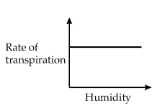
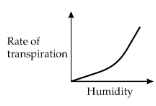
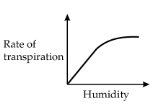
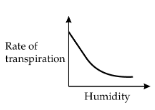
Which of the graph given below shows most clearly what will happen to the rate of transpiration as humidity increases?
  • A
    Image
  • Image
  • C
    Image
  • D
    Image
Answer
Correct option: B.
Image
(b)
Image

Explanation:
Transpiration is reduced if the air outside is humid. High humidity in the air reduces the rate of outward diffusion of the internal water vapour across stomata, thereby reducing the rate of transpiration.
View full question & answer
MCQ 211 Mark
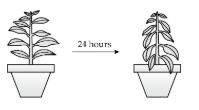
The diagram given below shows a potted plant and the same plant 24 hours later.
Image

What causes the change in the appearance of the plant?
  • Water loss is greater than water uptake
  • B
    Water moves from the leaves to the stem
  • C
    Water uptake is equal to water loss
  • D
    Water uptake is greater than water loss
Answer
Correct option: A.
Water loss is greater than water uptake
(a) Water loss is greater than water uptake
Explanation:
The wilting condition is found when plant tissues contain insufficient water to hold the cells rigid. This may occur when the rate of transpiration exceeds the rate at which water enters the root system from a soil containing ample water.
View full question & answer
MCQ 221 Mark
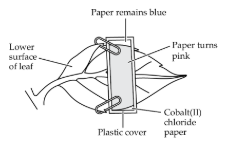
A piece of blue cobalt chloride paper is clipped to the lower surface of a fresh leaf and is then covered with plastic, as shown. After a few minutes, part of the paper turns pink, showing that water is present.
Image

Which process is carried out by leaves that causes the paper to turn pink?
  • A
    Absorption
  • B
    Photosynthesis
  • C
    Respiration
  • Transpiration
Answer
Correct option: D.
Transpiration
(d) Transpiration
Explanation :
Cobalt chloride paper is an indicator of moisture. It is blue when dry and turns pink when exposed to moisture. The initial blue cobalt chloride paper will turn pink only in the case of transpiration in which water vapour is released.
View full question & answer
MCQ 231 Mark
A student is investigating the effect of temperature on the rate of transpiration. Which environmental conditions should be kept constant during this investigation?
  • A
    Wind speedLight intensityHumidityTemperature
  • Wind speedLight intensityHumidityTemperature
    x
  • C
    Wind speedLight intensityHumidityTemperature
    xx
  • D
    Wind speedLight intensityHumidityTemperature
    xxx
Answer
Correct option: B.
Wind speedLight intensityHumidityTemperature
x
(b)
Wind speedLight intensityHumidityTemperature
x
Explanation:
The rate of transpiration is affected by several factors, including: temperature, humidity, wind speed and light intensity. To investigate the effect of temperature on the rate of transpiration, other factors such as humidity, wind speed and light intensity should be kept constant.
View full question & answer
MCQ 241 Mark
Guard cells:
  • A
    Regulate the closing of stomata
  • Regulate the opening and closing of stomata
  • C
    Regulate the opening of stomata
  • D
    Regulate the process of photosynthesis
Answer
Correct option: B.
Regulate the opening and closing of stomata
(b) Regulate the opening and closing of stomata
Explanation :
Guard cells are specialised cells in the epidermis of leaves and stems. They function to control the opening and closing of stomata. By adjusting the size of these openings, guard cells regulate gas exchange and water loss in plants.
View full question & answer
MCQ 251 Mark
Stomata:
  • Stomata help in diffusion of gases in the leaves and in transpiration.
  • B
    Reduce the amount of water lost during transpiration.
  • C
    Regulate the opening and closing of guard cells.
  • D
    Reduce the intensity of incident light.
Answer
Correct option: A.
Stomata help in diffusion of gases in the leaves and in transpiration.
(a)Stomata help in diffusion of gases in the leaves and in transpiration.
Explanation:
Stomata are tiny openings on the surface of leaves that allow for the exchange of gases (like oxygen and carbon dioxide) necessary for photosynthesis. They also play a key role in the process of transpiration, which is the loss of water vapor from the plant to the atmosphere.
View full question & answer
MCQ 261 Mark
Lenticels:
  • A
    They are present on the surface of leaves and stem.
  • B
    They are present on the surface of newly formed woody stem.
  • C
    They are present on the surface of older leaves and old woody stem.
  • They are present on the surface of hard, old woody stem.
Answer
Correct option: D.
They are present on the surface of hard, old woody stem.
(d) They are present on the surface of hard, old woody stem.
Explanation:
Lenticels are found as raised circular, oval, or elongated areas on stems and roots. In woody plants, lenticels commonly appear as rough, cork-like structures on young branches. Lenticels participate in gaseous exchange and transpiration.
View full question & answer
MCQ 271 Mark
Transpiration:
  • It is the loss of water as water vapour from the aerial parts/stems and leaves of the plants.
  • B
    The process of removal of water as water droplets from the aerial parts/leaf/stomata of a plant.
  • C
    Exudation of sap from injured parts of a plant.
  • D
    The loss of water in the form of water vapour from the surface of the leaf only.
Answer
Correct option: A.
It is the loss of water as water vapour from the aerial parts/stems and leaves of the plants.
(a) It is the loss of water as water vapour from the aerial parts/stems and leaves of the plants.
Explanation:
Transpiration is the biological process by which water is lost in the form of water vapour from the aerial parts of the plants, like stems and leaves.
View full question & answer
MCQ 281 Mark
The factor that does not affect the rate of transpiration:
  • A
    Intensity of light
  • B
    Velocity of wind
  • C
    Carbon dioxide
  • Oxygen
Answer
Correct option: D.
Oxygen
(d) Oxygen
Explanation:
Intensity of light, temperature, humidity, wind velocity and carbon dioxide concentration are the factors that affect transpiration.
View full question & answer
MCQ 291 Mark
The tissue that conducts water:
  • A
    Phloem
  • Xylem
  • C
    Companion cells
  • D
    Transfusion tissue
Answer
Correct option: B.
Xylem
(b) Xylem
Explanation:
Xylem is the tissue in plants responsible for conducting water and minerals from roots to other parts of the plant.
View full question & answer
MCQ 301 Mark
With respect to the Ganong's potometer, ____________ is incorrect.
  • A
    Coloured water is used
  • B
    Air bubble is introduced
  • Reading on the capillary tube indicates the volume of water lost.
  • D
    None of the above
Answer
Correct option: C.
Reading on the capillary tube indicates the volume of water lost.
(c) Reading on the capillary tube indicates the volume of water lost.
Explanation:
As the transpiration proceeds, i.e., as the water is lost from the twig, a suction force is set up which pulls the water from the beaker and the bubble in the capillary tube moves along. The readings on the capillary tube would give the volume of water lost in a given time.
View full question & answer
MCQ 311 Mark
_____________ is a device which measures the rate of water intake by a plant.
  • A
    Manometer
  • B
    Thermometer
  • Potometer
  • D
    Lactometer
Answer
Correct option: C.
Potometer
(c) Potometer
Explanation:
A potometer, sometimes known as transpirometer, is a device used for measuring the rate of water uptake of a leafy shoot which is almost equal to the water lost through transpiration.
View full question & answer
MCQ 321 Mark
Given below are the advantages of transpiration, except for ___________.
  • A
    Cooling
  • B
    Suction force
  • C
    Distributing water
  • Provides oxygen
Answer
Correct option: D.
Provides oxygen
(d) Provides oxygen
Explanation:
The process of transpiration helps in the exchange of gases; helps in sending out excessively absorbed water by plants; helps in the absorption and distribution of water in plants; and provides coolness to the plant body. It does not provide oxygen.
View full question & answer
MCQ 331 Mark
In a leaf, the cell sap in each cell exerts a ___________ outward on the cell wall.
  • A
    Wall pressure
  • Turgor Pressure
  • C
    Osmotic Pressure
  • D
    Both (a) and (b)
Answer
Correct option: B.
Turgor Pressure
(b) Turgor Pressure
Explanation:
In a leaf, the cell sap within each cell exerts a turgor pressure outward against the cell wall. This pressure is essential for maintaining the structure and rigidity of plant cells. Turgor pressure results from the osmotic flow of water into the cell, creating outward pressure on the cell-wall.
View full question & answer
MCQ 341 Mark
___________ are minute openings in the epidermal layer of leaves, primarily involved in gas exchange.
  • A
    Lenticels
  • B
    Cuticle
  • Stomata
  • D
    Stroma
Answer
Correct option: C.
Stomata
(c) Stomata
Explanation:
Stomata are minute openings in the epidermal layer of leaves, primarily involved in gaseous exchange.
View full question & answer
MCQ 351 Mark
If a plant is kept covered with a polythene sheet, we notice some water drops on the inner side of the sheet after sometime. This is due to __________.
  • A
    Evaporation
  • Transpiration
  • C
    Translation
  • D
    Transportation
Answer
Correct option: B.
Transpiration
(b) Transpiration
Explanation:
As the potted plant is covered with polythene bag and kept in the sunlight there will be the loss of water through the stomata present on the leaves. The water drops will appear inside the polythene bag as a result of a loss of water from the stomata. This is due to transpiration.
View full question & answer
MCQ 361 Mark
From which part of a leaf does most water evaporate during transpiration?
  • A
    The cuticle
  • B
    The guard cells
  • The spongy mesophyll cells
  • D
    The xylem vessels
Answer
Correct option: C.
The spongy mesophyll cells
(c) The spongy mesophyll cells
Explanation:
During transpiration, water vapor is primarily lost through these spaces, making the spongy mesophyll a key site for water evaporation in leaves. These cells are part of the leaf's internal structure and contain large air spaces that facilitate gas exchange.
View full question & answer
MCQ 371 Mark
What is a description of transpiration?
  • A
    Exchange of gases between the leaf and the atmosphere.
  • Loss of water vapour from the leaves and stems of a plant.
  • C
    Movement of water from the roots to the leaves.
  • D
    Movement of water through the cells of the leaf.
Answer
Correct option: B.
Loss of water vapour from the leaves and stems of a plant.
(b) Loss of water vapour from the leaves and stems of a plant.
Explanation :
Transpiration is the process where plants lose water vapour through small openings in their leaves and stems, known as stomata. This process helps in the movement of water and minerals from roots to leaves and also aids in temperature regulation of the plant.
View full question & answer
MCQ 381 Mark
Transpiration pull will be maximum under which condition?
  • Open stomata, dry atmosphere and moist soil.
  • B
    Open stomata, dry atmosphere and dry soil.
  • C
    Open stomata, high humidity and moist soil.
  • D
    Open stomata, high humidity and less temperature.
Answer
Correct option: A.
Open stomata, dry atmosphere and moist soil.
(a) Open stomata, dry atmosphere and moist soil.
Explanation:
Transpiration pull is highest when stomata are open (allowing water vapour to escape), the atmosphere is dry (creating a greater gradient for water vapour to move from the plant to the air), and the soil is moist (ensuring adequate water supply for transpiration). These conditions collectively maximize the rate of transpiration.
View full question & answer
MCQ 391 Mark
The rate of transpiration increases with:
  • A
    Increase in humidity
  • Increase in wind velocity
  • C
    Reduced light intensity
  • D
    Increase in the $CO _2$ level
Answer
Correct option: B.
Increase in wind velocity
(b) Increase in wind velocity
Explanation :
When the wind velocity increases, it removes the water vapour quickly from the leaf surroundings, reducing the external humidity around the leaf. This enhances the rate of transpiration as water vapour is drawn out of the leaves more rapidly.
View full question & answer
MCQ 401 Mark
Transpiration is highest during :
  • A
    Rainy season
  • B
    Winter
  • Summer
  • D
    Autumn
Answer
Correct option: C.
Summer
(c) Summer
Explanation:
During summer, the higher temperatures, increased light intensity, and often lower humidity levels lead to greater evaporation of water from the soil and increased water loss from the plant leaves. This combination of factors makes transpiration rates highest in the summer compared to other seasons.
View full question & answer
MCQ 411 Mark
On a dry, sunny day, how does water vapour move through the stomata of a leaf?
  • A
    Into the leaf by diffusion
  • B
    Into the leaf by respiration
  • Out of the leaf by transpiration
  • D
    Out of the leaf by respiration
Answer
Correct option: C.
Out of the leaf by transpiration
(c) Out of the leaf by transpiration
Explanation :
Transpiration is the process by which water vapour is lost from a plant to its environment. On a dry, sunny day, the rate of transpiration is generally higher because the warmer temperature and lower humidity outside the leaf encourage water vapour to diffuse out of the leaf into the atmosphere.
View full question & answer
MCQ - Biology STD 10 Questions - Vidyadip