Questions

[3 marks Question Answer]

🎯

Test yourself on this topic

10 questions · timed · auto-graded

Question 13 Marks
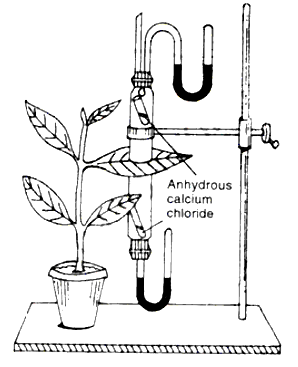
The apparatus shown here is Ganong's photometer designed to demonstrate unequal transpiration from the two surfaces of a dorsiventral leaf. Before keeping the leaf in between the cups, anhydrous calcium chloride ($CaCl_2$​​​​​​​​​​​​​​) contained in two small vials were weighted and placed in both the cups. The ends of the cups were weighted and with corks through which two mercury manometers were connected. After a few hours, $CaCl_2​​​​​​​$​​​​​​​​​​​​​​vials were taken out and weighed again.
(i) What is the purpose of keeping $CaCl_2​​​​​​​$​​​​​​​vials inside the cup?
(ii) After a few hours, $CaCl_2​​​​​​​$​​​​​​​vials were taken out and weighed again.
will you except any difference in weight? If so, give reasons.
(iii) What was expect the purpose of using a manometer?
(iv) What do you mean by transpiration?
Answer
(i) To absorb the moisture formed by transpiration.
(ii) Yes, the weight of $CaCl_2$​​​​​​​ vials kept on the lower side will be more because transpiration will be more on the lower surface and the moisture absorbed.
(iii) To check the outside and inside pressure.
(iv) Transpiration is the loss of water from the aerial parts of the plant in the form of water vapour.
View full question & answer
Question 23 Marks
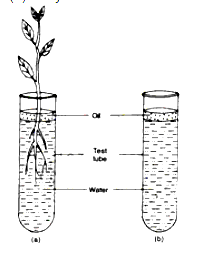
The figure below represents the set-up at the start of certain experiment to demonstrate an activity of plants:
(i) What is the aim of the experiment?
(ii) Why has oil been put in each test tube?
(iii) What will be the observations in the two test-tubes after about 2-3 days?
(iv) Give reasons to explain any change observed as answered in (iii) above.
(v) Why has the test-tube b without the plant, been taken in the experiment?
Answer
(i) The aim of the experiment is to demonstrate transpiration.
(ii) To prevent the evaporation of water from the surface.
(iii) The level of water in test tube (a) will decrease.
(iv) The fall in the water level in the test tube (a) is because of transpiration through aerial parts of the plant.
(v) Test tube (b) has been taken as a control experiment. Since no transpiration takes place without the plant.
View full question & answer
Question 33 Marks
Why do plants absorb more water than what is required by them? Give three uses of this phenomenon.
Answer
Plants absorb more water than what is required. Out of 100%, only 5% of the water is used in metabolic reactions while the remaining 95% is released into the atmosphere as transpiration.
The three uses of this phenomenon are:
(i) It helps in transportation of water and minerals to the various parts of the plant.
(ii) It produces a cooling effect to the plants.
(iii) It evaporates excess water.
View full question & answer
Question 43 Marks
Write short note on the following:
Guttation
Answer
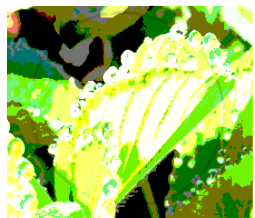
Guttation : It is the loss of water in the form of droplets through hydathodes . It generally occurs at night when transpiration has stopped and the rate of absorption is high. This condition cause maximum pressure on roots which forces the water upwards in the form of drops .
View full question & answer
Question 53 Marks
Write short note on the following:
Hydathodes
Answer
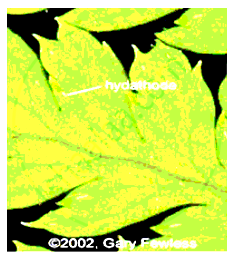
Hydathodes : Hydathodes are special tissues present on tip and margins of leaves . It performs an important function called guttation in which loss of water occur in the form of droplets . These hydathodes allow exudation of excess of water from uninjured plant .
View full question & answer
Question 63 Marks
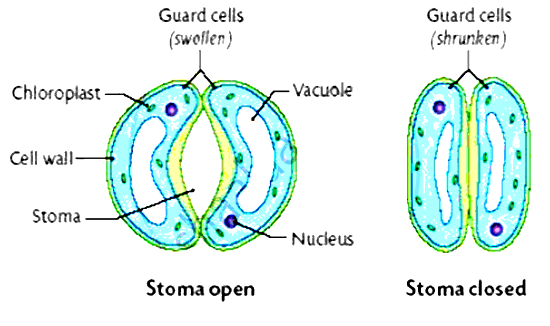
Explain typical structure of stomata.
Answer
The typical structure of stomata:
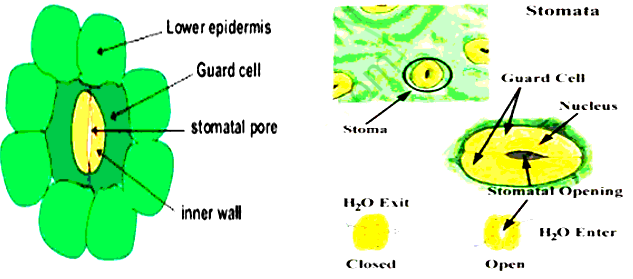
Stomata are minute pores of elliptical shape surrounded by two specialized epidermal cells called guard cells.These guard cells are kidney shaped which control the opening and closing of stomata.It also consists of nucleus, stoma, epidermis and chloroplast.
View full question & answer
Question 73 Marks
Explain the mechanism of stomata?
Answer
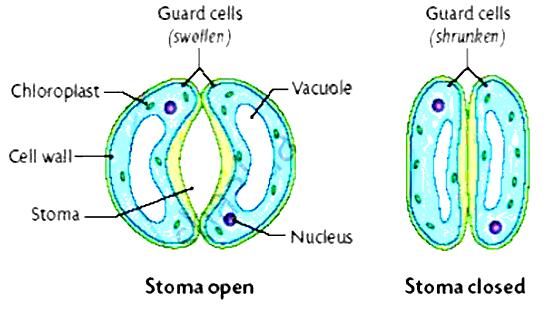
Mechanism of stomata: Stomata are small pores present on the leaves which contains two kidney-shaped guard cells. The opening and closing of stomata depends upon the changes in the turgidity of their guard cells. Due to absorption of water the guard cells become turgid.Their inner walls are pulled apart by their outer wall.The gap between the guard cells become wider and stomata open.When guard cells are flaccid due to loss of water, the outer walls are not stretched, their inner walls are not pulled apart decreasing the gap between the guard cells and stomata close.
View full question & answer
Question 83 Marks
Explain in brief the opening and closing mechanism of stomata.
Answer
The opening and closing of stomata depend upon the changes in the turgidity of their guard cells. Due to the absorption of water, the guard cells become turgid. Their inner walls are pulled apart by their outer wall. The gap between the guard cells becomes wider and stomata open. When guard cells are flaccid due to loss of water, the outer walls are not stretched, their inner walls are not pulled apart decreasing the gap between the guard cells and stomata close.
View full question & answer
Question 93 Marks
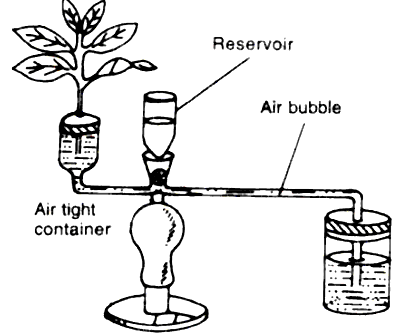
The diagram given alongside is an apparatus used to study a particular phenomenon in plants.
(i) Name the apparatus.
(ii) What is it used for?
(iii) What is the role played by the air bubble in this experiment?
(iv) Of what use is the reservoir?
Answer
(i) Potometer
(ii) Potometer is used to measure the rate of transpiration.
(iii) The rate of movement of the air bubble will indicate the rate of transpiration.
(iv) The reservoir is used to provide water to the potometer.
View full question & answer
Question 103 Marks
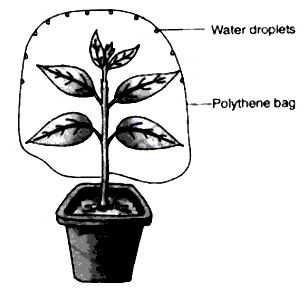
Suggest with an experiment, evaporation of water in vapour form, in transpiration process.
Answer
Experiment to show that during transpiration , evaporation of water takes place in vapour form :
  • Take a well watered potted plant .
  • Cover the potted plant in a polythene sheet.
  • Keep the potted plant in the sunlight.
  • Droplets of water are seen on the inner side of the polythene . This shows that the water evaporates and condenses to form droplets of water .
View full question & answer
[3 marks Question Answer] - Biology STD 10 Questions - Vidyadip