Question
Explain typical structure of stomata.
✓
Answer
The typical structure of stomata:
Stomata are minute pores of elliptical shape surrounded by two specialized epidermal cells called guard cells.These guard cells are kidney shaped which control the opening and closing of stomata.It also consists of nucleus, stoma, epidermis and chloroplast.
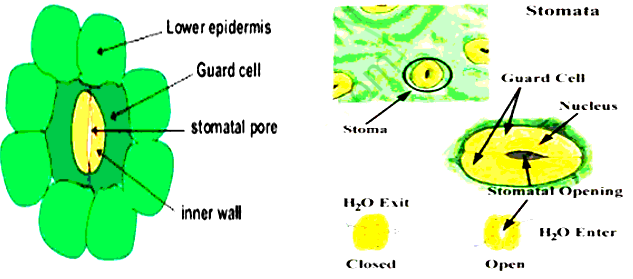
Stomata are minute pores of elliptical shape surrounded by two specialized epidermal cells called guard cells.These guard cells are kidney shaped which control the opening and closing of stomata.It also consists of nucleus, stoma, epidermis and chloroplast.
Need a full question paper?
Generate a complete, print-ready paper with questions like this in minutes — across 16+ boards, with answer keys.
Explore more
Similar questions
Differentiate between :
Plasmolysis and Deplasmolysis
Plasmolysis and Deplasmolysis
The diagram given below shows the internal structure of the spinal cord, depicting a simple reflex. Study the same and then answer the questions that follow:
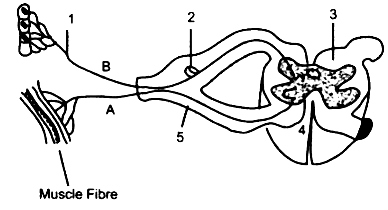
(i) Name the parts numbered 1 to 5.
(ii) Using the letters of the alphabet shown in the figure indicate the direction in which an impulse enters and leaves the spinal cord.
(iii) What is the term given to the point of contact between two nerve cells?
(iv) What is meant by ‘simple reflex’ ? Give two examples of simple reflexes and name the stimuli too.
(v) How does the arrangement of nerve cells in the spinal cord differ from that in the brain?
(i) Name the parts numbered 1 to 5.
(ii) Using the letters of the alphabet shown in the figure indicate the direction in which an impulse enters and leaves the spinal cord.
(iii) What is the term given to the point of contact between two nerve cells?
(iv) What is meant by ‘simple reflex’ ? Give two examples of simple reflexes and name the stimuli too.
(v) How does the arrangement of nerve cells in the spinal cord differ from that in the brain?
The diagram given below represents the structure found in the inner ear.
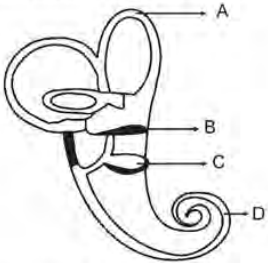
Study the same and then answer the questions that follow :
(i) Name the part of the ear responsible for transmitting impulses to the brain.
(ii) Name the audio receptor cells which pick up vibrations.
(iii) Name the fluid present in the inner ear.
Study the same and then answer the questions that follow :
(i) Name the part of the ear responsible for transmitting impulses to the brain.
(ii) Name the audio receptor cells which pick up vibrations.
(iii) Name the fluid present in the inner ear.
What are the common sources of oil spills, and how do they affect sea life.
Droplets of water may sometimes be seen along the margins of the leaves of a banana plant, growing in wet soil, in the mornings. Are these dew drops? Comment upon your answer.
Write an experiment to demonstrate that $CO_2$ is necessary for photosynthesis.
→Differentiate Between Transpiration and Guttation.
Enumerate the structural differences between white blood cells and red blood cells.
How does cytokinesis differ in a plant and animal cell?
Explain the Term: Glomerulus