Questions

[3 Mark Question Answer]

🎯

Test yourself on this topic

19 questions · timed · auto-graded

Question 13 Marks
Write the equation for the reaction in the Haber process, that forms ammonia.
Answer
The reactants nitrogen and hydrogen combine to form ammonia at low
temperature, high pressure in presence of catalyst to for maximum yield of ammonia. The balanced equation for the reaction is :
$N _2+3 H _2 \rightleftharpoons 2 NH _3+$ Heat
View full question & answer
Question 23 Marks
Is ammonia denser than air? Which property of ammonia is demonstrated by the Fountain experiment? Write the balanced equation for the reaction between ammonia and sulphuric acid.
Answer
Ammonia (vapour density $(V . D)=8.5$ ) is less dense than air (vapour density $(V . D)=$.14.4 ) and so is lighter than air.
Fountain experiment proves that ammonia is highly soluble in water.
The balanced equation for the reaction between ammonia and sulphuric acid is
$
2 NH _3+ H _2 SO _4 \longrightarrow\left( NH _4\right)_2 SO _4
$
View full question & answer
Question 33 Marks
Industrially, ammonia is obtained by direct combination of nitrogen and hydrogen.
(i) Write balanced equation for the direct combination of nitrogen and hydrogen.
(ii) Which of the metals - iron, platinum, copper - catalyse this direct combination?
(iii) Is the formation of ammonia promoted by high pressure or low pressure?
Answer
(i) The reactants nitrogen and hydrogen combine to form ammonia at low temperature, high pressure in presence of catalyst to for maximum yield of ammonia. The balanced equation for the reaction is:
$
N _2+3 H _2 \rightleftharpoons 2 NH _3+\text { heat }
$
(ii) Iron acts as catalyst.
(iii) Since the forward reaction occurs with decrease in volume, according to Le Chateliers principle, high pressure favours the formation of ammonia.
Key: Habers process
View full question & answer
Question 43 Marks
Look at the following reaction :
A. Nitrogen + metal → compound X
B. X + water → ammonia + another compound
C. Ammonia + metal oxide → metal + water + N2
(i) One metal that can be used for reaction in A is magnesium.
(a) Write the formula of the compound X, that is formed.
(b) Write the balanced equation for reaction B, where Xis the compound formed.
( c) Which property of ammonia is demonstrated by reaction C?
Answer
(a) Magnesium nitride $\left( Mg _3 N_2\right)$
(b) $Mg _3 N_2+6 H _2 O \rightarrow 3 Mg ( OH )_2+2 NH _3$
(c) Ammonia is a good reducing agent.
View full question & answer
Question 53 Marks
Write the equations for the action of heat on ammonium chloride and ammonium nitrate?
Answer
Action of heat on ammonium chloride is reversible. When heated, it decomposes to form ammonia and hydrogen chloride. When the products are cooled, they recombine to form ammonium chloride .
$
NH _4 CI \rightleftharpoons NH _3+ HCI
$
Ammonium nitrate on heating completely disappears, escaping in the form of water vapour and nitrous oxide.
$
NH _4 NO _3 \xrightarrow{\Delta} N _2 O +2 H _2 O
$
View full question & answer
Question 63 Marks
When an ammonium salt is warmed with sodium hydroxide solution, ammonia gas is evolved. State three ways by which you can identify this gas.
Answer
Three ways to identify ammonia gas:
1. It is a pungent smell gas.
2. It gives white precipitate when bubbles through a solution of lead nitrate.
3. It gives a brown colour or precipitate when treated with Nesslers reagent.
View full question & answer
Question 73 Marks
Explain, why ammonia is evolved when water is added to the product formed, when magnesium is burned in air.
Answer
Magnesium on burning in air produces magnesium nitride.
$
Mg + N _2 \longrightarrow Mg _3 N _2
$
When this magnesium ni tride comes in contact with water ammonia gas is released
$
Mg _3 N _2+6 H _2 O \longrightarrow 3 Mg ( OH )_2+2 NH _3
$
Key: Ammonia is formed from metal nitrides
View full question & answer
Question 83 Marks
(a) Name the catalyst used in 1(ii)
(b) In the reaction referred to in 1(ii), the catalyst glows red hot. Why?
(c) What is the name of the industrial process which starts with the reaction reffered to in 1 (ii)?
Answer
(a) Catalyst used is Platinum
(b) The catalyst glows red hot as this reaction is an exothermic reaction .
( c) Ostwalds Process
View full question & answer
Question 93 Marks
What is the purpose of Habers process? Name the gaseous inputs in the Habers process and state the ratio by volume in which the gases are mixed. What is done to increase the rate of the reaction in Habers process? Give two different ways by which the product can be separated from the reactants.
Answer
Habers process is used in industrial preparation of ammonia.
Gaseous inputs in Habers process are dry nitrogen and dry hydrogen gas. They are mixed in the ratio of 1:3 by volume.
The following conditions favour maximum yield of ammonia:
(a) Low temperature
(b) High pressure
(c) Use of catalyst
The gases after reaction pass through condensing pipes of cooling chamber where ammonia gets liquefied and is collected in receiver.
Ammonia can also be collected by downward displacement of air.
View full question & answer
Question 103 Marks
State what will you observe when ammonium hydroxide solution is added to copper sulphate in excess.
Answer
Initially when ammonium solution is added to aqueous solution of copper sulphate a bluish precipi tate of copper hydroxide is obtained which dissolves in excess of ammonium hydroxide.$CuSo _4+2 NH _4 OH \longrightarrow\left( NH _4\right)_2 SO _4+ Cu ( OH )_2$
$Cu ( OH )_2+\left( NH _4\right)_2 SO _4+2 NH _4 OH \longrightarrow\left[ Cu \left( NH _3\right)_4\right] SO _4+4 H _2 O$
View full question & answer
Question 113 Marks
What are chlorofluorocarbons, why they become popular as substitute of ammonia as refrigerant?
Answer
A chlorofluorocarbon (CFC) is an organic compound which contains carbon, chlorine and fluorine produced as a volatile derivative of methane and ethane. Pure ammonia gas is highly toxic to humans and would pose a threat if the refrigerator were to leak. Hence, CFCs became popular as a substitute of ammonia as a refrigerant.
View full question & answer
Question 123 Marks
Differentiate between:
Aqueous ferrous and ferric sulphate solution
Answer
Aqueous ferrous Ferric sulphate solution
When ammonium solution is added to aqueous solution of ferrous sulphate a dirty green precipi tate of ferrous hydroxide is obtained which is insoluble in excess of ammonium solution. Hydroxide.
$FeSO _4+2 NH _4 OH \longrightarrow\left( NH _4\right)_2 SO _4+ Fe ( OH )_2$
On adding ammonium solution to ferric sulphate solution we get ammonium sulphate and reddish brown precipi tate of ferric hydroxide which is insoluble in excess of ammonium solution .
$Fe _2\left( SO _4\right)_3+6 NH _4 OH \longrightarrow 3\left( NH _4\right)_2 SO _4+2 Fe (\phi H )_3$
View full question & answer
Question 133 Marks
Differentiate between:
Reaction of excess ammonia with chlorine and $NH_3$ with excess chlorine
Answer
  Reaction of excess ammonia with chlorine Reaction of ammonia with excess chlorine
1 It forms ammonium chloride and nitrogen . It forms nitrogen trichloride and hydrogen chloride
2 $8 NH _3$ (excess) $+3 CI _2 \longrightarrow N _2+6 NH _4 CI$ $NH _3+3 CI _2$ (excess) $\longrightarrow NCI _3+3 H \phi l$
3 The yellow green colour of chlorine gas disappears and white ammonium chloride is formed. Nitrogen trichloride is a yellow coloured highly explosive liquid
View full question & answer
Question 143 Marks
What do you observe when Ammonia solution is added drop by drop and then in excess to aqueous copper sulphate solution.
Answer
Initially when ammonium solution is added to aqueous solution of
copper sulphate a bluish precipi tate of copper hydroxide is obtained
which dissolves in excess of ammonium hydroxide.$CuSO _4+2 NH _4 OH \longrightarrow\left( NH _4\right)_2 SO _4+ Cu ( OH )_2$
$Cu ( OH )_2+\left( NH _4\right)_2 SO _4+2 NH _4 OH \longrightarrow\left( Cu \left( NH _3\right)_4\right) SO _4+4 H _2 O$
View full question & answer
Question 153 Marks
What do you observe when Ammonium solution is added to ferric chloride solution.
Answer
On adding ammonium solution to ferric chloride solution we get
ammonium chloride and reddish brown precipi tate of ferric hydroxide
which is insoluble in excess of ammonium solution .
$FeCI _3+3 NH _4 OH \longrightarrow 3 NH _4 CI + Fe ( OH )_3$
View full question & answer
Question 163 Marks
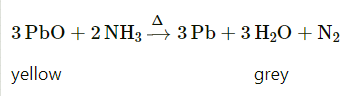
What do you observe when Ammonia is passed over heated lead oxide.
Answer
On passing ammonia over heated lead oxide yellow coloured lead
monoxide is reduced to grey coloured lead metal.\
Image
View full question & answer
Question 173 Marks
Give three uses of ammonium chloride.
Answer
Three uses of ammonium chloride:
1. For cleaning metal surfaces before soldering, tinning, etc.
2. In Leclanche cell and in dry cell .
3 . In medicine and dyeing.
View full question & answer
Question 183 Marks
Write the equation for the action of heat on:
(i) Ammonium chloride
(ii) Ammonium nitrate
State whether each reaction is an example of thermal dissociation or thermal decomposition.
Answer
(i) Action of heat on ammonium chloride is reversible. When heated, it decomposes to form ammonia and hydrogen chloride. When the products are cooled, they recombine to form ammonium chloride .
NH4CI
This is therm a I di ssoci a ti on reaction .
(ii ) Ammonium ni trate on heating completely disappears, escaping in the form of water vapour and ni trous oxide.
Nh4
This is therm a I di ssoci a ti on reaction .
View full question & answer
Question 193 Marks
How is ammonia gas prepared in laboratory starting from $NH_4Cl$? State the conditions and balanced equation for the preparation.
Answer
Ammonium chloride is heated with calcium hydroxide (an alkali), in ratio of $2: 3$ by weight, to produce ammonia .
Reactants should be dry and in grounded state. The reactants are heated to get the products.
Balanced reaction :
$
\begin{aligned}
& {[c e\{2 N H 4 C I+C a(O H) 2 \rightarrow[\Delta] C a C I 2+2 H 2 O+2 N H 3\}]} \\
& 2 NNH _4 CI + Ca ( OH )_2 \xrightarrow{\Delta} CaCI _2+2 H _2 O +2 NH _3
\end{aligned}
$
Key: Laboratory Preparation of Ammonia
View full question & answer