Questions

[2 Mark Question Answer]

🎯

Test yourself on this topic

12 questions · timed · auto-graded

Question 12 Marks
(a) A solution of silver nitrate is a good electrolyte but is not used for electroplating an article with silver. Give reason.
(b) To carry out the so called "electrolysis of water", sulphuric acid is added to water. How does the addition of sulphuric acid produce a conducting solution?
Answer
(a) The rate of deposition of silver is very high when silver nitrate is used as an electrolyte. This in turn forms an uneven and lose deposit on the surface of the article being electroplated.
(b) The sulphuric acid almost completely ionises to form H+ ions and $SO _4^{2-}$ ion. It is the presence of these ions which migrate to the oppositely charged electrodes which makes the solution conducting.
View full question & answer
Question 22 Marks
State the reason for difference in product formed at anode during electrolysis of copper sulphate using copper and platinum as anode.
Answer
When copper is used as anode, it being an active anode ionises to form copper ions which enter the solution.
Cu - 2e- → Cu2+
Thus, its mass continuously decreases.
When platinum is used as anode, it being inert anode does not ionise. Instead amongst the SO42- and OH- ions, the later discharge at anode to liberate oxygen gas.
4OH- - 4e- → 2H2O + O2
View full question & answer
Question 32 Marks
With reference to the nature of electrodes - name three active and three inert electrodes.
Answer
Active electrodes are those which take part in an electrolytic reaction. Copper, nickel and silver are active electrodes.
Inert electrodes are those which do not take part in an electrolytic reaction. Graphite, platinum and iron are inert electrodes.
View full question & answer
Question 42 Marks
Name the product formed at (i) cathode (ii) anode, when molten lead bromide is electrolysed.
Answer
(i) At cathode, lead metal is formed.
(ii) At anode, bromine is liberated.
View full question & answer
Question 52 Marks
When copper sulphate solution is electrolysed with copper electrodes, the blue copper ions are discharged at cathode and get deposited at it, yet the blue colour of copper sulphate does not fade. Explain.
Answer
It is because the number of copper ions discharged at the cathode is equal to the number of copper atoms which ionise to form copper ions at the anode.
As the concentration of copper ions does not change in electrolyte, therefore, blue colour of copper sulphate solution does not fade.
View full question & answer
Question 62 Marks
Name a substance which when dissolved in water contains (i) only ions (ii) ions and molecules.
Answer
(i) Sodium chloride.
(ii) Acetic acid.
View full question & answer
Question 72 Marks
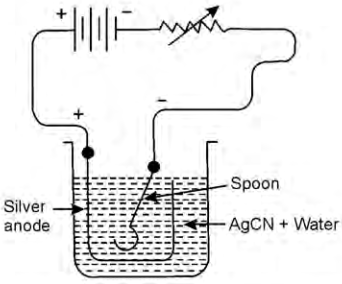
(i) Draw a labelled diagram for the apparatus used to electroplate a spoon with silver.
(ii) What are the ionic reactions that take place :
(1) at the anode (2) at the cathode?
Answer
(i) Diagram is given below :
Image
(ii) Reaction at the anode :
Ag - e- → Ag+
Reaction at the cathode :
Ag+ + e- → Ag
View full question & answer
Question 82 Marks
(a) Why is electrolysis of acidulated water considered an example of catalysis?
(b) If molten magnesium chloride is electrolysed, suggest a suitable anode.
Answer
(a) It is because, the amount of sulphuric acid does not change when water is electrolysed. The sulphuric acid just helps in increasing the conductivity of water.
(b) Graphite anode. It is because graphite does not react with nascent chlorine.
View full question & answer
Question 92 Marks
(a) Give the name of a metal which is extracted by electrolysis.
(b) At which electrode metal ions are discharged during electrolysis?
Answer
(a) Aluminium. (b) Cathode.
View full question & answer
Question 102 Marks
(a) Describe what would you see at the anode and the cathode during electrolysis of copper (II) chloride, using platinum as cathode and carbon as anode. Write ionic equations for the reactions at anode and cathode.
(b) Give two uses of electrolysis.
Answer
(a) On platinum cathode, a reddish layer of copper is deposited.
Cu2+ + 2e- → Cu
On carbon anode, carbon dioxide gas is formed, due to the discharge of OH- ions.
4ОН- - 4е- → 40H
4OH → 2H2O + 2 [O]
C+2 [0] → CO2
(b) (i) Electrolysis is used for electroplating.
(ii) Electrolysis is used for electro-refining of metals.
View full question & answer
Question 112 Marks
Explain, why a solution of an ionic compound is an electrolyte while that of a covalent compound is a non- electrolyte.
Answer
The solution of an ionic compound has free ions which can migrate to the cathode and anode and discharge. Thus, a solution of an ionic compound is a good conductor of electricity, and hence is an electrolyte.
However, a solution of a covalent compound, consists of only molecules and does not have any free ions, which can migrate to the cathode or anode. Hence, it is a non-electrolyte.
View full question & answer
Question 122 Marks
(a) What do you understand by the term electrolytic dissociation?
(b) The ionisation of sodium chloride in water is 99%. What do you mean by the statement?
Answer
(a) Electrolytic dissociation : The process in which separation of ions of an ionic compound takes place on heating or in an aqueous solution is called electrolytic dissociation.
(b) It means that at any time 99 molecules of sodium chloride are in an ionised state, out of 100 molecules of sodium chloride.
View full question & answer
[2 Mark Question Answer] - Chemistry STD 10 Questions - Vidyadip