Question types

Electrolysis question types

75 questions across 8 question groups — pick any mix to generate a Chemistry paper with step-by-step answer keys.

75
Questions
8
Question groups
5
Question types
Sample Questions

Electrolysis questions

One sample from each question group in this chapter. Select any group above to see the full set with answer keys.

Q 1MCQ1 Mark
Assertion (A): Burning of magnesium ribbon to form MgO is a redox reaction.
Reason (R): Magnesium undergoes oxidation and oxygen undergoes reduction.
  • Both A and R are true and R is the correct explanation of A.
  • B
    Both A and R are true but R is not the correct explanation of A.
  • C
    A is true but R is false.
  • D
    A is false but R is true.

Answer: A.

View full solution
Q 2MCQ1 Mark
Assertion (A): The nature of the anode determines the selective discharge of anions migrating towards it.
Reason (R): The anode can be inert or active.
  • A
    Both A and R are true and R is the correct explanation of A.
  • Both A and R are true but R is not the correct explanation of A.
  • C
    A is true but R is false.
  • D
    A is false but R is true.

Answer: B.

View full solution
Q 3MCQ1 Mark
Assertion (A): Articles to be electroplated must be very clean.
Reason (R): Any impurity present will not allow a firm deposit on the surface of the article.
  • Both A and R are true and R is the correct explanation of A.
  • B
    Both A and R are true but R is not the correct explanation of A.
  • C
    A is true but R is false.
  • D
    A is false but R is true.

Answer: A.

View full solution
Q 4MCQ1 Mark
The sulphuric acid added to copper sulphate:
  • A
    prevents hydrolysis of CuSO4
  • B
    makes the electrolyte more conductive
  • both of (a) and (b)
  • D
    none of these

Answer: C.

View full solution
Q 5MCQ1 Mark
During the electrolysis of normal solution of Cu(II) chloride using graphite electrodes, the anion which going to discharge at anode is:
  • A
    Cl- ion
  • OH- ion
  • C
    Cu2+ ions
  • D
    H+ ion

Answer: B.

View full solution
(a) A solution of silver nitrate is a good electrolyte but is not used for electroplating an article with silver. Give reason.
(b) To carry out the so called "electrolysis of water", sulphuric acid is added to water. How does the addition of sulphuric acid produce a conducting solution?
View full solution
When copper sulphate solution is electrolysed with copper electrodes, the blue copper ions are discharged at cathode and get deposited at it, yet the blue colour of copper sulphate does not fade. Explain.
View full solution
(i) Here is an electrode reaction:
Cu → Cu2+ + 2e-
At which electrode (anode or cathode) would such a reaction take place? Is this an example of oxidation or reduction?
(ii) A solution contains magnesium ions (Mg2+), iron (II) ions (Fe2+) and copper ions (Cu2+). On passing an electric current through this solution, which ions will be the first to be discharged at the cathode? Write the equation for the cathode reaction.
(iii) Why is carbon tetrachloride, which is a liquid, a non-electrolyte?
View full solution
Three different electrolytic cells A, B and C are connected in separate circuits. Electrolytic cell A contains sodium chloride solution. When the circuit is completed a bulb in the circuit glows brightly. Electrolytic cell B contains acetic acid solution and in this case the bulb in the circuit glows dimly. The electrolytic cell C contains sugar solution and the bulb does not glow. Give a reason for each of these observations.
View full solution
Answer the following questions about electroplating a copper wire with silver.
(i) What ions must be present in the electrolyte?
(ii) Of what substance must the anode be made?
(iii) What should be made cathode?
View full solution
Explain the following:
(i) Sodium chloride will conduct electricity only in fused or aqueous solution state.
(ii) In the electroplating of an article with silver, the electrolyte sodium argento-cyanide solution is preferred over silver nitrate solution.
(iii) Although copper is a good conductor of electricity, it is a non-electrolyte.
View full solution
The ________ (higher/lower) the concentration of an ion in a solution, the greater is the probability of its being discharged at its appropriate electrode.
View full solution
State one relevant observation for each of the following statements :
(i) At the cathode when acidified aqueous copper sulphate solution is electrolyzed with copper electrodes.
(ii) At the anode when aqueous copper sulphate solution is electrolysed using copper electrodes.
(iii) At the anode, when molten lead bromide is electrolysed using graphite electrodes.
(iv) Copper sulphate is electrolysed using copper electrodes.
View full solution
A metal article is to be electroplated with silver. The electrolyte selected is sodium argentocyanide.
(i) What kind of salt is sodium argentocyanide?
(ii) Why is it preferred to silver nitrate as an electrolyte?
(iii) State one condition to ensure that the deposit is smooth, firm and long lasting.
(iv) Write the reaction taking place at the cathode and anode.
View full solution
(a) Why does molten sodium chloride decompose on the passage of electric current?
(b) (i) Name two metals normally manufactured by the electrolysis of fused compounds.
(ii) Name two compounds used in (b) (i) above.
(iii) For one of the above metals, explain the reaction taking place at the cathode.
View full solution
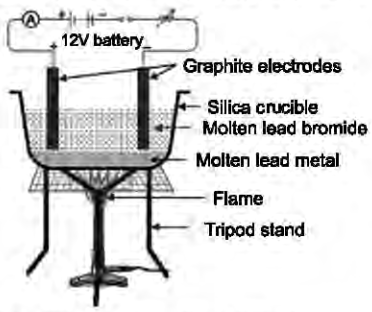
A diagram of the apparatus set up is given below for the electrolysis of fused lead bromide.
Image
(i) Write two properties of silica crucible used in the above apparatus.
(ii) Molten (fused) lead bromide is used as an electrolyte instead of solid lead bromide. Give reason.
(iii) Write the conditions required during the process.
(iv) Write the reactions taking place at the electrodes.
(v) Write the observations during the process.
View full solution
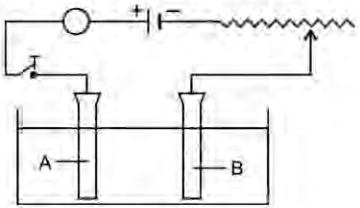
(a) Study the diagram given below and answer the questions that follow:
Image
(i) Give the names of the electrodes A and B.
(ii) Which electrode is the oxidizing electrode?
(b) A strip of copper is placed in four different colourless salt solutions. They are KNO3, AgNO3, Zn(NO3)2 Ca(NO3)2. which one of the solution will finally turn blue?
(c) Write the equation of the reactions which take place at the cathode and anode when acidified water is electrolysed.
View full solution
Column AColumn B
(a)Highly reactive metals1.Oxides are broken by direct heating.
(b)Moderately reactive metals2.Occur in free state.
(c )Hg and Ag3.Extracted by reduction using suitable reducing agents.
(d)Pt and Au4.Extracted by electrolytic reduction.
View full solution

Generate a Electrolysis paper free

Pick question groups from the list above, set marks and difficulty, and export a branded PDF with step-by-step answer keys. First 3 chapters free — no signup.

Download App