Question 15 Marks
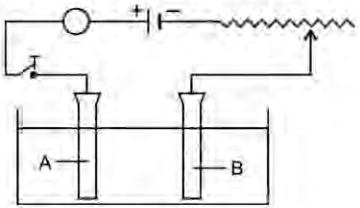
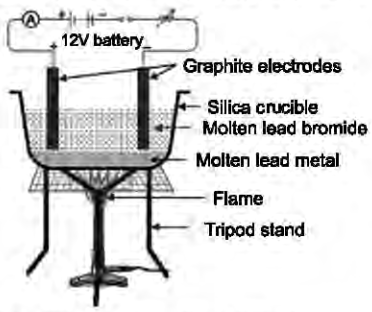
A diagram of the apparatus set up is given below for the electrolysis of fused lead bromide.
(i) Write two properties of silica crucible used in the above apparatus.
(ii) Molten (fused) lead bromide is used as an electrolyte instead of solid lead bromide. Give reason.
(iii) Write the conditions required during the process.
(iv) Write the reactions taking place at the electrodes.
(v) Write the observations during the process.
(i) Write two properties of silica crucible used in the above apparatus.
(ii) Molten (fused) lead bromide is used as an electrolyte instead of solid lead bromide. Give reason.
(iii) Write the conditions required during the process.
(iv) Write the reactions taking place at the electrodes.
(v) Write the observations during the process.
Answer
View full question & answer→(i) Silica crucible is used as:
• It is non-reactive and almost a bad conductor of electricity.
• It can withstand high temperature.
(ii) Solid lead bromide cannot be used as Pb2+ and Br- ions are held firmly by electrostatic forces. Thus, it is a bad conductor of electricity. In molten lead bromide, ions become free making it a good conductor.
(iii) Electrolyte is kept at a temperature above 380°C which is the melting point of PbBr2.
(iv) Cathode: Pb2+ + 2e- → Pb
Anode: Br- - e- → Br
Br + Br → Br2
(v) The lead metal so formed around the cathode is silvery grey in colour. It settles down at the base of the crucible. At the anode reddish vapours of bromine escape in air from fused lead bromide.
• It is non-reactive and almost a bad conductor of electricity.
• It can withstand high temperature.
(ii) Solid lead bromide cannot be used as Pb2+ and Br- ions are held firmly by electrostatic forces. Thus, it is a bad conductor of electricity. In molten lead bromide, ions become free making it a good conductor.
(iii) Electrolyte is kept at a temperature above 380°C which is the melting point of PbBr2.
(iv) Cathode: Pb2+ + 2e- → Pb
Anode: Br- - e- → Br
Br + Br → Br2
(v) The lead metal so formed around the cathode is silvery grey in colour. It settles down at the base of the crucible. At the anode reddish vapours of bromine escape in air from fused lead bromide.