Questions

[2 Mark Question Answer]

🎯

Test yourself on this topic

13 questions · timed · auto-graded

Question 12 Marks
Copper sulphate solution is electrolysed using a platinum anode. Study the diagram given alongside and answer the following questions:
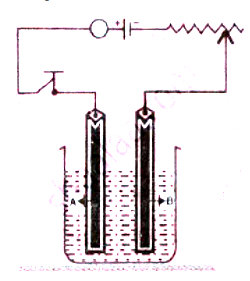
  1. Give the names of the electrodes A and B.
  2. Which electrode is the oxidising electrode?
Answer
  1. A = Platinum anode, B = Platinum or copper cathode
  2. A = Platinum anode
View full question & answer
Question 22 Marks
What is the difference between:
Electrolytic dissociation and thermal dissociation.
Answer
Electrolytic dissociation is the dissociation of an electrovalent compound into ions in the fused state or in aqueous solution state.

Thermal dissociation: Reversible breakdown of a chemical compound into simpler substances by heating it. The splitting of ammonium chloride into ammonia and hydrogen chloride is an example. On cooling, they recombine to form the salt.

View full question & answer
Question 32 Marks
Why cannot we store $AgNO_3$​​​​​​​ solution in copper vessel?
Answer
Copper is above silver in the electrochemical series and is thus more reactive than silver. So, copper displaces silver from silver nitrate. Hence, we cannot store $AgNO_3$​​​​​​​ solution in copper vessel.
$​​​​​​​Cu + AgNO_3 \rightarrow Cu(NO_3)_2 + 2Ag$
View full question & answer
Question 42 Marks
What is the difference between:
electrolytic dissociation and ionization.
Answer
Difference between electrolytic dissociation and ionization :
Ionization Dissociation
1. Formation of positively or negatively charged ions from molecules which are not initially in the ionic state. 1. Separation of ions which are already present in an ionic compound.
2. Polar covalent compounds show ionization. e.g. $HCl, H_2CO_3, NH_4OH$ etc. 2. Electrovalent compounds show dissociation. e.g. Potassium chloride, lead bromide, etc.
View full question & answer
Question 52 Marks
What is the difference between:
Modern explanation and Arrhenius explanation for the theory of electrolysis:
Answer
Difference between Modern explanation and Arrhenius explanation for the theory of electrolysis:
Arrhenius considered that water ionizes electrolytes but Modern theory explained that electrolytes are ionic even in solid state and their ions are held by strong electrostatic forces which make them immobile. Water renders these ions mobility by breaking the electrostatic forces.
View full question & answer
Question 62 Marks
Define the following term:
Non-electrolyte
Answer
Non-electrolyte: It is a compound which neither in solution nor in the molten state allows an electric current to pass through it.
View full question & answer
Question 72 Marks
Define the following term:
Electrolysis
Answer
Electrolysis: It is the process of decomposition of a chemical compound in aqueous solutions or in a molten state accompanied by a chemical change using direct electric current.
View full question & answer
Question 82 Marks
Explain the following:
During the electrolysis of an aqueous solution of $NaCI$, hydrogen ion is reduced at the cathode and not the sodium ion though both $Na^+$ and $H^+$ ions are present in the solution.
Answer
Hydrogen is placed lower in the electrochemical series and sodium is placed at a higher position. This is because $H^+$ ions are discharged more easily at the cathode than $Na^+$ during electrolysis and gains electrons more easily.
Therefore, $H^+$​​​​​​​ ion is reduced at the cathode and not $Na^+$​​​​​​​ ion.
View full question & answer
Question 92 Marks
Explain the following:
Hydrochloric acid is a good conductor of electricity.
Answer
Hydrochloric acid is a strong electrolyte and dissociates completely in aqueous solution. The solution contains free mobile ions which allow electric current to pass through it. Hence, hydrochloric acid is a good conductor of electricity.
View full question & answer
Question 102 Marks
Explain the following:
A solution of cane sugar does not conduct electricity, but a solution of solution of sodium chloride is a good conductor.
Answer
Cane sugar is a compound which does not have ions even in solution and contains only molecules. Hence, it does not conduct electricity. On the other hand, sodium chloride solution contains free mobile ions and allows electric current to pass through it. This makes it a good conductor of electricity.
View full question & answer
Question 112 Marks
Write two applications of electrolysis in which the anode diminishes in mass.
Answer
  1. Electroplating of metals
  2. Electrorefining of metals
View full question & answer
Question 122 Marks
Give reasons for the following:
Lead bromide undergoes electrolytic dissociation in the molten state but is a non-electrolyte in the solid-state.
Answer
Lead bromide dissociate into ions in the molten state whereas it does not dissociate in solid state. The ions become free when lead bromide is in molten state but in the solid state the ions are not free since they are packed tightly together due to electrostatic force between them. Therefore, lead bromide undergoes electrolytic dissociation in the molten state.
View full question & answer
Question 132 Marks
Give reason for the following:
Electrolysis of molten lead bromide is considered to be a reaction in which oxidation and reduction go side by side, i.e., a redox reaction.
Answer
During electrolysis of lead bromide, there is loss of electrons at anode by bromine and gain of electrons at cathode by lead. Thus oxidation and reduction go side by side. Therefore, it is a redox reaction.
$PbBr_2$  $Pb^{+2} + 2Br ^–$​​​​​​​
View full question & answer
[2 Mark Question Answer] - Chemistry STD 10 Questions - Vidyadip