Questions

[3 Mark Question Answer]

🎯

Test yourself on this topic

18 questions · timed · auto-graded

Question 13 Marks
Answer the following question:
What is the difference between calcination and roasting?
Answer
Calcination Roasting
1. The ore is heated in the absence of air. 1. The ore is heated in excess of air.
2. Moisture and organic impurities are removed and the ore becomes porous and more reactive. 2. Volatile impurities are removed as oxides $(SO_2, P_2O_5, As_2O_3)$ and the ore becomes porous and more reactive.
3. Carbonate and hydrated ores are calcined and $CO_2 $or water vapour is given off. $ZnCo _3 \longrightarrow ZnO + CO _2$ 3. Sulphide ores are roasted, so $SO_2$​​​​​​​ is given off.$2 ZnS +3 O _2 \xrightarrow{800^{\circ}-900^{\circ} C } 2 ZnO +2 SO _2$
View full question & answer
Question 23 Marks
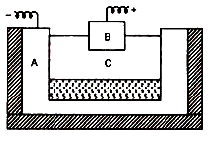
The following is a sketch of an electrolytic cell used in the extraction of aluminium :

(a) What is the substance of which the electrode A and B are made?
(b) At which electrode (A or B) is aluminium formed?
(c) What are the two aluminium compounds in the electrolyte C?
(d) Why is it necessary for electrode B to be continuously replaced?
Answer
(i) $A$ is made of carbon and $B$ is a thick graphite rod.
A $\rightarrow$ Cathode
$B \rightarrow$ Anode
(ii) Aluminium is formed at electrode A.
(iii) The two aluminium compound in the electrolyte $C$ is $Na _3 AlF _6, Al _2 O _3$.
(iv) It is necessary to continuously replace electrode B from time to time as it gets oxidized by the oxygen evolved.
View full question & answer
Question 33 Marks
The following is an extract from 'Metals in the service of Man, Alexander and street /Pelican 1976':
'Alumina (aluminium oxide) has a very high melting point of over $2000^oC$ so that it cannot readily be liquefied. However, conversion of alumina to aluminium and oxygen, by electrolysis, can occur when it is dissolved in some other substance'.
(a) Which solution is used to react with bauxite as a first step in obtaining pure aluminium oxide?
(b) The aluminium oxide for the electrolytic extraction of aluminium is obtained by heating aluminium hydroxide. Write the balanced chemical equation for this reaction.
(c) Name the element which serves both as the anode and the cathode in the extraction of aluminium.
(d) Write the balanced chemical equation for the reaction that occurs at the cathode during the extraction of aluminium by electrolysis.
(e) Give the balanced chemical equation for the reaction which occurs at the anode when aluminium is purified by electrolysis.
Answer
(a) Sodium hydroxide.
(b) $2 Al ( OH )_3 \xrightarrow[1000^{\circ} C ]{\text { Heat }} Al _2 O _3+3 H _2 O$
(c) Graphite
(d) Reaction at cathode: $Al ^{3+}+3 e ^{-} \rightarrow Al$
(e) Reaction at anode: $Al -3 e ^{-} \rightarrow Al ^{3+}$
View full question & answer
Question 43 Marks
What is an alloy? How do the properties of an alloy differ from its constituents?
Answer
Alloy is a homogeneous mixture of two or more metals or of one or more metals with certain nonmetallic elements.
The properties of alloys are often greatly different from those of the components.
For example: Gold is too soft to be used without small percentage of copper.
A low percentage of molybdenum improves the toughness and wear resistance of steel.
Bell metal is more sonorous than copper or tin.
Alnico an alloy of aluminium, nickel, and cobalt can lift 60 times its own mass.
These added elements improve hardness, wear resistance, toughness and other properties.
View full question & answer
Question 53 Marks
In construction work, why is the alloy of aluminium - duralumin used rather than pure aluminium?
Answer
In construction work, the alloy of aluminium–duralumin is used rather than pure aluminium because of the following reasons:
Duralumin is lighter and strong, but aluminium is light and not strong.
Duralumin is unaffected by moist air, while aluminium gets affected by moist air.
Duralumin is corrosion-resistant, while aluminium can undergo corrosion.
View full question & answer
Question 63 Marks
Give three ways in which the metal zinc differs from the non-metals carbon. At least one of the differences must be a chemical difference ?
Answer
The three ways in which metal zinc differs from the non-metal carbon is:
  1. Zinc has avalency$2$ and carbon has valency $4$.
  2. Zinc does not form hydride but carbon does $(CH_4).$
  3. Oxides of zinc are amphoteric $(ZnO)$ whereas oxides of carbon are acidic $(CO_2)$ and neutral $(CO)$.
View full question & answer
Question 73 Marks
Aluminium is extracted from its chief ore, bauxite. The ore is first purified and then the metal is extracted from it by electrolytic reduction
Write three balanced equation for the purification of bauxite ?
Answer
Balanced equations for the purification of bauxite: $Al _2 O _3 2 H _2 O +2 NaOH \longrightarrow 2 NaAlO _2+3 H _2 O$ $NaAlO _2+2 H _2 O \longrightarrow NaOH + Al ( OH )_3 \downarrow$
$
2 Al ( OH )_3 \xrightarrow[1000^{\circ} C ]{\text { heat }} Al _2 O _3+3 H _2 O
$
View full question & answer
Question 83 Marks
In order to obtain 1 tonne of aluminium the following inputs are required. 4 tonnes of bauxite, $150 kg$ of sodium hydroxide and $600 kg$ of graphite. The aluminium compound in bauxite is aluminium oxide and the main impurity is iron (III) oxide, Aluminium is obtained by the electrolysis of aluminium oxide dissolved in cryolite
1. Write the formula of cryolite.
2. Write down the word which correctly completes the following sentence. By dissolving aluminium oxide in cryolite a (conducting/non-conducting) solution is produced.
3. Why is so much graphite required for the electrolytic process?
4. Write the equation for the reaction which takes place at the cathode.
5. What is cathode made up of?
Answer
(i) The formula of the cryolite is $Na _3 AlF _6$
(ii) By dissolving aluminium oxide in cryolite, a conducting solution is produced.
(iii) Thick graphite rods are used as the anode. The anode has to be replaced from time to time, as it gets oxidised by evolved oxygen.
(iv) Reaction at the cathode:
$
4 Al ^{3+}+12 e ^{-} \longrightarrow 4 Al
$
(v) The cathode is made of carbon.
View full question & answer
Question 93 Marks
Give the chemical names and formulae of the main ores of (i) aluminium, (ii) iron and (iii) zinc.
Answer
The chemical names and formulae of the ores of aluminium are:
OreChemical nameFormula
BauxiteHydrated aluminium oxide$Al _2 O _3 \cdot 2 H _2 O$
CryoliteSodium aluminium$N a_3 A l F_6$
Corundumfluoride
Anhydrous aluminium
oxide
$Al _2 O _3$
View full question & answer
Question 103 Marks
Some metallic oxides can be reduced by hydrogen, carbon and carbon monoxide and some cannot. explain
Answer
Oxides of highly active metals like potassium, sodium, calcium, magnesium and aluminium have a great affinity towards oxygen and so cannot be reduced by carbon or carbon monoxide or hydrogen.
Metals in the middle of activity series (iron, zinc, lead, copper) are moderately reactive and are not found in oxide form. These are found in nature as sulphides or carbonate. These are first converted into oxides and can be reduced by $C _1 CO$ or $H _2$.
$ZnO + C \xrightarrow{400^{\circ} C } Zn + CO$
$PbO + CO \xrightarrow{\Delta} Pb + CO _2$
Metals low in the activity series is very less reactive and oxides of these metals are reduced to metals by heating alone.
View full question & answer
Question 113 Marks
Compare roasting and calcination.
Answer
RoastingCalcination
1.This method is generally used for sulphide oresThis method is generally used for carbonate ores.
2.In this method, ores are heated in excess of air.In this method, ores are heated in a limited supply of air.
3.In roasting, generally sulphur dioxide gas is evolved.In calcination, generally carbon dioxide gas is evolved.
4.In this method, sulphide ores are oxidized to form metal oxides.
E.g. $2 ZnS +3 O _2 \longrightarrow 2 ZnO +2 SO _2 \uparrow$
In this method, carbonate ores decompose to form metal oxide.
E.g. $ZnCO _3 \longrightarrow ZnO + CO _2 \uparrow$
View full question & answer
Question 123 Marks
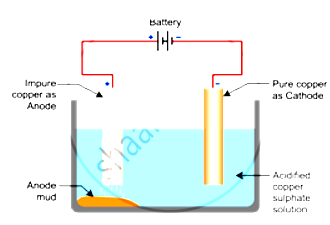
With a labelled diagram explain electro-refining of a particular metal.
Answer

The process of electrolytic refining of copper:
i. In this electrolytic refining, the electrolyte is a solution of copper sulphate.
ii. In this process, the anode is impure copper, whereas the cathode is a thin strip of pure copper.
iii. On passing the current through the electrolyte, the pure copper from the anode dissolves into the electrolyte.
iv. An equivalent amount of pure copper from the electrolyte is deposited at the cathode.
v. The insoluble impurities settle down at the bottom of the anode (the positively charged electrode) are known as anode mud.
View full question & answer
Question 133 Marks
Give equation for the reduction of Lead (II) oxide
Answer
Reduction of lead (II) oxide:
$PbO + C \xrightarrow{\Delta} Pb + CO $
$PbO + CO \xrightarrow{\Delta} Pb + CO _2 $
$PbO + H _2 \xrightarrow{\Delta} Pb + H _2 O$
View full question & answer
Question 143 Marks
Give equation for the reduction of Iron (III) oxide
Answer
Reduction of iron (III) oxide:
$FeO + C \xrightarrow{\Delta} Fe + CO$
$FeO + CO \xrightarrow{\Delta} Fe + CO _2$
$FeO + H _2 \xrightarrow{\Delta} Fe + H _2 O$
View full question & answer
Question 153 Marks
Give the equation for the reduction of Copper oxide
Answer
Reduction of copper oxide:
$CuO + C \xrightarrow{\Delta} Cu + CO $
$CuO + CO \xrightarrow{\Delta} Cu + CO _2$
$CuO + H _2 \xrightarrow{\Delta} Cu + H _2 O$
View full question & answer
Question 163 Marks
Define calcination. Give example and equation for calcination.
Answer
Calcination is the process of heating the concentrated ore such as carbonate or hydrated oxide to a high temperature in the absence of air.
Example: Metal carbonates get decomposed to produce metal oxides.
$ZnCO _3 \longrightarrow ZnO + CO _2 $
$CaCO _3 \longrightarrow CaO + CO _2$
View full question & answer
Question 173 Marks
State why aluminium is extracted from its oxide by electrolysis while copper, lead, iron by reducing agents and mercury and silver by thermal decomposition.
Answer
Aluminium has a great affinity towards oxygen and so cannot be reduced by carbon or carbon monoxide. So it is extracted from its oxide by electrolysis.
Metals like copper, lead, and iron are placed in the middle of the activity series and re moderately reactive and their oxides can be reduced by carbon, CO and hydrogen. Mercury and silver are less reactive and are placed lower in the reactivity series. The oxides of these metals are reduced to metals by heating their oxides.
View full question & answer
Question 183 Marks
From the list of characteristics given below, select the five which are relevant to non-metals and their compounds:
1. Ductile
2. Conduct electricity
3. Brittle
4. Acidic Oxides
5. Basic Oxides
6. Discharged at anode
7. Discharged at cathode
8. Ionic chlorides
9. Covalent chlorides
10. Reaction with dilute sulphuric acid yields hydrogen
11. 1,2 or 3 valence electrons
12. 5,6,7 valence electrons
(Write the five letters corresponding to the correct characteristics).
Answer
Acidic oxide(D)
Discharged at anode (F)
Covalent chlorides (I)
5,6,7 valence electrons (L)
Brittle(C)
View full question & answer
[3 Mark Question Answer] - Chemistry STD 10 Questions - Vidyadip