Questions

[2 Mark Question Answer]

🎯

Test yourself on this topic

18 questions · timed · auto-graded

Question 12 Marks
A researcher measures 10.0 liters of oxygen gas (O2) at 300 K and 2 atm. The researcher then measures 10.0 liters of nitrogen gas (N2) under the same conditions.
(i) How do the number of moles of oxygen and nitrogen gases compare?
(ii) Describe the principle from Avogadro's Law that supports this comparison.
Answer
(i) Same
(ii) Since the volume of the two gases are same, the number of moles of oxygen and nitrogen gas will be equal.
View full question & answer
Question 22 Marks
A balloon is filled with hydrogen gas (H2) at a pressure of 1.5 atm and a temperature of 350 K. The balloon is then placed in a cooler environment where the temperature drops to 250 K, while the volume of the balloon remains constant.
(i) Determine the final pressure of the hydrogen gas in the balloon.
(ii) Explain why the pressure changes when the temperature changes, according to Gay Lussac's Law.
Answer
(i) P1 = 1.5 atm, T1 = 350 K, T2 = 250 K
Volume remains constant, so V1 = V2 = V (say)
As per Combined Gas Law, $\frac{P_1 V_1}{T_1}=\frac{P_2 V_2}{T_2}$
By substituting the values, $\frac{1.5 \times V }{350}=\frac{ P _2 \times V }{250} \Rightarrow P _2=$ 1.07 atm
(ii) According to the law, as temperature of gas decreases the pressure ssure of the gas also decrease. At lower temperature, gas molecules have less kinetic energy and move with less force resulting in fewer collisions, therefore, pressure of the gas decreases.
View full question & answer
Question 32 Marks
A 5.0 I container is filled with nitrogen gas (N2) at a temperature of 300 K and a pressure of 2.0 atm. The container is then heated to 450 K while keeping the volume constant.
(i) What will be the new pressure of the nitrogen gas inside the container?
(ii) Explain how Gay Lussac's Law applies to this scenario.
Answer
(i) V1 = V2 = 5.0 liters (volume remains constant)
T1 = 300K (initial temperature), T2 = 450 K (final temperature), P1 = 2.0 atm (initial pressure)
Using the combined gas law:
$\frac{ P _1 V_1}{T_1}=\frac{ P _2 V_2}{T_2}$
Substituting the given values, we get,
$\frac{2 \times 5}{300}=\frac{P_2 \times 5}{450} \Rightarrow P_2=$ 3 atm
(ii) Gay Lussac's Law, also known as the pressure-temperature law, states that the pressure of a gas is directly proportional to its temperature, provided that the volume and amount of gas remain constant. Mathematically, it can be expressed as:
$\frac{ P _1}{T_1}=\frac{ P _2}{T_2}$
where P1 and P2 are the initial & final pressures of the gas, respectively and T1 and T2 are the initial & final temperatures of the gas, respectively.
Since the volume remains constant, according to Gay-Lussac's Law, the pressure of the gas will be directly proportional to its temperature. As the temperature increases from 300 K to 450 K, the pressure of the nitrogen gas will also increase proportionally.
View full question & answer
Question 42 Marks
Calculate the percentage of water of crystallisation in washing soda [Na2CO3.10H2O]
[Na = 23; C = 12; O = 16; H = 1]
Answer
Molecular weight of Na2CO3.10H2O = 46 + 12 + 48 + 180 = 286 amu.
Molecular weight of 10 molecules of water = 10 $\times$ 18 =180 amu
$\therefore \%$ age of water of crystallisation $=\frac{180}{286} \times 100=$ 62.93%.
View full question & answer
Question 52 Marks
Urea is very important fertiliser. The formula is (CON2H4). Calculate the percentage of nitrogen in urea. [C= 12; N = 14; O = 16; H = 1]
Answer
Molecular weight of urea [CON2H4] = [12+16 + 28 + 4) = 60 amu
Also, weight of nitrogen in urea = 14 +14 = 28 amu
$\therefore \%$ age of nitrogen in urea $=\frac{28}{60} \times 100=$ 46.67%.
View full question & answer
Question 62 Marks
Calculate the percentage of nitrogen in NH4NO3. [N = 14; H = 1; O = 16]
Answer
Molecular weight of NH4NO3 = 14+4+14+48 = 80 amu
Also, weight of nitrogen in NH4NO3 = 14 + 14 = 28 amu
$\therefore \%$ age of nitrogen in $NH _4 NO _3=\frac{28}{80} \times 100=$ 35%.
View full question & answer
Question 72 Marks
If 100 cm3 of oxygen contains Y molecules, how many molecules of nitrogen will be present in 50 cm3 of nitrogen under the same conditions of temperature and pressure.
Answer
100 cm3 of oxygen contains number of molecules = Y
$\therefore$ By Avogadro's Law : $100 cm^3$ of nitrogen contains number of molecules $= Y$
$\therefore 50 cm^3$ of nitrogen contains number of molecules $=\frac{50 Y }{100}=\frac{ Y }{2}$.
View full question & answer
Question 82 Marks
CH4 + 2O2 → CO2 + 2H2O ...(1)
2H2 + O2 → 2H2O ...(2)
Calculate the volume of oxygen required when a mixture of 33.6 dm3 of methane and 22.4 dm3 of hydrogen burn completely as shown by the equation above.
View full question & answer
Question 92 Marks
(i) State Gay Lussac's Law of combining gases.
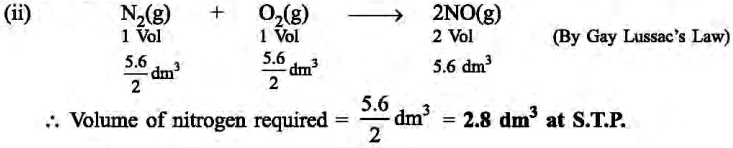
(ii) Nitrogen and oxygen react as illustrated by an equation below :
N2(g) + O2(g) → 2NO
Calculate the volume of nitrogen gas to produce 5.6 dm3 of nitric oxide gas at S.T.P
Answer
(i) Gay Lussac's Law : Whenever the gases react chemically, they do so in volumes which bear a simple whole number ratio to one another and the products, if gaseous, provided the gases are at same temperature and pressure.
Image
View full question & answer
Question 102 Marks
LPG stand for liquefied petroleum gas. Varieties of LPG are marketed including a mixture of propane (60%) and butane (40%). If 10 litre of this mixture is burnt, find the total volume of carbon dioxide gas added to the atmosphere. Combustion reactions can be represented as:
C3H2(g) + 5O2(g) → 3CO2(g) + 4H2O(g)
2C4H10(g) + 13O2(g) → 8CO2(g) + 10H2O(g)
View full question & answer
Question 112 Marks
67.2 litres of hydrogen combines with 44.8 litres of nitrogen to form ammonia under specific conditions as :
N2(g) + 3H2(g) → 2NH3(g)
Calculate the volume of ammonia produced. What is the other substance, if any, that remains in the resultant mixture
View full question & answer
Question 122 Marks
What volume of oxygen is required to burn completely 90 dm3 of butane under similar conditions of temperature and pressure?
2C4H10 + 13O2 → 8CO2 + 10H2O
View full question & answer
Question 132 Marks
A compound made up of two elements X and Y has an empirical formula X2Y. If the atomic weight of X is 10 and that of Y is 5 and the compound has a vapour density 25, find its molecular formula.
Answer
Empirical weight of X2Y = 2(10) + 1(5) = 25
Vapour density of X2Y = 25.
$\therefore$ Molecular weight of $X _2 Y =2 \times$ vapour density $=2 \times 25=50$.
Now, Molecular weight = n $\times$ empirical weight
$\begin{aligned} & & 50 & =n \times 25 \\ \therefore & & n & =2\end{aligned}$
$\therefore$ Molecular formula of compound $=n \times$ Empirical formula
= 2 $\times$ X2Y = X4Y2
View full question & answer
Question 142 Marks
Oxygen oxidises ethyne to carbon dioxide and water as shown by the equation :
2C2H2 + 5O2 → 4CO2 + 2H2O
What volume of ethyne gas at s.t.p. is required to produce 8.4 dm3 of carbon dioxide at s.t.p.? [H = 1, C = 12, O = 16]
Answer
$\underset{2 Vol }{2 C _2 H _2}+5 O _2 \longrightarrow \underset{4 Vol }{4 CO _2}+2 H _2 O$. [By Gay Lussac's law]
4 volumes of carbon dioxide at s.t.p. requires ethyne 2 = volumes
$\therefore 8.4 dm ^3$ of carbon dioxide at s.t.p. requires ethyne $=\frac{2 \times 8.4}{4} dm ^3=$ 4.2 dm3.
View full question & answer
Question 152 Marks
The equation 4NH3 + 5O2 → 4NO + 6H2O, represents the catalytic oxidation of ammonia. If 100 cm3 of ammonia is used, calculate the volume of oxygen required to oxidise the ammonia completely.
Answer
$
\begin{array}{l}
4 NH_3(g)+5 O_2(g) \longrightarrow 4 NO(g)+6 H_2 O(l) \\
4 Vol \quad 5 Vol \\
1 Vol \quad \frac{5}{4} Vol
\end{array}
$ (By Gay Lussac's Law)
$100 cm^3 \quad \frac{5}{4} \times 100=125$
$\therefore$ Volume of oxygen required $=125 cm^3$.
View full question & answer
Question 162 Marks
Propane burns in air according to the following equation :
C3H8 + 5O2 → 3CO2 + 4H2O.
What volume of propane is consumed on using 1000 cm3 of air, considering only 20% of air contains oxygen?
Answer
Amount of oxygen in $1000 cm^3$ of air $=1000 \times \frac{20}{100}=200 cm^3$
$
\begin{array}{l}
C_3 H_8+5 O_2 \longrightarrow 3 CO_2+4 H_2 O \\
1 \text { vol } \quad 5 Vol \quad 3 Vol
\end{array}
$
For 5 volumes of oxygen, the propane consumption = 1 Vol
$\therefore 200 cm^3$ of oxygen, the propane consumption $=\frac{200}{5}=40 cm^3$.
View full question & answer
Question 172 Marks
Ethane burns in oxygen to form CO2 and H2O according to the equation :
2C2H6 +7O2 → 4CO2 + 6H2O.
If 1250 cc of oxygen is burnt with 300 cc of ethane.
Calculate:
(i) the volume of CO2 formed.
(ii) the volume of unused O2.
View full question & answer
Question 182 Marks
Given: 2C2H6 + 7O2 → 4CO2 + 6H2O
2000 cc of O2 was burnt with 400 cc of ethane.
Calculate the volume of CO2 formed and unused O2.
Answer
$\underset{\substack{\text { 2Vol. }}}{2 C _2 H _6}+\underset{7 Vol .}{7 O _2} \longrightarrow \underset{4 Vol .}{4 CO _2}+6 H _2 O$ [By Gay Lussac's law]
2 volumes of ethane require oxygen = 7 volumes
$\therefore 400 cc$ of ethane require oxygen $=\frac{7}{2} \times 400 cc =1400 cc$
Thus, volume of unused O2 = 2000 cc - 1400 cc = 600 сс.
Again, 2 volumes of ethane produce CO2 = 4 volumes
$\therefore 400 cc$ of ethane produce $CO _2=\frac{4}{2} \times 400 cc = 8 0 0 cc$.
View full question & answer
[2 Mark Question Answer] - Chemistry STD 10 Questions - Vidyadip