Question types

Mole Concept and Stoichiometry question types

60 questions across 8 question groups — pick any mix to generate a Chemistry paper with step-by-step answer keys.

60
Questions
8
Question groups
5
Question types
Sample Questions

Mole Concept and Stoichiometry questions

One sample from each question group in this chapter. Select any group above to see the full set with answer keys.

Q 1MCQ1 Mark
A chemist is decomposing calcium carbonate to produce calcium oxide and carbon dioxide according to the equation: CaCO3 → CaO + CO2
The chemist starts with 200 grams of CaCO3 (molar mass = 100 g/mol).
Assertion (A): The mass of CaO produced will be 112 grams (molar mass of (CaO = 56) g/mol).
Reason (R): The molar ratio of CaCO3 to CaO in the balanced equation is 1:1.
Choose the correct option:
  • Both A and R are true, and R is the correct explanation of A.
  • B
    Both A and R are true, but R is not the correct explanation of A.
  • C
    A is true, but R is false.
  • D
    A is false, but R us true.

Answer: A.

View full solution
Q 2MCQ1 Mark
Assertion (A): The empirical formula and molecular formula of a compound can be identical.
Reason (R): The molecular formula of a compound is always a multiple of its empirical formula.
  • Both Assertion (A) and Reason (R) are true, and Reason (R) is the correct explanation of Assertion (A).
  • B
    Both Assertion (A) and Reason (R) are true, but Reason (R) is not the correct explanation of Assertion (A).
  • C
    Assertion (A) is true, but Reason (R) is false.
  • D
    Assertion (A) is false, but Reason (R) is true.

Answer: A.

View full solution
Q 3MCQ1 Mark
Assertion (A): If the temperature of a gas is tripled, while keeping the volume constant, the pressure of the gas will also triple.
Reason (R): According to Gay Lussac's Law, the pressure of a gas is directly proportional to its absolute temperature when the volume is constant.
  • Both Assertion (A) and Reason (R) are true, and Reason (R) is the correct explanation of Assertion (A).
  • B
    Both Assertion (A) and Reason (R) are true, but Reason (R) is not the correct explanation of Assertion (A).
  • C
    Assertion (A) is true, but Reason (R) is false.
  • D
    Assertion (A) is false, but Reason (R) is true.

Answer: A.

View full solution
Q 4MCQ1 Mark
One twelfth mass of carbon atom ${ }_6^{12} C$ is called
  • A
    atomic mass
  • B
    atomic number
  • atomic mass unit
  • D
    all of these

Answer: C.

View full solution
Q 5MCQ1 Mark
C3H4(g) + 4O2(g) → 3CO2(g) + 2H2O
Propyne gas burns as is shown in equation above. If 5.6 dm3 of propyne at S.T.P. burns completely the volume of oxygen required at S.T.P. is:
  • A
    11.2 dm3
  • B
    19.6 dm3
  • C
    5.6 dm3
  • 22.4 dm3

Answer: D.

View full solution
A researcher measures 10.0 liters of oxygen gas (O2) at 300 K and 2 atm. The researcher then measures 10.0 liters of nitrogen gas (N2) under the same conditions.
(i) How do the number of moles of oxygen and nitrogen gases compare?
(ii) Describe the principle from Avogadro's Law that supports this comparison.
View full solution
A balloon is filled with hydrogen gas (H2) at a pressure of 1.5 atm and a temperature of 350 K. The balloon is then placed in a cooler environment where the temperature drops to 250 K, while the volume of the balloon remains constant.
(i) Determine the final pressure of the hydrogen gas in the balloon.
(ii) Explain why the pressure changes when the temperature changes, according to Gay Lussac's Law.
View full solution
A 5.0 I container is filled with nitrogen gas (N2) at a temperature of 300 K and a pressure of 2.0 atm. The container is then heated to 450 K while keeping the volume constant.
(i) What will be the new pressure of the nitrogen gas inside the container?
(ii) Explain how Gay Lussac's Law applies to this scenario.
View full solution
A chemist has a 1.00 gram sample of water (H2O).
(i) Determine the number of moles of water in the sample.
(ii) Calculate the number of water molecules in the sample.
(iii) Discuss the significance of Avogadro's number in understanding the scale of chemical reactions.
View full solution
A steel tank contains 5.0 moles of nitrogen gas (N2) at a temperature of 300 K. The tank is heated until the temperature reaches 500 K. (P1 = 1 atm)
(i) Calculate the final pressure of the nitrogen gas in the tank.
(ii) Determine the change in pressure when the temperature is increased.
(iii) Discuss the application of Gay Lussac's Law in this scenario.
View full solution
From the equation,
CaCO3 + 2HCl → CaCl2 + H2O + CO2
Calculate: (i) the weight of calcium chloride obtained from 10 g of calcium carbonate (ii) the volume at STP of carbon dioxide obtained from 10 g of calcium carbonate.
(Ca = 40; C = 12; O = 16; H = 1; Cl = 35.5 and 1 mole of a gas at STP occupies 22.4 litres)
View full solution
From the equation :
3Cu + 8HNO3 → 3Cu(NO3)2 + 4H2O + 2NO [Take Cu = 64; H = 1; N = 14; O = 16]
Calculate : (i) the mass of copper needed to react with 63 g of nitric acid, (ii) the volume of nitric oxide at STP that can be collected. (1 gram-molecular volume of gas at STP = 22.4 litres)
View full solution
For a sample of glucose (C6H12O6) having a mass of 30 grams,
(a) The molar mass of glucose.
(b) The number of moles of glucose in the sample.
(c) The number of molecules of glucose in the sample.
(d) Grams of oxygen required to react with 28g of glucose, if all the glucose gets reacted.
View full solution
For the initial condition, if the gas constant (R=0.0821), the initial number of moles of nitrogen gas using the ideal gas law (PV = nRT) is ________ (1/0.244/2) moles.
View full solution
If the volume of nitrogen gas is doubled while keeping the temperature constant, the number of moles of nitro- gen gas will be ________ (two/three/four) times the initial number of moles.
View full solution
If the temperature of the nitrogen gas is increased to 450 K while keeping the volume constant, the new pres- sure of the nitrogen gas, according to Gay-Lussac's Law, will be ________ (1.5/4.5/3.0) atm.
View full solution
Methane burns in air, by the following reaction
CH4 + 2O2 → CO2 + 2H2O
(i) What mass of water is produced by burning 500g of methane?
(ii) How many moles of oxygen are required to burn 500g of methane?
(iii) What volume of carbon dioxide is produced at STP?
(iv) If the reaction takes place with 80% efficiency, what is the actual mass of water produced?
View full solution
A chemist investigates the behavior of gases at different temperatures and volumes. Initially, the chemist fills a 2 I container with nitrogen gas (N2) at a temperature of 300 K and a pressure of 1.00 atm.
(i) If the temperature of the nitrogen gas is increased to 400 K while keeping the volume constant, what will happen to the pressure?
(ii) Calculate the new pressure of the nitrogen gas at 400 K.
(iii) Explain how Avogadro's law applies to this scenario.
(iv) Discuss the implications of Avogadro's law in understanding the behavior of gases.
View full solution
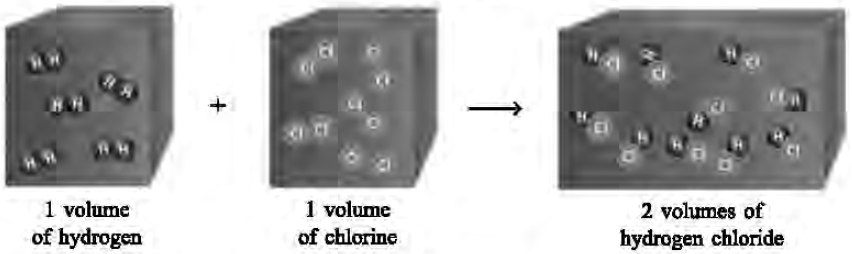
(i) Look at the given figure and identify the law applicable here. State the law.
Image
(ii) 120 cm3 of hydrogen gas is mixed with 120 cm3 of oxygen gas and then exploded. Calculate the composi- tion of the resulting mixture on cooling.
View full solution
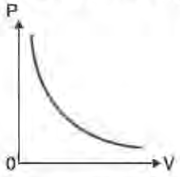
(i) Identify which law is applicable in the given below graph. State the law.
Image
(ii) One mole of hydrocarbon is subjected to combustion. The product obtained is condensed and the resulting gaseous product occupied a volume of 89.6 $l$ at STP. Oxygen required for this combustion is 145.6 $l$ at STP. What should be the molecular formula of X?
View full solution
A chemical reaction involving the formation of ammonia (NH3) from nitrogen gas (N2) and hydrogen gas (H2) is conducted in a sealed container at constant temperature and pressure. Initially, the container holds 1.00 mole of nitrogen gas and 3.00 moles of hydrogen gas.
(i) According to Avogadro's law, what can be said about the volumes of the reactant gases and the product gas in the container?
(ii) If the reaction goes to completion, what will be the number of moles of ammonia produced?
(iii) Calculate the volume of the ammonia gas produced at the same temperature and pressure.
(iv) Explain the application of Avogadro's law in this scenario.
(v) Discuss the practical implications of Avogadro's law in chemical reactions
View full solution
Column AColumn B
(a)Molar Mass1.6.022 × 1023 particles/mol
(b)Avogadro's Number2.Simplest whole-number ratio of elements in a compound
(c )Empirical Formula3.The maximum amount of product that can be formed from the given reactants
(d)Molecular Formula4.The mass of one mole of a substance
5.The actual formula of a molecule showing the number of atoms of each element
View full solution

Generate a Mole Concept and Stoichiometry paper free

Pick question groups from the list above, set marks and difficulty, and export a branded PDF with step-by-step answer keys. First 3 chapters free — no signup.

Download App