Questions

[3 Mark Question Answer]

🎯

Test yourself on this topic

15 questions · timed · auto-graded

Question 13 Marks
Discuss the significance of Avogadro's number in understanding the scale of chemical reactions.
Answer
(i) Avogadro's number is crucial in understanding the scale of chemical reactions because it allows us to relate the macroscopic world (grams, liters) to the microscopic world (atoms, molecules).
(ii) It helps us understand that equal volumes of gases at the same temperature and pressure contain the same number of molecules, irrespective of the type of gas.
(iii) This concept is fundamental in stoichiometry, where we use mole ratios to predict the amounts of reactants and products in chemical reactions.
(iv) Avogadro's number allows chemists to bridge the gap between macroscopic observations and the behavior of individual atoms and molecules, facilitating precise calculations and predictions in chemistry.
View full question & answer
Question 23 Marks
A chemist has a 1.00 gram sample of water (H2O).
(i) Determine the number of moles of water in the sample.
(ii) Calculate the number of water molecules in the sample.
(iii) Discuss the significance of Avogadro's number in understanding the scale of chemical reactions.
Answer
(i) The molar mass of water (H2O) = 18 g/mol
Number of moles $=\frac{\text { Given mass }}{\text { Molecular Mass }}=\frac{1}{18}=0.055 mol$
(ii) Number of molecules = Number of moles $\times$ NA
(iii) Number of molecules = 0.0555 mol $\times$ 6.022 $\times$ 1023 molecules
(iv) Number of molecules = 3.34 $\times$ 1022 molecules
View full question & answer
Question 33 Marks
A steel tank contains 5.0 moles of nitrogen gas (N2) at a temperature of 300 K. The tank is heated until the temperature reaches 500 K. (P1 = 1 atm)
(i) Calculate the final pressure of the nitrogen gas in the tank.
(ii) Determine the change in pressure when the temperature is increased.
(iii) Discuss the application of Gay Lussac's Law in this scenario.
Answer
(i) As $\frac{P_1}{T_1}=\frac{P_2}{T_2} \Rightarrow \frac{1 atm}{300}=\frac{P_2}{500}$
$\therefore$ P2 = 1.67 atm
(ii) The change in pressure $(\Delta P )$ can be calculated as the difference between the final pressure and the initial pressure:
$(\Delta P )$ = P2 - P1
$(\Delta P )$ = 1.67 atm-1 atm $\Rightarrow$ $(\Delta P )$ = 0.67 atm
(iii) In this scenario, Gay Lussac's Law is applied to relate the pressure and temperature of a gas when the volume and amount of gas remain constant. As the temperature increases, the pressure of the gas also increases proportionally. This relationship helps in understanding how changes in temperature affect the pressure of a gas in a closed system.
View full question & answer
Question 43 Marks
From the equation,
CaCO3 + 2HCl → CaCl2 + H2O + CO2
Calculate: (i) the weight of calcium chloride obtained from 10 g of calcium carbonate (ii) the volume at STP of carbon dioxide obtained from 10 g of calcium carbonate.
(Ca = 40; C = 12; O = 16; H = 1; Cl = 35.5 and 1 mole of a gas at STP occupies 22.4 litres)
View full question & answer
Question 53 Marks
From the equation :
3Cu + 8HNO3 → 3Cu(NO3)2 + 4H2O + 2NO [Take Cu = 64; H = 1; N = 14; O = 16]
Calculate : (i) the mass of copper needed to react with 63 g of nitric acid, (ii) the volume of nitric oxide at STP that can be collected. (1 gram-molecular volume of gas at STP = 22.4 litres)
View full question & answer
Question 63 Marks
(a) State Avogadro's law.
(b) The mass of 5.6 litres of certain gas is 12 g. What is the relative molecular mass?
Answer
(a) Equal volumes of all gases, under similar conditions of temperature and pressure, contain equal number of molecules.
(b) 5.6 lt of gas at STP weighs = 12 g
$\therefore$ 22.4 I of gas at STP weighs $=\frac{12 \times 22.4}{5.6}=48 g$.
$\therefore$ Relative g-molecular mass of gas = 48 g
$\therefore$ Relative molecular mass of gas = 48 amu.
View full question & answer
Question 73 Marks
(a) Explain what is meant by "molar volume of a gas."
(b) Calculate the number of moles of nitrogen in 7 grams of nitrogen.
Answer
(a) The volume occupied by 1 mole (1 gram-molecule) of a gas at STP is called molar volume of the gas. Its experimental value is 22.4 dm3 at STP.
(b) 1 g-molecule of nitrogen = 2 $\times$ 14 = 28 g.
Now, 28 g of nitrogen = 1 mole
$\therefore 7 g$ of nitrogen $=\frac{7}{28}$ moles $=0.25$ moles.
View full question & answer
Question 83 Marks
A compound X consists of 4.8% carbon and 95.2% bromine by mass
(i) Determine the empirical formula of this compound working correct to one decimal place (C = 12, Br = 80).
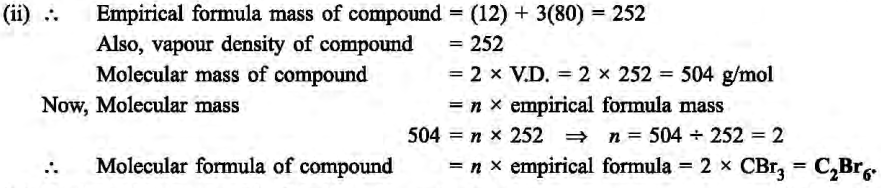
(ii) If the vapour density of the compound is 252, what is the molecular formula of the compound?
Answer
(i)
ElementPercentage compositionAt. massRelative no. of molesSimple ratio of atoms
C4.8%124.8 $\div$ 12 = 0.40.4 $\div$ 0.4 = 1
Br95.2%8095.2 $\div$ 80 = 1.201.20 $\div$ 0.4 = 3
$\therefore$ Empirical formula is CBr3

Image
View full question & answer
Question 93 Marks
Calculate the empirical formula of a compound having the following percentage composition.
[Na = 42.1%, P = 18.9% and oxygen = 39%]
[Na = 23, P = 31 and O = 16].
Answer
ElementPercentage weightAtomic weightRelative Number of molesSimple ratio of atoms
Na42.12342.1 $\div$ 23 = 1.831.83 $\div$ 0.61 = 3
P18.93118.9 $\div$ 31 = 0.610.61 $\div$ 0.61 = 1
O391639 $\div$ 16 = 2.442.44 $\div$ 0.61 = 4
$\therefore$ Empirical formula of the compound $= Na _3 PO _4$.
View full question & answer
Question 103 Marks
(i) What do you understand by the term empirical formula?
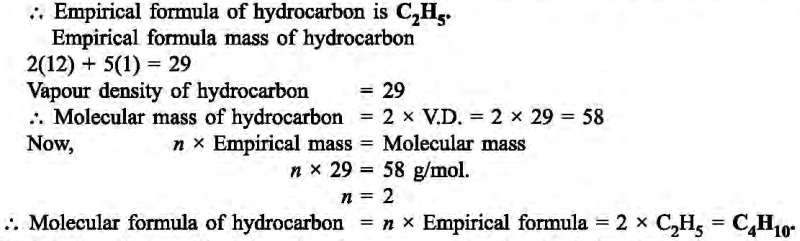
(ii) A gaseous hydrocarbon of vapour density 29, contains 82.76% of carbon. Calculate its empirical formula and molecular formula. [C = 12, H = 1]
Answer
(i) Empirical Formula : It is the formula of a compound which shows the simplest whole number ratio between the atoms of various elements in a compound.
(ii) %age of carbon = 82.76%.
$\therefore \%$ age of hydrogen $=(100-82.76)=17.24 \%$
Element% age weightAtomic weightRelative Number of molesSimple ratio of atoms
C82.761282.76 $\div$ 12 = 6.896.89 $\div$ 6.89 = 1 or 2
H17.24117.24 $\div$ 1 = 17.2417.24 $\div$ 6.89 = 2.5 ог 5
Image
View full question & answer
Question 113 Marks
A compound has the following percentage composition by mass :
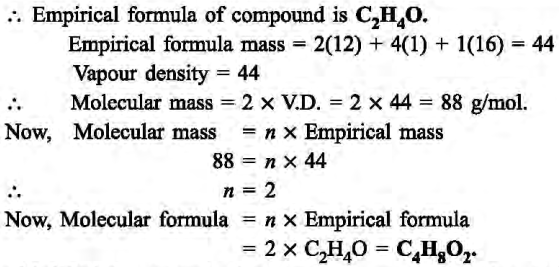
Carbon = 54.55%, Hydrogen = 9.09% and Oxygen = 36.26%. Its vapour density is 44. Find the empirical and molecular formula of the compound. (H = 1; C = 12; O = 16)
View full question & answer
Question 123 Marks
An organic compound with vapour density = 94 contains C = 12.67%, H = 2.13%, and Br = 85.11%. Find the molecular formula.
(Atomic mass : C = 12, H = 1, Br = 80}
Answer
Element% ageAtomic weightRelative Number of molesSimple ratio of atoms
C12.671212.67 $\div$ 12 = 1.051.05 $\div$ 1.05 = 1
H2.1312.13 $\div$ 1 = 2.132.13 $\div$ 1.05 = 2
Br85.118085.11 $\div$ 80 = 1.061.06 $\div$ 1.05 = 1
$\therefore$ Empirical formula $= CH _2 Br$
$\therefore$ Empirical formula mass $=1(12)+2(1)+1(80)=94$
Vapour density = 94
$\therefore$ Molecular weight $=2 \times VD =2 \times 94=188 / g / mol$.
Now, Molecular weight $=n \times$ empirical weight $\Rightarrow 188=n \times 94 \quad \therefore n=2$
now, molecular formula = n $\times$ empirical formula = 2 $\times$ (CH2Br) = C2H4Br2
View full question & answer
Question 133 Marks
A gaseous hydrocarbon contains 82.76% of carbon. Given that its vapour density is 29, find its molecular formula. [C = 12, H = 1]
Answer
ElementPercentage At. WeightAtomic weightRelative number of molesSimple ratio of atoms
C82.71282.7 $\div$ 12 = 6.96.9 $\div$ 6.9 = 1 or 2
H17.3117.3 $\div$ 1 = 17.317.3 $\div$ 6.9 = 2.5 or, 5
$\therefore$ Empirical formula of compound $= C _2 H _5$.
Empirical formula mass of compound = 2 $\times$ 12+ 5 $\times$ 1 = 29
Vapour of density of compound = 29
$\therefore$ Molecular weight of compound $=2 \times$ V.D. $=2 \times 29=58 g / mol$.
Now, Molecular weight = n $\times$ empirical weight
$\begin{aligned} 58 & =n \times 29 \\ n & =2\end{aligned}$
$\therefore$ Molecular formula of compound $=n \times$ Empirical formula $=2 \times C _2 H _5=$ C4H10
View full question & answer
Question 143 Marks
The percentage composition of a gas is : Nitrogen 82.35%, Hydrogen 17.64%.
Find the empirical formula of the gas. [N = 14, H = 1]
Answer
ElementPercentage weightAtomic weightRelative number of molesSimple ratio of atoms
Nitrogen82.351482.35 $\div$ 14 = 5.885.88 $\div$ 5.88 = 1
Hydrogen17.64117.64 $\div$ 1 = 17.6417.64 $\div$ 5.88 = 3
$\therefore$  Empirical formula of compound = NH3.
View full question & answer
Question 153 Marks
A compound gave a following data:
C = 57.82%, O = 38.58% and the rest hydrogen. Its relative molecular mass is 166.
Find its empirical formula and molecular formula.
[C = I2, O = 16, H = 1]
Answer
ElementPercentage weightAtomic weightRelative number of molesSimple ratio of atoms
C57.821257.82 $\div$ 12 = 4.824.82 $\div$ 2.41 = 2 or, 2 $\times$ 2 = 4
O38.581638.58 $\div$ 16 = 2.412.41 $\div$ 2.41 = 1 or, 2 $\times$ 1 = 2
H100 - (57.82+ 38.58) = 100 - 96.40 = 3.6013.6 $\div$ 1 = 3.603.60 $\div$ 2.41 $\approx$ 1.5 or, 2 $\times$ 1.5 = 3
Thus, empirical formula of compound = C4H3O2
So, empirical formula mass of C₂H3O2 = 4 $\times$ 12 + 3 $\times$ 1 + 2 $\times$ 16 = 48 + 3 + 32 = 83
Now, $n=\frac{\text { Molecular mass }}{\text { Empirical formula mass }}=\frac{166}{83}=2$
Thus, Molecular formula = 2 $\times$ Empirical formula = 2 (C4H3O2) = C8H6O4
View full question & answer
[3 Mark Question Answer] - Chemistry STD 10 Questions - Vidyadip