Questions

[5 Mark Question Answer]

🎯

Test yourself on this topic

3 questions · timed · auto-graded

Question 15 Marks
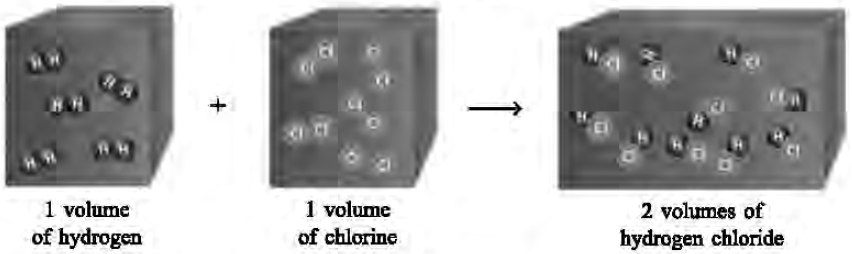
(i) Look at the given figure and identify the law applicable here. State the law.
Image
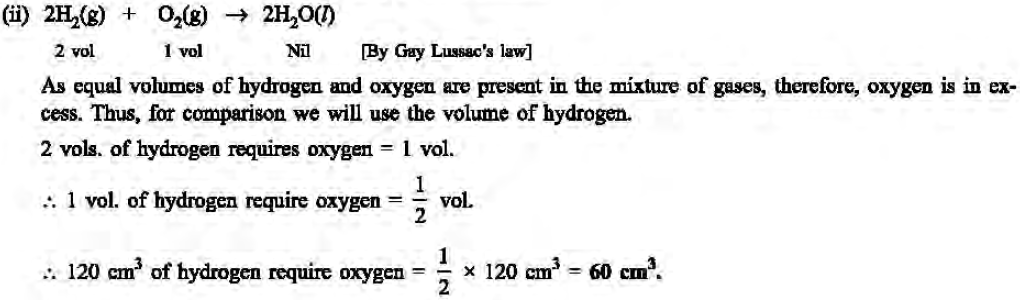
(ii) 120 cm3 of hydrogen gas is mixed with 120 cm3 of oxygen gas and then exploded. Calculate the composi- tion of the resulting mixture on cooling.
Answer
(i) Gay Lussac's law of combining volumes: When gases react together to form other gases, all volumes are measured at the same temperature and pressure: The ratio between the volumes of the reactant gases and the products can be expressed in simple whole numbers.
Image
View full question & answer
Question 25 Marks
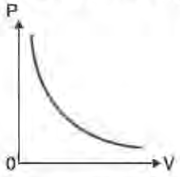
(i) Identify which law is applicable in the given below graph. State the law.
Image
(ii) One mole of hydrocarbon is subjected to combustion. The product obtained is condensed and the resulting gaseous product occupied a volume of 89.6 $l$ at STP. Oxygen required for this combustion is 145.6 $l$ at STP. What should be the molecular formula of X?
Answer
(i) Boyle's law : It states that the pressure P and volume V of a given mass of confined gas are inversely pro-portional, provided the temperature remains unchanged with the closed system.
(ii) Equation for the combustion of hydrocarbon is $C _x H _y+\left(x+\frac{y}{4}\right) O _2 \rightarrow x CO _2+\frac{y}{2} H _2 O$.
The gaseous product left after condensation of water vapour is CO2.
As Number of moles $=\frac{\text { Given volume }}{22.4 l \text { at STP }}$
$\therefore$ 89.6 $l$ CO2 contains $=\frac{89.6}{22.4}=4$ moles; i.e., $x=4$
22.4 $l$ of volume at STP is occupied by = 1 mole of O2.
145.6 $l$ of O2 corresponds to $=\frac{145.6 \times 1}{22.4}$ = 6.5 moles of O2
$\therefore x+\frac{y}{4}=6.5 ; 4+\frac{y}{4}=6.5 \Rightarrow y=10 \therefore$ Hydrocarbon is C4H10.
View full question & answer
Question 35 Marks
A chemical reaction involving the formation of ammonia (NH3) from nitrogen gas (N2) and hydrogen gas (H2) is conducted in a sealed container at constant temperature and pressure. Initially, the container holds 1.00 mole of nitrogen gas and 3.00 moles of hydrogen gas.
(i) According to Avogadro's law, what can be said about the volumes of the reactant gases and the product gas in the container?
(ii) If the reaction goes to completion, what will be the number of moles of ammonia produced?
(iii) Calculate the volume of the ammonia gas produced at the same temperature and pressure.
(iv) Explain the application of Avogadro's law in this scenario.
(v) Discuss the practical implications of Avogadro's law in chemical reactions
Answer
(i) According to Avogadro's law, at constant temperature and pressure, equal volumes of gases contain equal numbers of moles. Therefore, the volumes of the reactant gases (N2 and H2) and the product gas (NH3) will be in a simple ratio of their coefficients in the balanced chemical equation.
(ii) The balanced chemical equation for the formation of ammonia from nitrogen and hydrogen is:
N2 + 3H2 → 2NH3
Since the stoichiometric coefficient of NH3 is 2, for every one mole of N2 reacted, two moles of NH3 are produced. So, if the reaction goes to completion, 1.00 mole of N2 will produce 2.00 moles of NH3.
(iii) To calculate the volume of ammonia gas produced, we use Avogadro's law, which states that equal volumes of gases at the same temperature and pressure contain equal numbers of moles. Given that 1 mole of N2 produces 2 moles of NH3, and the initial volume of the reactant gases is not specified, we cannot directly calculate the volume of NH3 produced without additional information.
(iv) Avogadro's law is applied in this scenario to determine the relationship between the volumes of gases involved in the reaction and the number of moles of each gas present. It helps us understand how the volume of gases changes with the number of moles of gas molecules present, given constant temperature and pressure.
(v) Avogadro's law has several practical implications in chemical reactions. It allows chemists to predict the volumes of reactant gases required for a reaction, the volumes of product gases produced, and to scale up reactions from laboratory to industrial scales. Additionally, it provides a basis for stoichiometric calculations, enabling precise control over reaction conditions and product yields.
View full question & answer
[5 Mark Question Answer] - Chemistry STD 10 Questions - Vidyadip