Question types

Organic Chemistry question types

103 questions across 8 question groups — pick any mix to generate a Chemistry paper with step-by-step answer keys.

103
Questions
8
Question groups
5
Question types
Sample Questions

Organic Chemistry questions

One sample from each question group in this chapter. Select any group above to see the full set with answer keys.

Q 1MCQ1 Mark
Assertion (A):Drinking of methanol can cause blindness but ethanol does not.
Reason (R): They both are alcohols.
  • A
    Both A and R are true and R is the correct explanation of A
  • Both A and R are true but R is not the correct explanation of A
  • C
    A is true but R is false
  • D
    A is false but R is true

Answer: B.

View full solution
Q 2MCQ1 Mark
Assertion (A): Ethane undergoes addition reaction.
Reason (R): Ethane is a saturated compound.
  • A
    Both A and R are true and R is the correct explanation of A
  • B
    Both A and R are true but R is not the correct explanation of A
  • C
    A is true but R is false
  • A is false but R is true

Answer: D.

View full solution
Q 3MCQ1 Mark
Assertion (A): Carbon possesses property of catenation.
Reason (R): Carbon atoms form double as well as triple bonds only during catenation.
  • A
    Both A and R are true and R is the correct explanation of A
  • B
    Both A and R are true but R is not the correct explanation of A
  • A is true but R is false
  • D
    A is false but R is true

Answer: C.

View full solution
Q 4MCQ1 Mark
A hydrocarbon has condensed formula :
Image
The IUPAC name of hydrocarbon is:
  • A
    pentane
  • B
    pentene
  • pentyne
  • D
    none of these

Answer: C.

View full solution
Q 5MCQ1 Mark
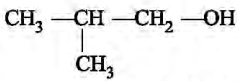
An organic compound has condensed formula
Image
The IUPAC name of the compound is:rocarbon is:
  • A
    butanol
  • B
    2-methyl propanol
  • C
    2-methyl propan-1-ol
  • both (b) and (C )

Answer: D.

View full solution
Complete the following table which relates to the homologous series of hydrocarbons.
General formulaIUPAC name of the homologous seriesCharacteristic bond typeIUPAC name of the first member of the series
CnH2n-2(A) ________(B) ________(C) ________
CnH2n+2(D) ________(E) ________(F) ________
View full solution
A list of some organic compounds is given below :
List: ethene, ethyne, methanol and methane.
From the list above, name a compound :
(i) Which has a vapour density 14 and turns alkaline potassium permanganate solution colourless?
(ii) Which forms methanoic acid on oxidation in the presence of copper at 200°C?
(iii) Which forms chloroform on halogenation in the presence of sunlight?
View full solution
(a) Which compound should be heated with soda lime to obtain ethane gas in the laboratory? Write an equation for the reaction.
(b) Write a balanced equation for the complete combustion of ethane.
(c) Name a solid which can be used instead of sulphuric acid to prepare ethylene by the dehydration of ethanol.
View full solution
Explain the following:
(i) When bromine vapours are passed into ethyne solution in carbon tetrachloride.
(ii) When a gaseous product obtained by the dehydration of alcohol is passed through bromine water.
(iii) Addition of ethyl alcohol to acetic acid in the presence of concentrated sulphuric acid.
(iv) A piece of sodium metal is put into ethanol at room temperature.
View full solution
(a) Give the IUPAC name of the following organic compounds :
Image
(b) What is the special feature of the structure of ethyne?
(c) Give the structural formula of Acetic acid.
View full solution
Write balanced chemical equations for the following:
(i) Monochloro ethane is hydrolysed with aqueous KOH.
(ii) A mixture of sodalime and sodium acetate is heated.
(iii) Ethanol under high pressure and low temperature is treated with acidified potassium dichromate.
(iv) Ethanol reacts with sodium at room temperature.
View full solution
Shown below are the structural formulae of four carbon compounds.
Image
(i) Two of these compounds are more likely to have similar chemical properties. Identify these two compounds. Give a reason for your answer.
(ii) Identify which of these compounds are likely to have the same boiling point. Justify your answer.
View full solution
Name the organic compound prepared by each of the following reactions :
(i) $CH _3 COONa + NaOH \xrightarrow[\Delta]{ CuO }$, (ii) CaC2 + H2O →
(iii) C2H5Br + KOH (alc) →, (iv) C2H5Br + KOH (aq) →
View full solution
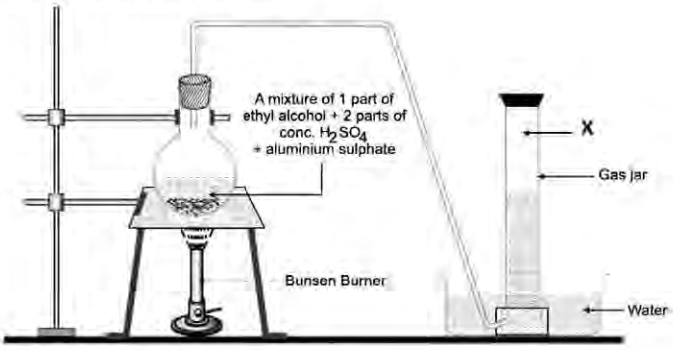
Look at the set-up of given apparatus carefully.
Image
(i) Identify 'X'.
(ii) Name the process of collection of 'X'. Justify.
(iii) Write the chemical equations involved.
(iv) What is the role of sulphuric acid in the above process?
View full solution
The table given below shows the hints about various compounds.
S.No.Hints
(i)Substance 'C' is used as a preservative
(ii)C' has two carbon atoms 'C' is obtained by the reaction of 'A' in presence of alkaline potassium permanganate followed by acidification.
(iii)Misuse of 'A' in industries is prevented by adding methanol, benzene, and pyridine to 'A'.
(iv)'F' is formed on heating 'A' in presence of conc. sulphuric acid.
(v)'F' reacts with hydrogen gas in presence of nickel and palladium catalyst.
Based on the above hints answer the following questions:
(a) Give the IUPAC names of A and F.
(b) Illustrate with the help of chemical equations the changes taking place. (A → C and A → F)
View full solution
Column AColumn B
(a) Catalyst used for conversion of ethene to ethane1. Ethyne
(b) Process of formation of ester2. Nickel
(c) Step down reaction3. Ethanoic acid
(d) Forms red precipitate with ammoniacal cuprous chloride4. Decarboxylation
5. Esterification
View full solution
Column AColumn B
(a) Process by which ethane is obtained from ethene.1. Addition
(b) A hydrocarbon which contributes towards the greenhouse effect.2. Hydrolysis
(c) An organic compound whose functional group is carboxyl.3. Acetic acid
(d) The property of elements by virtue of which atoms of the element can link to each other in the form of a long chain or ring structure.4. Catenation
5. Methane
View full solution

Generate a Organic Chemistry paper free

Pick question groups from the list above, set marks and difficulty, and export a branded PDF with step-by-step answer keys. First 3 chapters free — no signup.

Download App