Question
The table given below shows the hints about various compounds.
S.No.Hints
(i)Substance 'C' is used as a preservative
(ii)C' has two carbon atoms 'C' is obtained by the reaction of 'A' in presence of alkaline potassium permanganate followed by acidification.
(iii)Misuse of 'A' in industries is prevented by adding methanol, benzene, and pyridine to 'A'.
(iv)'F' is formed on heating 'A' in presence of conc. sulphuric acid.
(v)'F' reacts with hydrogen gas in presence of nickel and palladium catalyst.
Based on the above hints answer the following questions:
(a) Give the IUPAC names of A and F.
(b) Illustrate with the help of chemical equations the changes taking place. (A → C and A → F)
Answer

(a) 'A' CH3CH2OH (Ethanol), 'F' = Ethene (C2H4)
(b) (i) $\underset{(A)}{ CH _3- CH _2- OH } \underset{\text { Alkaline } KMnO _4}{[ O ]} CH _3 COO ^{-} K ^{+} \xrightarrow{ H ^{+}} \underset{\text { (C) }}{ CH _3 COOH }$
(ii) $CH _3-\underset{\text { (A) }}{ CH _2- OH } \xrightarrow[443 K]{\text { Conc. } H _2 SO _4} \underset{\text { (F) }}{ CH _2}= CH _2$

Need a full question paper?

Generate a complete, print-ready paper with questions like this in minutes — across 16+ boards, with answer keys.

Start Generating Free

Similar questions

You are given three white powders-calcium carbonate, lead carbonate and zinc carbonate. Describe the tests you would carry out in solution, to identify the metal ion in each of the above compounds. Indicate clearly how you would prepare the solutions for the tests.
(a) Copy and complete the following table which refers to two practical applications of electrolysis
  Anode Electrolyte Cathode
Silver plating of a spoon   A solution of potassium argentocyanide  
Purification of copper      
(iii) Extraction of sodium      
(b) Write the equation taking place at the anode for Q. 2(a).
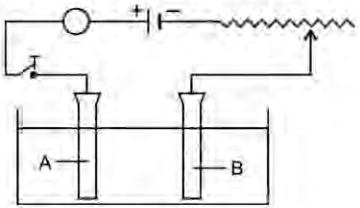
(a) Study the diagram given below and answer the questions that follow:
Image
(i) Give the names of the electrodes A and B.
(ii) Which electrode is the oxidizing electrode?
(b) A strip of copper is placed in four different colourless salt solutions. They are KNO3, AgNO3, Zn(NO3)2 Ca(NO3)2. which one of the solution will finally turn blue?
(c) Write the equation of the reactions which take place at the cathode and anode when acidified water is electrolysed.
Copy and complete the following table which relates to three homologus series of hydrocarbons:
General formula $C_nH_{2n}$ $C_nH_{2n-2}$ $C_nH_{2n+2}$​​​​​​​
IUPAC name of the homologus series      
Characteristic bond type     Single bond
IUPAC name of the first member of the series      
Type of reaction with chlorine   Addition  
Compare the process of calcination and roasting.
A gaseous hydrocarbon contains $82.76\%$ of carbon. Given that its vapour density is $29,$ find its molecular formula.
$[C = 12, H = 1]$
Draw the structures of isomer of : pentane. Write the IUPAC and common names of these isomer
Draw the structure of ammonia and give the reason for alkaline nature of aqueous ammonia.
Why is ammonium hydroxide used in qualitative analysis? Give two equations to justify your answer.
(a) Give only one suitable chemical test to identify the following gases.
(i)Ammonia
(ii) Sulphur dioxide
(iii)Hydrogen Chloride
(iv)Chlorine
(v)Carbon Dioxide
(vi)Oxygen
(vii)Hydrogen
(b) Select a basic gas mentioned in Q. 1 (a). How is the basic nature suspected?
(c) Select acidic gases from the gases mentioned in Q .1 (a). How is the acidic nature suspected?
(d) The two gases $A$ and $B$ are bleaching agents. $A$ is greenish-yellow and bleaches due to its oxidizing property while $B$ is a colourless gas that bleaches due to reduction. Identify $A$ and $B$ ?
(e) Which gas turn blue cobalt chloride paper light pink?
Give one similarity in the test between (i) $Cl _2$ and HCl (ii) $SO _2$ and $CO _2$.