Questions

[5 Mark Question Answer]

🎯

Test yourself on this topic

10 questions · timed · auto-graded

Question 15 Marks
A compound X when treated with an organic acid Y (having vinegar-like smell) in the presence of the acid Z, forms a compound P which has a fruity smell.
(a) Identify X, Y, and Z
(b) Write the structural formula of X and Y.
(c) What type of compound P is?
(d)Name the above reaction.
(e) If compound X and Y both have 2 carbon atoms. Write the reaction.
View full question & answer
Question 25 Marks
Name the alkyl radical and the functional group of the following organic compounds:
(a) $CH_3OH$
(b) $C_2H_5OH$
(c) $C_3H_7CHO$
(d) $C_4H_9COOH$
(e) $CH_3COOH$
(f) $HCHO$
Answer
The alkyl radical and the functional group are:
Sr.No Formula Name of the alkyl radical Name of Functional group
$a$ $CH_3OH$ Methyl Alcohol
$b$ $C_2H_5OH$ Ethyl Alcohol
$c$ $C_3H_7CHO$ Propyl Aldehyde
$d$ $C_4H_9COOH$ Butyl Carboxyl
$e$ $CH_3COOH$ $CH_3$ $COOH$
$f$ $HCHO$ $H$ $CHO$
View full question & answer
Question 35 Marks
Give the trivial (common) names and IUPAC names of the following:
(a) $C_3H_6$
(b) $C_2H_4$
(c) $C_2H_2$
(d) $CH_3OH$
(e) $C_2H_5OH$
Answer
S. No. Formula Common Name IUPAC
$1$ $C_3H_6$ Propylene Propene
$2$ $C_2H_4$ Ethylene Ethene
$3$ $C_2H_2$ Acetylene Ethyne
$4$ $CH_3OH$ Methyl alcohol Methanol
$5$ $C_2H_5OH$ Ethyl alcohol Ethanol
View full question & answer
Question 45 Marks
Give a chemical test to distinguish between Saturated and Unsaturated?
Answer
Chemical test to distinguish :
Saturated and Unsaturated
Chemical test:- Bromine water test, if unsaturated hydrocarbons are added to it then the solution turns colourless. The unsaturated hydrocarbon decolourise bromine water. Whereas no change takes place to the solution when saturated hydrocarbons are added to bromine water.
Physical test:- Distinction between saturated and unsaturated hydrocarbons: Saturated hydrocarbons burn in the air with clear (blue) flame, whereas burning of unsaturated hydrocarbons (alkenes and alkynes) gives sooty (yellowish) flame. Saturated hydrocarbons contain less percentage of carbon as compared to unsaturated hydrocarbons; therefore, they get completely oxidised by the oxygen present in the air on burning. Unsaturated hydrocarbons require a lot of oxygen for complete oxidation whose demand is not fulfilled by air. Due to this reason, unsaturated hydrocarbons burn with a sooty flame. The sooty flame contains partially burnt carbon in the form of soot.
View full question & answer
Question 55 Marks
Write the
(a) Molecular formula
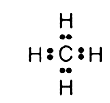
(b) Electron dot formula and
(c) The structural formula of methane and ethane
Answer
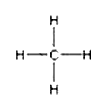
For methane:
(a) The molecular formula is $CH_4$
(b) Electron dot formula

(c) Structural formula

For ethane:
(a) The molecular formula is :- $C_2H_6$​​​​​​​
(b) Electron dot formula:
View full question & answer
Question 65 Marks
Draw the structures of isomer of : pentane. Write the IUPAC and common names of these isomer
Answer
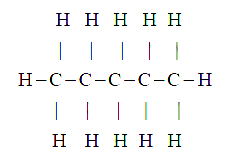
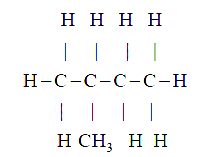
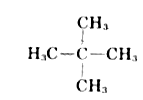
The structures of isomers of Pentane are:
(1)

Common name: n-pentane
IUPAC name:- Pentane
(2)

Common name:- iso pentane
IUPAC name:- 2-methyl butane
(3)

Common name - neo pentane
IUPAC name:- 2,2-dimethyl propane
View full question & answer
Question 75 Marks
Write the names and formula of the products formed when Methane reacts with : (i) Chlorine (ii) bromine. Write the chemical equations.
Answer
(i) When ethane reacts with chlorine it forms hexachoroethane.
$C_2H_6 +Cl_2 \rightarrow C_2H_5Cl + HCl$
Chloroethane
$C_2H_5Cl + Cl_2 \rightarrow C_2H_4Cl_2+HCl$
Dichloroethane
$C_2H_4Cl_2 +Cl_2 \rightarrow C_2H_3Cl_3+HCl$
Trichloroethane
$C_2H_3Cl_3 + Cl_2 \rightarrow C_2H_2Cl_4 + HCl$
Tetrachloroethane
$C_2H_2Cl_4 +Cl_2 \rightarrow C_2HCl_5 +HCl$
Pentachloroethane
$C_2HCl_5 +Cl_2 \rightarrow C_2Cl_6 + HCl$
Hexachloroethane$​​​​​
(ii) When ethane reacts with bromine it forms Hexabromoethane
$C_2H_6 +Br_2 \rightarrow C_2H_5Br + HBr$
Bromoethane
$C_2H_5B_r + Br_2 \rightarrow C_2H_4Br_2+HBr$
Dibromoethane
$C_2H_4Br_2 +Br_2 \rightarrow C_2H_3Br_3+HBr$
Tribromoethane
$C_2H_3Br_3 + Br_2 \rightarrow C_2H_2Br_4 + HBr$
Tetrabromoethane
$C_2H_2Br_4 +Br_2 \rightarrow C_2HBr_5 +HBr$
Pentabromoethane
$C_2HBr_5 +Br_2 \rightarrow C_2Br_6 + HBr$
HexaBromoethane
View full question & answer
Question 85 Marks
Write the names and formula of the products formed when Methane reacts with $: (i)$ Chlorine $(ii)$ bromine. Write the chemical equations.
Answer
$(i)$ When methane reacts with chlorine in the presence of sunlight or $UV$ light, it undergoes substitution reaction to form Tetrachloromethane.
$\ce{CH_4 + Cl_2} \xrightarrow{\text { hv }} \underset{\text { Chloromethane }}{ \ce{CH_3Cl }} + \ce{HCl}$
$\ce{CH_3 Cl + Cl_2} \xrightarrow{\text { hv }} \underset{\text { Dichloromethane }}{ \ce{CH_2Cl_2}} + \ce{HCl}$
$\ce{CH_2 Cl_2+ Cl _2} \xrightarrow{\text { hv }} \underset{\text { Trichloromethane }}{ \ce{CHCl_3}} + \ce{HCl}$
$\ce{CHCl_3 + Cl_2} \xrightarrow{\text { hv }} \underset{\text { Tetrachloromethane }}{ \ce{CCl_4}} + \ce{HCl}$
$(ii)$ When it reacts with bromine it forms Tetrabromomethane
$\ce{CH_4 + Br_2} \rightarrow \ce{CH_3Br + HCl}$
$\ce{CH_3Br + Br _2} \rightarrow \ce{CH_2Br_2 + HCl}$
Dibromomethane
$\ce{CH_2Br _2 + Br_2} \rightarrow \ce{CHBr_3 + HCl}$
Tribromo methane
$\ce{CHBr_3 + Br_2} \rightarrow \ce{CBr_4 + HCl}$
Tetrabromomethane
View full question & answer
Question 95 Marks
Define or explain chain isomerism and position isomerism with examples in each case.
Answer
Chain isomerism
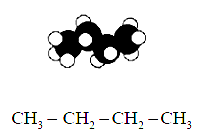
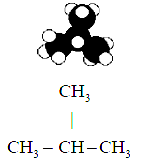
Chain isomerism arises due to the difference in the arrangement of C atoms in the chain. For
example, there are two isomers of butane, C4H10. In one of them, the carbon atoms lie in a
"straight-chain" whereas in the other the chain is branched.

Position isomerism
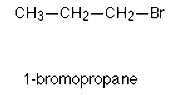
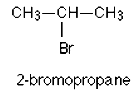
It is due to the difference in the position of functional groups.
For example, there are two structural isomers with the molecular formula C3H7Br. In one of them, the bromine atom is at the end of the chain, whereas in the other it is attached in the middle.

View full question & answer
Question 105 Marks
Copy and complete the following table which relates to three homologus series of hydrocarbons:
General formula $C_nH_{2n}$ $C_nH_{2n-2}$ $C_nH_{2n+2}$​​​​​​​
IUPAC name of the homologus series      
Characteristic bond type     Single bond
IUPAC name of the first member of the series      
Type of reaction with chlorine   Addition  
Answer
The homologous series of hydrocarbons are:
General formula $C_nH_{2n}$ $C_nH_{2n-2}$ $C_nH_{2n+2}$
IUPAC name of the homologus series Alkenes Alkynes Alkanes
Characteristic bond type Double bond Triple bond Single bond
IUPAC name of the first member of the series Ethene Ethyne Methane
Type of reaction with chlorine Addition Addition Substitution
View full question & answer
[5 Mark Question Answer] - Chemistry STD 10 Questions - Vidyadip