Question
Define or explain chain isomerism and position isomerism with examples in each case.
Answer

Chain isomerism
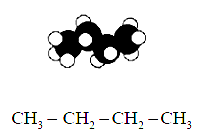
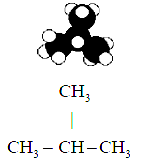
Chain isomerism arises due to the difference in the arrangement of C atoms in the chain. For
example, there are two isomers of butane, C4H10. In one of them, the carbon atoms lie in a
"straight-chain" whereas in the other the chain is branched.

Position isomerism
It is due to the difference in the position of functional groups.
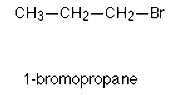
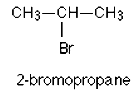
For example, there are two structural isomers with the molecular formula C3H7Br. In one of them, the bromine atom is at the end of the chain, whereas in the other it is attached in the middle.

Need a full question paper?

Generate a complete, print-ready paper with questions like this in minutes — across 16+ boards, with answer keys.
Start Generating Free

Similar questions

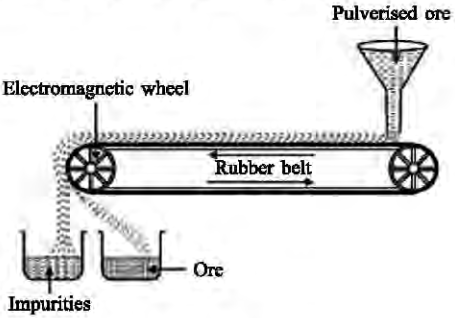
Look at the given picture carefully and answer the related questions:
Image
(i) Which step of metallurgy is performed by this method?
(ii) Give two examples of ores related to this method.
(iii) Write the property of ore and the principle of this process.
(iv) Name two other processes that come under the step of metallurgy in (i).
In order to obtain one tone of aluminium, the following inputs are required:
4 tones of bauxite, $150 Kg $ of sodium hydroxide and $600 \ Kg$ of graphite.
The aluminium compound in bauxite is aluminium oxide and the main impurity is iron (II) oxide. Aluminium is obtained by the electrolysis of aluminium oxide dissolved in cryolite.
(i) Write the formula of cryolite.
(ii) Write down the word which correctly completes the following sentence.
"By dissolving aluminium oxide in cryolite, a ______ (conducting / non- conducting) solution is produced.
(iii) Why so much graphite required for this electrolytic process.
(iv) Write the equation for the reaction which takes place at cathode.
With reference to the electrolysis of acidulated water, answer the following :
a) why distilled water is a non- electrolyte?
b) What is the electrolytic cell called?
c) State what you would observe at the (i) Cathode (ii) Anode
d) Summarize the electrode reactions.
e) why is electrolysis of acidulated water considered as an example of catalysis?
Determine the empirical formula of the compound whose composition by mass is $42\%$ nitrogen$, 48\%$ oxygen and $9\%$ hydrogen.$\ [N=14,O=16,H=1]$
Describe the theory of manufacture of sulphuric acid by contact process, with all the necessary conditions (No technical details are required but equations should be given for each stage of process).
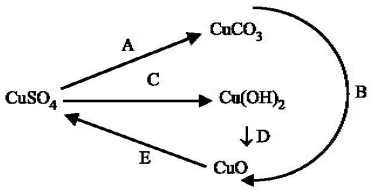
For each of the conversions A, B, C, D and E in the scheme below, state briefly in words, how the conversions can be carried out.
Image
How is ore purified (give equations also)

Complete the following table and write your observations.

Hydrogen sulphide Ammonia Sulphur dioxide Hydrogen chloride
Shake the gas with red litmus solution
Shake the gas with blue litmus solution
Apply a burning splint to a gas
Why is ammonium hydroxide used in qualitative analysis? Give two equations to justify your answer.
The percentage composition of sodium phosphate, as determined by analysis is $: 42.1\% \ Na, 18.9\%\  P, 39\%$ of $O$. Find the empirical formula of the compound.
$[H =1, N =14, Na = 23, P = 31, Cl = 35.5, Pt = 195]$