Question types

Study of Compounds - Hydrogen Chloride question types

110 questions across 7 question groups — pick any mix to generate a Chemistry paper with step-by-step answer keys.

110
Questions
7
Question groups
5
Question types
Sample Questions

Study of Compounds - Hydrogen Chloride questions

One sample from each question group in this chapter. Select any group above to see the full set with answer keys.

Q 1MCQ1 Mark
When sodium chloride is heated with concentrated sulphuric acid below $200^{\circ} C$, one of the products formed is ________ .
  • sodium hydrogen sulphate
  • B
    sodium sulphate
  • C
    Chlorine
  • D
    All of these bove

Answer: A.

View full solution
Q 2MCQ1 Mark
Choose the correct answer from the options given below :
The drying agent used to dry HCl gas is : ________ .
  • Conc. $H _2 SO _4$
  • B
    ZnO
  • C
    $Al _2 O _3$
  • D
    CaO

Answer: A.

View full solution
Q 3MCQ1 Mark
Which of the following scientists first prepared hydrogen chloride by heating common salt with sulphuric acid?
  • A
    Rudolf Glauber
  • B
    Joseph Priestley
  • C
    Humphry Davy
  • D
    Antoine Lavoisier
View full solution
Q 4MCQ1 Mark
Match the following:
 Chemical Processes Results
(i)Synthesis of Hydrogen Chloride(p)Results in a highly acidic solution.
(ii)Polar Nature of HCl(q)Utilises a direct combination of hydrogen and chlorine gases.
(iii)Reaction of HCl with Ammonia(r)Due to the electronegativity difference between hydrogen and chlorine.
(iv)Solubility of HCl in Water(s)Formation of white fumes of ammonium chloride.
  • A
    (i)-(q), (ii)-(r), (iii)-(s), (iv)-(p)
  • B
    (i)-(s), (ii)-(r), (iii)-(p), (iv)-(q)
  • C
    (i)-(s), (ii)-(p), (iii)-(r), (iv)-(q)
  • D
    i)-(p), (ii)-(q), (iii)-(s), (iv)-(r )
View full solution
Q 5MCQ1 Mark
Which reaction mechanism does not involve the production of hydrogen chloride?
  • A
    The Deacon process
  • B
    The Haber process
  • C
    The Raschig process
  • D
    The electrolysis of aqueous sodium chloride
View full solution
Solution $A$ reacts with an acid $B$ (which gives greenish yellow gas on reacting with oxidizing agents like $Pb_3O_4$ )to give white precipitate $C$ insoluble in nitric acid but soluble in ammonium hydroxide. Name $A, B$ and $C.$
View full solution
Explain why A solution of hydrogen chloride in water turns blue litmus red, and conducts electricity, while a solution of the same gas in toluene:
(i) has no effect on litmus, and
(ii) does not conduct electricity.
View full solution
A solution of hydrogen chloride in water is prepared. The following substances are added to separate portions of the solution :
S.NO. Substance added Gas evolved Odour
1 Calcium carbonate _________ _________
2 Magnesium ribbon _________ _________
3 Manganese (IV) oxide with heating _________ _________
4 Sodium sulphide _________ _________
View full solution
Draw a labelled diagram for the laboratory preparation of hydrogen chloride gas and answer the following.
$a.$ Name the acid used. Why is this particular acid preferred to other acids?
$b.$ Give the balanced equation for the reaction.
$c.$ Name the drying agent used in drying hydrogen chloride gas.
$d.$ Phosphorous pentoxide and calcium oxide are good drying agents, but they cannot be used to dry hydrogen chloride gas. Why?
$e.$ Why is the direct absorption of $\text{HCl}$ gas in water not feasible?
$f.$ What arrangement is done to dissolve $\text{HCl}$ gas in the water?
View full solution
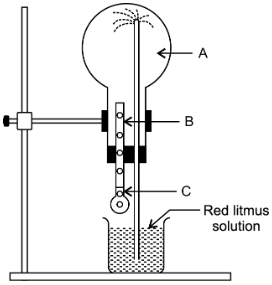
Given below in column A is a schematic diagram Fountain experiment. Identify the parts labelled as A, B and C with the correct options from the column B.
Column AColumn B
Image1. Hydrogen chloride
2. Jet tube
3. Dropper
4. Water
5. Sodium chloride
View full solution
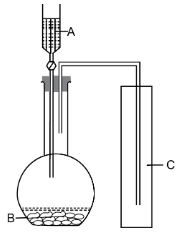
Given below in column A is a schematic diagram of an apparatus for the laboratory preparation of hydrogen chloride. Identify the parts labelled as A, B and C with the correct options from the column B.
Column AColumn B
Image1. Sodium Chloride
2. Calcium carbonate
3. Sulphuric acid
4. Acetic acid
5. Hydrogen chloride
View full solution

Generate a Study of Compounds - Hydrogen Chloride paper free

Pick question groups from the list above, set marks and difficulty, and export a branded PDF with step-by-step answer keys. First 3 chapters free — no signup.

Download App