Questions

[2 Mark Question Answer]

🎯

Test yourself on this topic

26 questions · timed · auto-graded

Question 12 Marks
AB is a diameter of a circle with centre C = (- 2, 5). If A = (3, – 7). Find
(i) the length of radius AC
(ii) the coordinates of B.
Answer
(i) $AC =\operatorname{Sqrt}\left((3+2)^2+(-7-5)^2\right) \quad \ldots($ Distance Formula $)$
$=\sqrt{25+144}$
Radius = $\sqrt{169}$ = 13 units
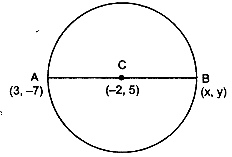
(ii) As 'c' is midpoint of AB
$-2=\frac{3+x}{2}$ ...(midpoint theorem)
or - 4 = 3 + x
x = - 7
and $5=\frac{-7+y}{2}$
and 10 = - 7 + y
and y = 17
∴ B(-7, 17)
View full question & answer
Question 22 Marks
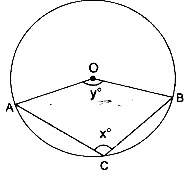
C is a point on the minor arc AB of the circle, with centre O. Given ∠ACB = x° and ∠AOB = y° express y in terms of x. Calculate x, if ACBO is a parallelogram.
Answer
Clearly, major arc AB subtends x° at a point on the remaining part of the circle.
∴ reflex ∠ AOB = 2x°
⇒ 360° - y° = 2x°
⇒ y° = 360° - 2x°


Thus, y = 360° - 2x°
If ACBO is a parallelogram,then
x° = y° i.e., x = y
⇒ x = 360° - 2x
⇒ 3x = 360°
⇒ x = 120°.
View full question & answer
Question 32 Marks
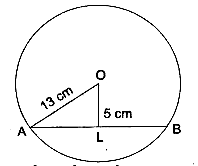
Find the length of a chord which is at a distance of $5 \ cm$ from the centre of a circle of radius $13 \ cm.$
Answer
Let $A B$ be a chord of a circle with centre $O$ and radius 13 cm . Draw $O L \perp A B$.
Join OA. Clearly, OL $=5 cm$ and $O A=13 cm$.
In the right triangle $OLA$, we have
$OA^2 = OL^2+ AL^2$​​​​​​​


$\Rightarrow 13^2= 5^2+ AL^2$
$\Rightarrow AL^2 = 144 cm^2$
$\Rightarrow AL = 12 cm$
Since, the perpendicular from centre to the chord bisects the chord. Therefore,
$AB = 2AL = 2 x 12 cm = 24 cm.$
View full question & answer
Question 42 Marks
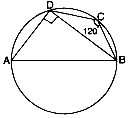
In the adjoining figure, AB is the diameter of the circle with centre O. If ∠BCD = 120°, calculate:
(i) ∠BAD (ii) ∠DBA

Answer
(i) Since AOB is a diameter
∴ ∠ADB = 90° ...( C is a semi-circle)
Also, ABCD is a cyclic quadrilateral.
∴ ∠BCD + ∠BAD = 180°
∠BAD = 180° - 120°
⇒ ∠BAD = 60°

(ii) Now, In Δ BAD,
∠BAD + ∠BDA + ∠DBA = 180°
60° + 90° + ∠DBA = 180°
∠DBA = 180° - 150°
∠DBA = 30°

View full question & answer
Question 52 Marks
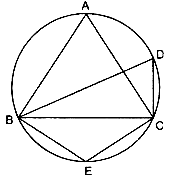
In the figure, ∠ DBC = 58°, BD is diameter of the circle.
Calculate:
(i) ∠ BDC
(ii) ∠ BEC
(iii) ∠ BAC

Answer
∠ DBC = 58°...(Given)
Now, BD is the diameter.
∠ BCD = 90°....(angle in a semicircle)
In Δ BDC,
∠ BDC + 90° + 58° = 180°...( Sum of the angles of a triangle)
∴ ∠ BDC = 180° - (90° + 58°) = 32°
(ii) BECD is a cyclic quadrilateral.
∵ ∠ BEC + ∠ BDC = 180°....(Opposite angles of a cyclic quadrilateral)
∴ ∠ BEC = 180° - ∠ BDC
∴ ∠ BEC = 180° - 32° = 148°
(ii) ∠ BAC = ∠ BDC = 32°...(angles in the same segment of a circle)
View full question & answer
Question 62 Marks
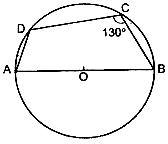
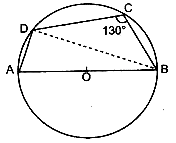
In the given figure, AB is the diameter of a circle with centre O.
BCD = 130°. Find: (i) DAB (ii) DBA

Answer
(i) ∠ DAB + ∠ BCD = 180° ...(Opposite angle of a cyclic quadrilateral)
∠ DAB + 130° = 180°


∠ DAB = 180° - 130°
∠ DAB = 50°(ii) ∠ADB = 90° ...(angle in semicircle)
In Δ ADB,
∠DAB + ∠ADB + ∠DBA = 180° ....(angle sum property)
50° + 90° + ∠DBA = 180°
∠DBA = 180° - 140°
∠DBA = 40°
View full question & answer
Question 72 Marks
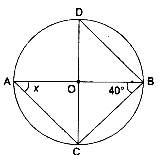
If O is the centre of the circle, find the value of x in each of the following figures

Answer
In $BOC,$
$OB = OC ...$ (radii)
So, $OCB = OBC = 40^\circ$
In $BOC,$
$BOC = 180^\circ - (40^\circ + 40^\circ)$
$BOC = 180^\circ - 80^\circ$
So,
$x=\frac{B O C}{2} $
$ x=\frac{100^{\circ}}{2}=50^{\circ} .$
View full question & answer
Question 82 Marks
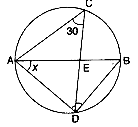
In the given circle with diameter AB, find the value of x.
Answer
∠ ABD = ∠ ACD = 30°...(∠s of same segment)
∠ADB = 90°....(∠ in the semi circle)
In ΔADB,
x° + 90° + 30° = 180°....(Sum of all ∠s of triangle)
x° = 180° - 120°
x° = 60°.
View full question & answer
Question 92 Marks
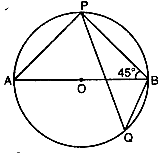
In the given figure, O is the centre of the circle and ∠PBA = 45°. Calculate the value of ∠PQB

.
Answer
Given ∠PBA = 45°
AOB is a diameter of circle.
∠APB = 90°....(Angle in semi-circle)
So, in ΔAPB,
∠PAB = 180° - (90° + 45°) = 45°
∠PAB = ∠PQB...(Angle in same segment)
∴ ∠PQB = 45°.
View full question & answer
Question 102 Marks
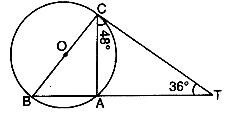
A, B, and C are three points on a circle. The tangent at C meets BN produced at T. Given that ∠ ATC = 36° and ∠ ACT = 48°, calculate the angle subtended by AB at the center of the circle.
Answer
Join BC. Let O be the centre of a circle. Join OA and OB

In Δ BCT, Δ ACT,
∠BTC = ∠ATC = 36°
∠ACT = ∠ABC = 48°∴∠BAC = ∠ACT + ∠ATC
∠BAC = 48° + 36° = 84°∴∠BCA = 180° - (∠ABC +∠BAC )
∠BCA = 180° - (48° + 84°) = 48°∴∠BOA = 2∠BCA
∠BOA = 2 x 48° = 96°
View full question & answer
Question 112 Marks
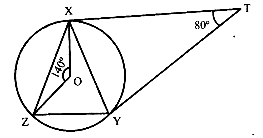
In the alongside, figure, O is the centre of the circumcircle of triangle XYZ. Tangents at X and Y intersect at T. Given ∠XTY = 80° and ∠XOZ = 140°. Calculate the value of ∠ZXY.

Answer
∠ TXY = ∠ TYX = 50°...(since XT = YT)
∠ OXZ = ∠ OZX = 20°...(since OX = OZ)( In ΔXOZ, 140° + ∠ OXZ + ∠OZX = 180°)
⇒ ∠ OXZ = 20°
⇒ ∠ OXY = 40°...(Since ∠OXT = 90°)
⇒ ∠ZXY = ∠ OXZ + ∠ OXY
= 20° + 40° = 60°.
View full question & answer
Question 122 Marks
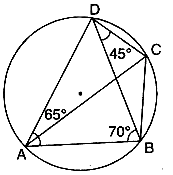
In the given below figure,
∠ BAD = 65°
∠ ABD = 70°
∠ BDC = 45°
Find: (i) ∠ BCD, (ii) ∠ ADB.
Hence show that AC is a diameter.
Answer
Given:
∠ BAD = 65°
∠ ABD = 70°
∠ BDC = 45°
(i) Quadrilateral ABCD is cyclic quadrilateral.
∴ ∠ DAB + ∠ BCD = 180°
∴ 65° + ∠ BCD = 180°
∴ ∠ BCD = 180° - 65°
∴ ∠ BCD = 115°
(ii) In ΔADB,
∴ ∠ DAB + ∠ ABD + ∠ ADB = 180°
∴ 65° + 70° + ∠ ADB = 180°
∴ ∠ ADB = 180° - 135°
∴ ∠ ADB = 45°.
View full question & answer
Question 132 Marks
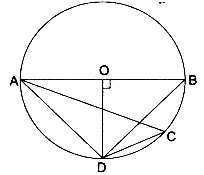
AB is a diameter of a circle with centre O and radius OD is perpendicular to AB. If C is any point on arc DB, find ∠ BAD and ∠ ACD.
Answer
Since, chord BD makes ∠BOD at the centre and ∠BAD at A.
∴ ∠BAD = $=\frac{1}{2} \angle BOD$
$=\frac{1}{2} \times 90^{\circ}$
$=45^{\circ}$

Similarly,
Chord AD makes ∠AOD at the centre and ∠ACD at C.
∴ ∠ACD = $\frac{1}{2} \angle AOD$
$=\frac{1}{2} \times 90^{\circ}=45^{\circ}$
Thus, $\angle B A D=\angle A C D=45^{\circ}$.
View full question & answer
Question 142 Marks
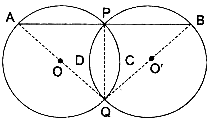
Two equal circles intersect in P and Q. A straight line through P meets the circles in A and B. Prove that QA = QB
Answer
Let C (O, r) and C(O', r) be two equal circles. clearly, C(O, r) ≅ C(O', r).Since PQ is a common chord of two congruent circles.
Therefore,
arc PCQ = arc PDQ
⇒ ∠ QAP = ∠ QBP


Thus, in ΔQAB, we have
∠ QAP = ∠ QBP
⇒ QA = QB
Hence proved.
View full question & answer
Question 152 Marks
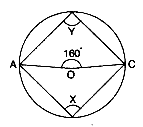
In the given below the figure, O is the centre of the circle and ∠ AOC = 160°. Prove that 3∠y - 2∠x = 140°.
Answer
We know that angle by the same arc at circle i.e., on the circumference is half of the angle by the same arc at the center.
∵ ∠x = $\frac{1}{2}$ x 160° = 80° ....(Opposite triangles of a cyclic quadrilateral supplementary)
∴ ∠x + ∠y = 180°
∴ ∠y = 100°
∴ 3∠y - 2∠x
= 3 x 100° - 2 x 80°
= 300° - 160°
= 140°.
View full question & answer
Question 162 Marks
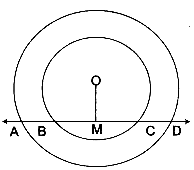
In the given figure, l is a line intersecting the two concentric circles, whose common center is O, at the points A, B, C, and D. Show that AB = CD.
Answer
Let OM be perpendicular from O on line l.
We know that the perpendicular from the centre of a circle to as chord; bisect the chord.
Since BC is a chord of the smaller circle and OM ⊥ BC.
∴ BM = CM....(i)
Again, AD is a chord of the larger circle and OM ⊥ AD.
∴ AM = DM....(ii)
Subtracting (i) from (ii), we get,
AM - BM = DM - CM ⇒ AB = CD
Hence proved.
View full question & answer
Question 172 Marks
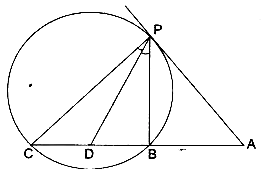
In Fig. AP is a tangent to the circle at P, ABC is secant and PD is the bisector of ∠BPC. Prove that ∠BPD = $\frac{1}{2}$ (∠ABP - ∠APB).
Answer
Since ∠APB and ∠BCP are angles in the alternate segment of chord PB.
∴ ∠APB = ∠BCP ...(i)
Since PD is the bisector of ∠BPC.
∴ ∠CPB = 2 ∠BPD ...(ii)
In ΔPCB, side CB has been produced to A, forming exterior angle ∠ABP.
∴ ∠ABP = ∠BCP + ∠CPB
⇒ ∠ABP = ∠APB + 2 ∠BPD ....(Using (i) and (ii))
⇒ 2 ∠BPD = ∠ABP - ∠APB
⇒ ∠BPD = $\frac{1}{2}$ (∠ABP - ∠APB)
Hence proved.
View full question & answer
Question 182 Marks
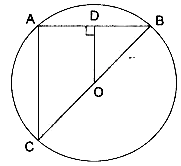
In the given figure, OD is perpendicular to the chord AB of a circle whose center is O. If BC is a diameter, show that CA = 2 OD.
Answer
Since OD ⊥ AB and the perpendicular drawn from the centre to a chord bisects the chord.
∴ D is the midpoint of AB.
Also, O being the center is the midpoint of BC.
Thus, in Δ ABC, D and O are the midpoint of AB and BC respectively.
Therefore, OD || AC
and OD = $\frac{1}{2}$CA ....[ ∵ Segment joining the midpoints of two sides of a triangle is half of the third side ]
⇒ CA = 2OD ...Hence proved.
View full question & answer
Question 192 Marks
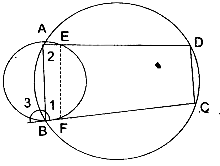
In Fig. ABCD is a cyclic quadrilateral. A circle passing through A and B meets AD and BC in the points E and F respectively. Prove that EF || DC.

Answer
In order to prove that EF || DC. It is sufficient to show that ∠2 = ∠3.
Since ABCD is a cyclic quadrilateral.
∴ ∠1 + ∠3 = 180°...(i)
Similarly, in the cyclic quadrilateral ABFE, we have
∠1 + ∠2 = 180°...(ii)
From (i) and (ii), we get
⇒ ∠1 + ∠3 = ∠1 + ∠2
⇒ ∠3 = ∠2
Hence, EF || DC.
View full question & answer
Question 202 Marks
If two chords of a circle are equally inclined to the diameter through their point of intersection, prove that the chords are equal.
Answer
Let AB and AC be two chords and AOD be a diameter such that
∠ BAO = ∠ CAO
Draw OL ⊥ AB and OM ⊥ AC.
Now prove, Δ OLA = Δ OMA
Then OL = OM ⇒ AB = CD......(Chords which are equidistant from the centre are equal.)
Hence proved.
View full question & answer
Question 212 Marks
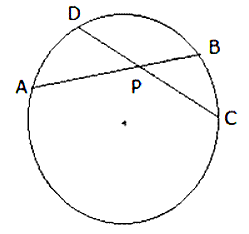
In the given Figure, AB and CD are two chords of a circle, intersecting each other at P such that AP = CP. Show that AB= CD.
Answer

If two chords of a circle interest internally then the products of the lengths of segments are equal, then
AP x BP= CP x DP ... ( 1)
But, AP= CP (Given) ....(2)
Then from ( 1) and (2), we have
BP= DP ......(3)
Adding (2) and (3),
AP + BP= CP + DP
⇒ AB = CD
Hence Proved.
View full question & answer
Question 222 Marks
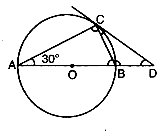
In Figure, AB is diameter and AC is a chord of a circle such that ∠BAC = 30°. The tangent at C intersects AB produced at D. Prove that BC = BD.
Answer
Join OC.
∠ ACB = 90°...(Angle of the semicircle)
∠ ABC = 60°...(Angle Sum property)
∠ CBD = 120°...(adj to angle CBA 30°)
∠ OCD = 90°...(tangent)
∠ COB = 60°...(Angle at the center is equal to twice that of the circumference)
∠ OCB = 60°...(Angle Sum property)
∠BCD = ∠ OCD - ∠OCB = 90° - 60° = 30°
∠BDC = ∠BCD = 30°
BD = BC
Hence proved.
View full question & answer
Question 232 Marks
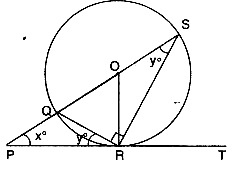
In the given figure, PT touches a circle with centre O at R. Diameter SQ when produced to meet the tangent PT at P. If ∠SPR = x° and ∠QRP = y°; Show that x° + 2y° = 90°

Answer
PRT is tangent at R and QR is a chord.
∠QRP = ∠QSR...(Angle is an alternate segment)
∠QRP = y°
and ∠QSR = 90°...( QS is diameter and angle in a semicircle is right angle)
Now, in Δ PRS,
∠SPR + ∠PRS + ∠RSP = 180°
x° + y° + 90° + y° = 180°
x° + 2y° = 180° - 90°
x° + 2y° = 90°
Hence proved.
View full question & answer
Question 242 Marks
Two circles are drawn with sides AB, AC of a triangle ABC as diameters. They intersect at a point D. Prove that D lies on BC.
Answer
$A B$ and $A C$ are diameters of circles with oentre $O$ and $O^1$ respectively $\angle A D B=90^{\circ}--$ (1) (Angle in a semi circle is a right angle)
Similarly, $\angle \mathrm{ADB}=90^{\circ}--(2)$
Adding (1) and (2)
$\angle \mathrm{ADB}+\angle \mathrm{ADC}=90+90$
$\angle \mathrm{BDC}=180^{\circ}$
Hence, $B D C$ is a straight line.
View full question & answer
Question 252 Marks
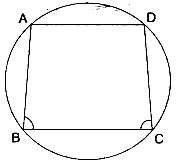
If ABCD is a cyclic quadrilateral in which AD || BC. Prove that ∠B = ∠C.
Answer
ABCD is a cyclic quadrilateral.
So, ∠A + ∠C = 180° ...(i)Since AD || BC
So, ∠B + ∠A = 180° ....(ii)
From (i) and (ii)
∠A + ∠C = ∠B + ∠A
∠C = ∠B
or ∠B = ∠C
Hence proved.
View full question & answer
Question 262 Marks
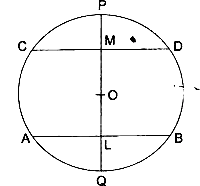
If a diameter of a circle bisects each of the two chords of a circle, prove that the chords are parallel.
Answer
Let O be the centre of a circle and AB, CD be the two chords.
Let PQ be the diameter bisecting chord AB and CD at L and M respectively.


L is the midpoint of AB.
So, OL ⊥ AB ⇒ ∠ ALO = 90°
Similarly,
∠CMO = 90°.
∠ ALO = ∠CMO
But these are alternate angles.
So, AB || CD....Hence Proved.
View full question & answer
[2 Mark Question Answer] - Mathematics STD 10 Questions - Vidyadip