Questions

[2 Mark Question Answer]

🎯

Test yourself on this topic

48 questions · timed · auto-graded

Question 12 Marks
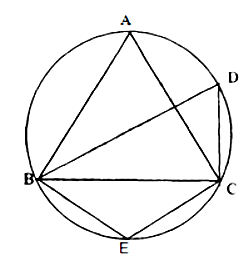
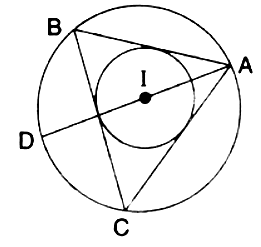
If I is the incentre of triangle ABC and AI when produced meets the cicrumcircle of triangle ABC in points D . if ∠BAC = 66° and ∠ABC = 80°. Calculate : ∠IBC
Answer
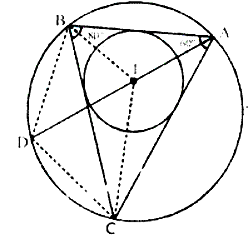
Join DB and DC , IB and IC ,
∠ BAC = 66° , ∠ ABC = 80° , I is the incentre of theΔ ABC,
Since I is the incentre of ∆ABC, IB bisects ∠ABC
$\therefore \angle IBC =\frac{1}{2} \angle ABC =\frac{1}{2} \times 80^{\circ}=40^{\circ}$
View full question & answer
Question 22 Marks
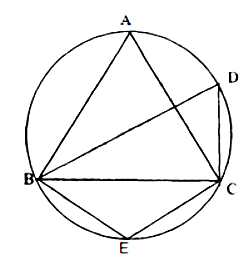
In the figure, ∠DBC = 58°. BD is a diameter of the circle. Calculate : ∠BAC
Answer
In cyclic quadrialteral ABEC,
∠BAC + ∠BEC = 180°
⇒ ∠BAC + 148° = 180°
⇒ ∠BAC = 180° - 148°
⇒ ∠BAC = 32°
View full question & answer
Question 32 Marks
In the figure, ∠DBC = 58°. BD is a diameter of the circle. Calculate : ∠BEC
Answer
We know that the opposite angles of a cyclic quadrilateral are supplementary.
Thus, in cyclic quadrilateral BECD ,
∠ BEC + ∠ BDC = 180°
⇒ ∠ BEC + 32° = 180°
⇒ ∠ BEC = 180° - 32°
⇒ ∠ BEC = 148°
View full question & answer
Question 42 Marks
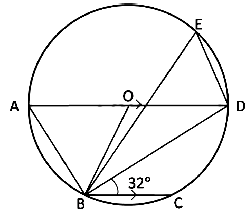
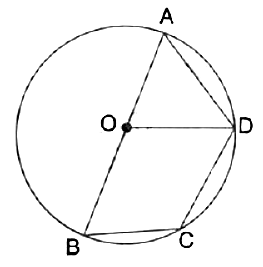
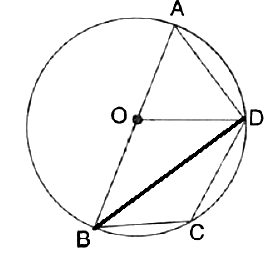
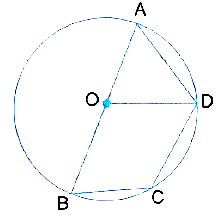
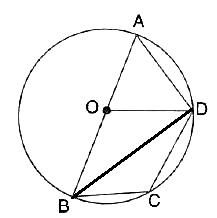
In the figure given below, an AD is a diameter. O is the centre of the circle AD is parallel to BC and$\angle C B D=32^{\circ}$. Find $\angle O B D$
Answer
AD is parallel to BC, i.e., OD is parallel to BC and BD is transversal
$\Rightarrow \angle O D B=\angle C B D=32^{\circ} \ldots$. (Alternate angles)
InΔOBD
OD = OB....(Radii of the same circle)
$\Rightarrow \angle O D B=\angle O B D=32^{\circ}$
View full question & answer
Question 52 Marks
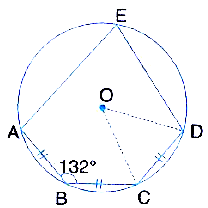
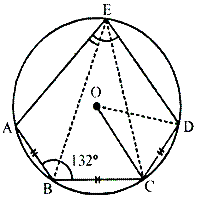
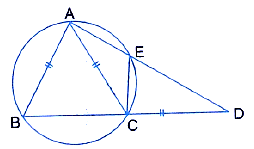
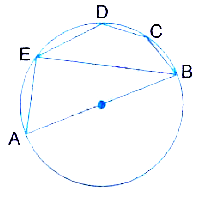
In the given figure, AB = BC = CD and ∠ABC = 132° . Calcualte: ∠AED
Answer

In the figure, O is the centre of circle, with AB = BC = CD.
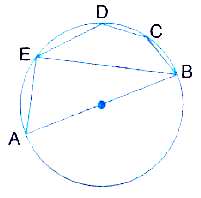
Also, ∠ABC = 132°
Similarly, AB = BC = CD
∠AEB = ∠BEC = ∠CED = 24°
∠AED = ∠AEB + ∠BEC + ∠CED
= 24° + 24° + 24°= 72°
View full question & answer
Question 62 Marks
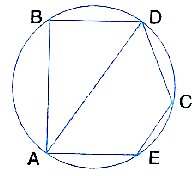
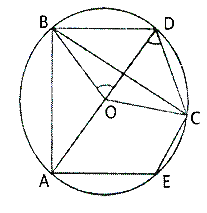
In the given figure, BD is a side of a regular hexagon, DC is a side of a regular pentagon and AD is a diameter. Calculate :

(i) ∠ADC (ii) ∠BDA, (iii) ∠ABC, (iv) ∠AEC.
Answer

Join BC, BO, CO and EO
Since BD is the side of a regular hexagon,
$\angle B O D==\frac{360}{6}=60$
Since DC is the side of a regular pentagon,
$\angle C O D=\frac{360}{5}=72^{\circ}$
In ∆BOD. ∠BOD = 60° and OB = OD
∴ ∠OBD = ∠ODB = 60°
(i) In ∆OCD, ∠COD = 72°and OC = OD
$\therefore \angle ODC =\frac{1}{2}\left(180^{\circ}-72^{\circ}\right)$
$=\frac{1}{2} \times 108^{\circ}$
$=54^{\circ}$
Or, $\angle A D C=54^{\circ}$
(ii) ∠BDO = 60° or ∠BDA = 60°
(iii) Arc AC subtends ∠AOC at the centre and
∠ABC at the remaining part of the circle.
$\therefore \angle A B C=\frac{1}{2} \angle A O C$
$=\frac{1}{2}(\angle A O D-\angle C O D)$
$=\frac{1}{2} \times\left(180^{\circ}-72^{\circ}\right)$
$=\frac{1}{2} \times 108^{\circ}$
$=54^{\circ}$
(iv) In cyclic quadrilateral AECD
$\angle AEC + \angle ADC = 180^\circ$ (sum of opposite angles)
$\Rightarrow \angle AEC + 54^\circ = 180^\circ$
$\Rightarrow \angle AEC = 180^\circ - 54^\circ$
$\Rightarrow \angle AEC = 126^\circ$
View full question & answer
Question 72 Marks
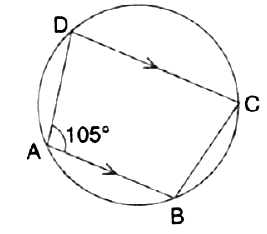
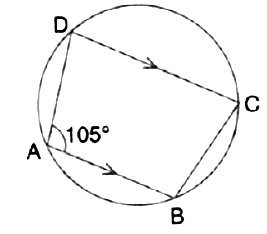
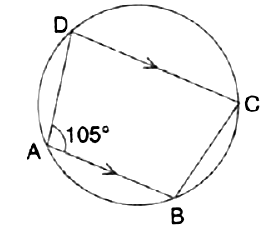
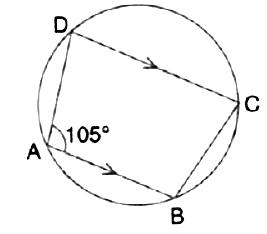
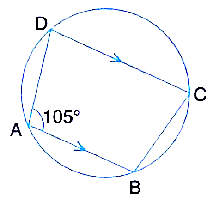
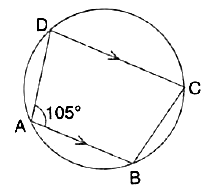
In the figure, given below, find: ∠ ABC Show steps of your working.
Answer

∠ADC +∠ABC = 180°
(Sum of opposite angles of a cyclic quadrilateral is 180°)
⇒∠ABC = 180° - 75° = 105°
View full question & answer
Question 82 Marks
In the figure, given below, find: ∠ ADC show steps of your working.
Answer

Now, AB ∥ CD
∴ ∠BAD + ∠ADC = 180°
(Interior angles on the same side of parallel lines is 180° )
⇒∠ADC =180° -105° = 75°
View full question & answer
Question 92 Marks
In the figure, given below, find: ∠BCD, Show steps of your working .
Answer

∠BCD + ∠BAD = 180°
(Sum of opposite angles of a cyclic quadrilateral is 180° )
⇒ ∠BCD= 180° -105° = 75°
View full question & answer
Question 102 Marks
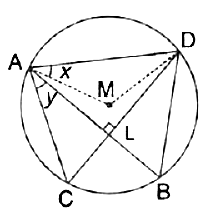
In the given figure, M is the centre of the circle. Chords AB and CD are perpendicular to each other.
If ∠MAD = x and ∠BAC = y , Prove that : x = y
Answer
In the figure, M is the centre of the circle.
Chords AB and CD are perpendicular to each other at L.
∠MAD = x and ∠BAC = y
we have, ∠ABD =90° - y and ∠ABD = 90° - x [proved]
∴ 90° - x 90° - y
⇒ x = y
View full question & answer
Question 112 Marks
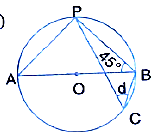
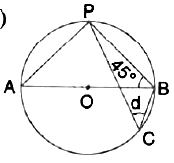
In the following figures, O is the centre of the circle. Find the values of a, b, c and d.
Answer

∠APB = 90° (Angle in a semicircle)
∴ ∠BAP = 90° - 45° = 45°
Now, d = ∠BCP = ∠BAP = 45°
(Angle subtended by the same chord on the circle are equal)
View full question & answer
Question 122 Marks
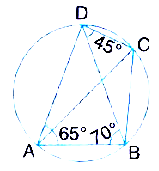
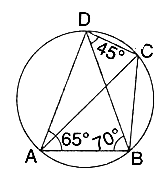
In the given figure, ∠BAD = 65°, ∠ABD = 70° and ∠BDC = 45°. Find: ∠BCD
Hence, show that AC is a diameter
Answer

In cyclic quadrilateral ABCD,
∠BCD = 180° - ∠BAD = 180° - 65° = 115°
(pair of opposite angles in a cyclic quadrilateral are supplementary)
View full question & answer
Question 132 Marks
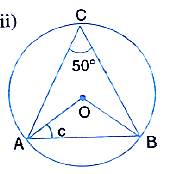
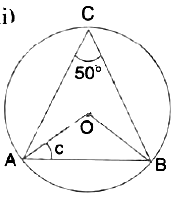
In the following figures, O is the centre of the circle. Find the values of a, b, c and d
.
Answer

∠AOB = 2 ∠AOB = 2×50°= 100°
(Angle at the centre is double the angle at the circumference subtended by the same chord)
Also, OA = OB
⇒ ∠OBA = ∠OAB = C
$\therefore c=\frac{180^{\circ}-100^{\circ}}{2}=40^{\circ}$
View full question & answer
Question 142 Marks
In the given figure, the centre O of the small circle lies on the circumference of the bigger circle. If ∠APB = 75° and ∠BCD = 40°, find : ∠ABD
Answer

Join AB and AD
In cyclic quadrilateral ABDC
∠ABD = 180° - ∠ACD = 180° - (40° + 30° ) = 110°
(pair of opposite angles in a cyclic quadrilateral are supplementary)
View full question & answer
Question 152 Marks
In the given figure, the centre O of the small circle lies on the circumference of the bigger circle. If ∠APB = 75° and ∠BCD = 40°, find : ∠ACB
Answer

In cyclic quadrilateral AOBC,
∠ACB =180° - ∠AOB = 180° -150° = 30°
(pair of opposite angles in a cyclic quadrilateral are supplementary)
View full question & answer
Question 162 Marks
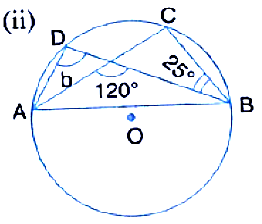
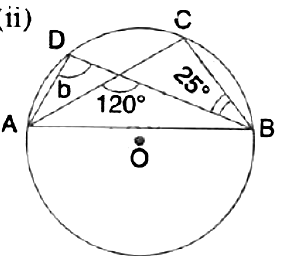
In the following figures, O is the centre of the circle. Find the values of a, b, c and d.
Answer

Here, ∠DAC = ∠CBD = 25°
(Angle subtended by the same chord on the circle are equal)
Again, 120°= b + 25°
(In a triangle, measure of exterior angle is equal to the sum of pair of opposite interior angles)
⇒ b = 95°
View full question & answer
Question 172 Marks
AB is the diameter of the circle with centre O. OD is parallel to BC and ∠ AOD = 60° ; calculate the numerical values of: ∠ ADC
Answer

∠ABC = ∠ABD + ∠DBC = 30° + 30° = 60°
In cyclic quadrilateral ABCD,
∠ADC = 180° - ABC = 180° - 60° = 120°
(pair of opposite angles in a cyclic quadrilateral are supplementary)
View full question & answer
Question 182 Marks
AB is the diameter of the circle with centre O. OD is parallel to BC and ∠AOD = 60°. Calculate the numerical values of : ∠ABD
Answer

Join BD.
$\angle ABD =\frac{1}{2} \angle AOD =\frac{1}{2} \times 60^{\circ}=30^{\circ}$
(Angle at the first is double the angle at the circumference subtended by the same chord)
View full question & answer
Question 192 Marks
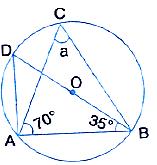
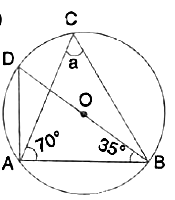
In the following figures, O is the centre of the circle. Find the value of a, b, c and d.
Answer

Here, ∠BAD = 90° (Angle in a semicircle)
∴ ∠BDA =90° -35°=55°
Again, a ∠ACB =∠BDA = 55°
(Angle subtended by the same chord on the circle are equal)
View full question & answer
Question 202 Marks
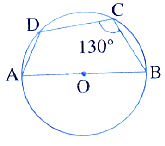
In the given figure, AB is the diameter of a circle with centre O. ∠BCD = 130°. Find:
(i) ∠DAB
(ii) ∠DBA
Answer
i. ABCD is a cyclic quadrilateral
m∠DAB = 180° − ∠DCB
= 180° - 130°
= 50°
ii. In ∆ADB,
m∠DAB + m∠ADB + m∠DBA = 180°
⇒ 50° + 90° + m∠DBA = 180°
⇒ m∠DBA = 40°
View full question & answer
Question 212 Marks
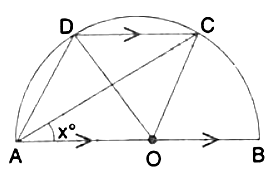
In the given figure, $AOB$ is a diameter and $DC$ is parallel to $AB$. If $\angle CAB = x^o $; find (in terms of $x$) the values of: $\angle DAC$
Answer

$\angle DAC=\frac{1}{2} \angle DOC =\frac{1}{2}\left(180^{\circ}-4 x\right)=90^{\circ}-2 x$
(Angle at the centre is double the angle at the circumference subtended by the same chord)
View full question & answer
Question 222 Marks
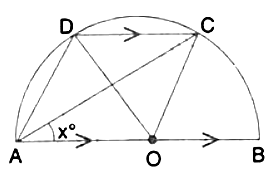
In the given figure, AOB is a diameter and DC is parallel to AB. If ∠CAB = x°; find (in terms of x) the values of ;
∠COB,
Answer

∠COB = 2 ∠CAB = 2x
(Angle ate the centre is double the angler at the circumference subtended by the same order)
View full question & answer
Question 232 Marks
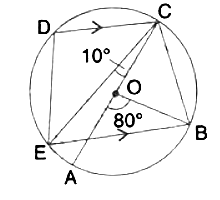
In the given figure, $AC$ is the diameter of circle, centre $O. CD$ and BE are parallel. Angle $AOB = 80^o$and angle $ACE = 10^o.$ Calculate: Angle $CED.$​​​​​​​
Answer

$\angle BED =180^\circ - \angle BCD =180^\circ -100^\circ = 80^\circ$
(pair of opposite angles in a cyclic quadrilateral are supplementary)
$\Rightarrow \angle CED + 50^\circ = 80^\circ$
$\Rightarrow \angle CED = 30^\circ$
View full question & answer
Question 242 Marks
In the given figure, AC is the diameter of the circle with centre O. CD and BE are parallel. Angle ∠AOB = 80° and ∠ACE = 10°.
Calculate : Angle BEC,
Answer

∠BOC = 180° - 80° = 100° (Straight line)
And ∠BOC = 2∠BEC
(Angle at the centre is double the angle at the circumference subtended by the same chord)
$\Rightarrow \angle BEC =\frac{100^{\circ}}{2}=50^{\circ}$
View full question & answer
Question 252 Marks
In the given figure, AB = AC = CD and ∠ADC = 38°. Calculate:
(i) Angle ABC
(ii) Angle BEC
Answer
(i) AC = CD
∴∠CAD = ∠CDA = 38°
∴∠ACD = 180° - 238° = 104°
∴∠ACB = 180° -104° = 76° (Straight line)
Also, AB = AC
∴ ∠ABC = ACB = 76°
(ii) By angle sum property,
∠BAC = 180° - 2 × 76°
∠BAC = 28°
∴ ∠BEC = ∠BAC = 28° ...(Angles in the same chord)
View full question & answer
Question 262 Marks
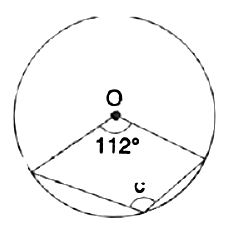
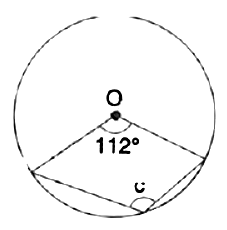
In the following figures, O is the centre of the circle. Find the values of a, b and c.
Answer

Here, $c =\frac{1}{2}$ Reflex $\left(112^{\circ}\right)$
(Angle at the cente is double the angle at the circumference subtended by the same chord)
$\Rightarrow C =\frac{1}{2} \times\left(360^{\circ}-112^{\circ}\right)=124^{\circ}$
View full question & answer
Question 272 Marks
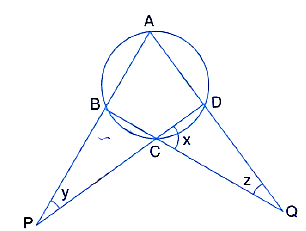
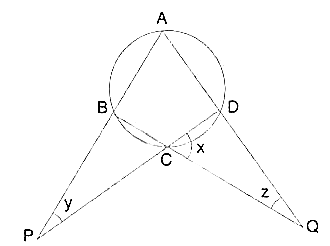
Calculate the angles x, y and z if:
$\frac{x}{3}=\frac{y}{4}=\frac{z}{5}$
Answer

Let $x = 3k, y = 4k$ and $z = 5k$
$\angle ADB = x + z = 8k$ and $\angle ABC = x + y = 7k$
(Exterior angle of a $\triangle$ is equal to the sum of pair of interior opposite angles)
Also, $\angle ABC + \angle ADC = 180^\circ$
(pair of opposite angles in a cyclic quadrilateral are supplementary)
$\Rightarrow 8k + 7k = 180^\circ$
$\Rightarrow 15k = 180^\circ$
$\therefore k=\frac{180^{\circ}}{15}=12$
$\therefore x=3 \times 12=36^{\circ}$
$y=4 \times 12=48^{\circ}$
$z=5 \times 12=60^{\circ}$
View full question & answer
Question 282 Marks
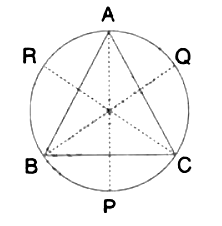
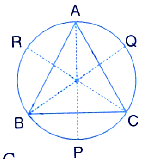
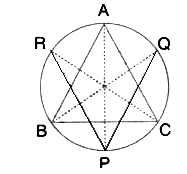
A triangle ABC is inscribed in a circle. The bisectors of angles BAC, ABC and ACB meet the circumcircle of the triangle at points P, Q and R respectively. Prove that:
$\angle QPR =90^{\circ}-\frac{1}{2} \angle BAC$
View full question & answer
Question 292 Marks
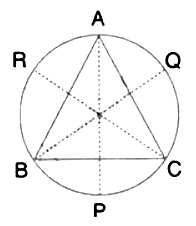
A triangle ABC is inscribed in a circle. The bisectors of angles BAC, ABC and ACB meet the circumcircle of the triangle at points P, Q and R respectively. Prove that:
∠ ACB = 2 ∠APR ,
Answer

CR is the bisector of ∠ ACB
$\Rightarrow \angle ACR =\frac{1}{2} \angle ACB$
Also, ∠ACR = ∠APR
(Angle in the same segment)
∴ ∠ACB = 2 ∠APR
View full question & answer
Question 302 Marks
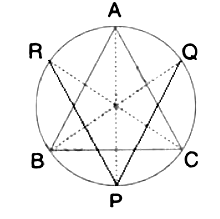
A triangle ABC is inscribed in a circle. The bisectors of angles BAC, ABC and ACB meet the circumcircle of the triangle at points P, Q and R respectively. Prove that :
∠ABC = 2∠APQ,
Answer

Join PQ and PR
BQ is the bisector of ∠ABC
$\Rightarrow \angle ABQ =\frac{1}{2} \angle ABC$
Also, ∠APQ = ∠ABQ
(Angle in the same segment)
∴ ∠ABC = 2∠APQ
View full question & answer
Question 312 Marks
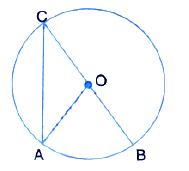
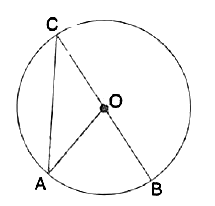
Given O is the centre of the circle and ∠AOB = 70°. Calculate the value of:
(i) ∠OCA .
(ii)∠OCA .
Answer

Here, ∠AOB= 2∠ACB
(Angle at the center is double the angle at the circumference by the same chord)
⇒ ∠ACB =$\frac{70}{2}$ =35°
Now, OC = OA (radii of same circle)
⇒ ∠OCA = ∠OAC =35°
View full question & answer
Question 322 Marks
In the given figure, AB is a diameter of the circle with centre O. DO is parallel to CB and ∠DCB = 120°.
Calculate : ∠DBC
Also, show that the Δ AOD is an equilateral triangle.
Answer

OD = OB
∴ ∠ODB = ∠OBD
Or ∠ABD = 30°
Also, AB || ED
∴ ∠DBC = ∠ODB = 30° (Alternate angles)
View full question & answer
Question 332 Marks
In the given figure, AB is a diameter of the circle with centre O. DO is parallel to CB and ∠DCB = 120°.
Calculate : ∠DBA
Also, show that the Δ AOD is an equilateral triangle.
Answer

∠ADB = 90°
(Angle in a semicircle is a right angle)
∴ ∠DBA = 90° - ∠DAB = 90° - 60°= 30°
View full question & answer
Question 342 Marks
In the given figure, AB is a diameter of the circle. Chord ED is parallel to AB and ∠EAB = 63°. Calculate : ∠ EBA
Answer

(i) $\angle AEB =90$
(Angle in a semicircle is a right angle)
Therefore $\angle EBA =90^{\circ}-\angle EAB =90^{\circ}-63^{\circ}=27^{\circ}$
View full question & answer
Question 352 Marks
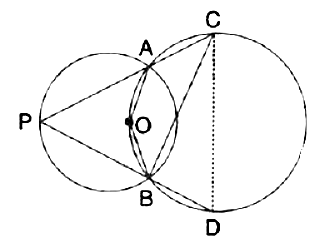
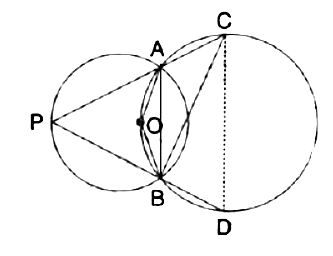
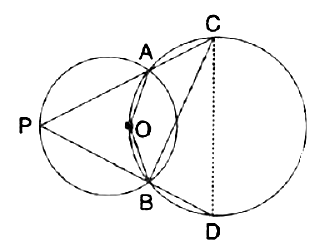
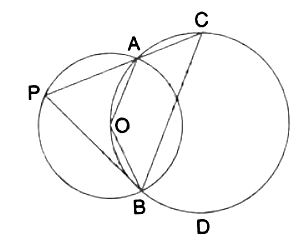
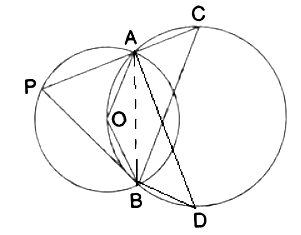
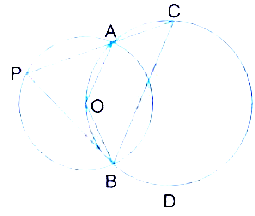
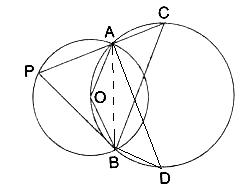
The figure shows two circles which intersect at $A$ and $B$. The centre of the smaller circle is $O$ and lies on the circumference of the larger circle. iven that $\angle APB = a^o$. Calculate, in terms of $a^o$​​​​​​​, the value of: $\angle ADB.$
Give reasons for your answers clearly.
Answer

Join $AB.$
$\angle ADB = \angle ACB =180^\circ - 2a^\circ$
(Angle subtended by the same arc on the circle are equal)
View full question & answer
Question 362 Marks
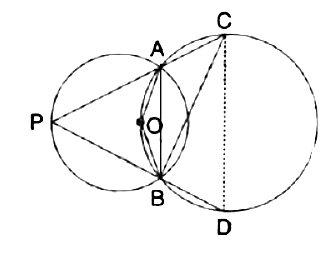
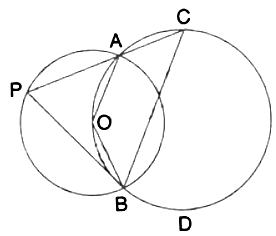
The figure shows two circles which intersect at A and B. The centre of the smaller circle is $O$ and lies on the circumference of the larger circle. Given that $\angle APB = a^o$. Calculate, in terms of $a^o​​​​​​​$​​​​​​​, the value of: $\angle ACB .$
Give reasons for your answers clearly.
Answer

$OABC$ is a cyclic quadrilateral
$\angle AOB + \angle ACB = 180^\circ$
(Pair of opposite angles in a cyclic quadrilateral are supplementary)
$\Rightarrow \angle ACB = 180^\circ - 2a^\circ$
View full question & answer
Question 372 Marks
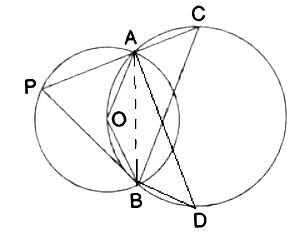
The figure shows two circles which intersect at A and B. The centre of the smaller circle is O and lies on the circumference of the larger circle. Given that ∠APB = a°.
Calculate, in terms of a°, the value of : obtuse ∠AOB,
Give reasons for your answers clearly.
Answer

Obtuse ∠AOB = 2°∠APB = 2a°
(Angle at the centre is double the angle at the circumference subtended by the same chord)
View full question & answer
Question 382 Marks
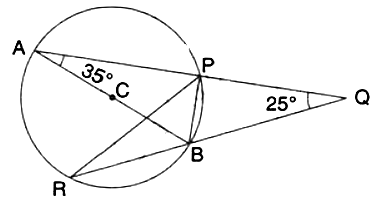
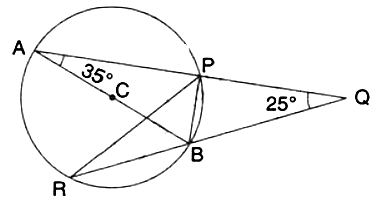
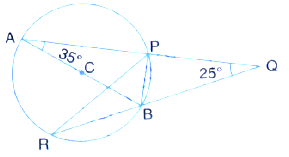
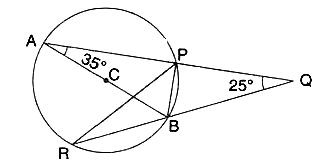
AB is a diameter of the circle APBR as shown in the figure. APQ and RBQ are straight lines. Find : ∠ PBR
Answer

∠BPA = 90°
(angle in a semicircle is a right angle)
∴ ∠BPQ = 90°
∴ ∠PBR = ∠BQP + ∠BPQ = 25° + 90° = 115°
(Exterior angle of a ∆ is equal to the sum of pair of interior opposite angles)
View full question & answer
Question 392 Marks
AB is a diameter of the circle APBR as shown in the figure. APQ and RBQ are straight lines.
Find : ∠PRB
Answer

∠PRB = ∠PAB = 35°
(Angles subtended by the same chord on the circle are equal)
View full question & answer
Question 402 Marks
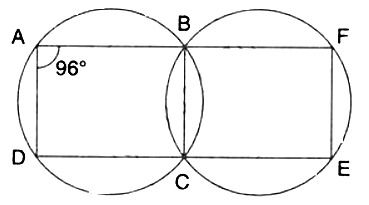
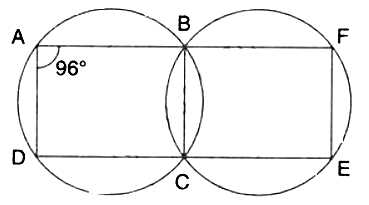
In the following figure, Prove that AD is parallel to FE.
Answer

Now, ∠BAD + ∠BFE = 96 °+ 84° = 180°
But these two are interior angles on the same side
of a pair of lines AD and FE
∴ AD || FE
View full question & answer
Question 412 Marks
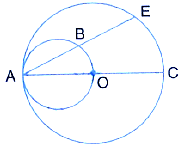
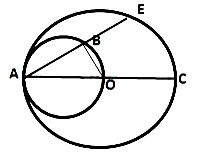
In the given figure, AC is a diameter of a circle, whose centre is O. A circle is described on AO
as diameter. AE, a chord of the larger circle, intersects the smaller circle at B. prove that AB =
BE.
Answer

Join OB,
Then ∠OBA = 90°
(Angle in a semicircle is a right angle)
i.e. OB⊥AE
We know the perpendicular drawn from the centre to a chord bisects the chord.
∴ AB = BE
View full question & answer
Question 422 Marks
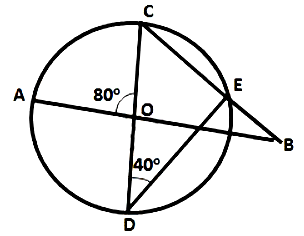
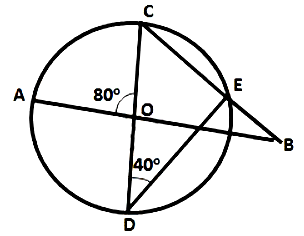
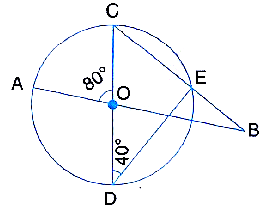
In the figure given alongside, AB and CD are straight lines through the centre O of a circle. If ∠AOC = 80° and ∠CDE = 40°, Find the number of degrees in : ∠ ABC .
Answer

In ΔBOC,
∠AOC = ∠OCB + ∠OBC
(Exterior angle of a Δ is equal to the sum of pair of interior opposite angles)
⇒ ∠OBC = 80° - 50° = 30° (∠AOC = 80° ,given)
Hence, ∠ABC = 30°
View full question & answer
Question 432 Marks
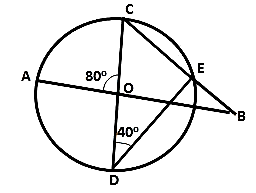
In the figure given below, AB and CD are straight lines through the centre O of a circle. If ∠AOC
= 80° and ∠CDE = 40°, Find the number of degrees in:
∠ DCE .
Answer

Here, ∠CED =90°
(Angle in a semicircle is a right angle)
∴ ∠DCE = 90° - ∠CDE = 90° - 40° = 50°
∴ ∠DCE = ∠OCB = 50°
View full question & answer
Question 442 Marks
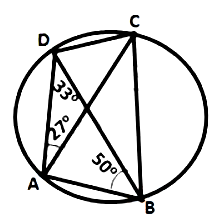
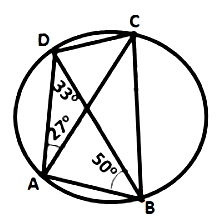
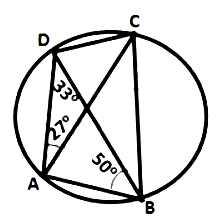
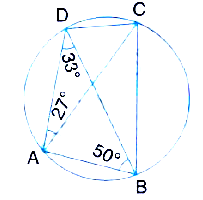
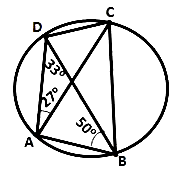
In ABCD is a cyclic quadrilateral in which ∠ DAC = 27° , ∠ DBA = 50° and ∠ ADB = 33°. Calculate ∠ CAB.
Answer

∠ DAB + ∠ DCB = 180°
(Pair of opposite angles in a cyclic quadrilateral are supplementary)
⇒ 27° + ∠ CAB + 83° = 180°
⇒ ∠ CAB = 180° - 110° = 70°
View full question & answer
Question 452 Marks
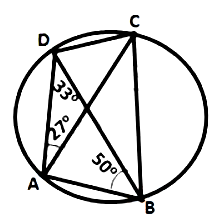
In ABCD is a cyclic quadrilateral in which ∠ DAC = 27° , ∠ DBA = 50° and ∠ ADB = 33°. Calculate ∠ DCB.
Answer

∠ACB = ∠ ADB = 33°
∠ACD = ∠ABD = 50°
(Angles subtended by the same chord on the circle are equal)
∴ ∠DCB = ∠ACD + ∠ACB = 50° + 33° = 83°
View full question & answer
Question 462 Marks
ABCD is a cyclic quadrilateral in which ∠DAC = 27° ; ∠DBA = 50° and ∠ADB = 33°. Calculate : ∠DBC,
Answer

∠DBC =∠DAC = 27°
(Angle subtended by the same chord on the circle are equal)
View full question & answer
Question 472 Marks
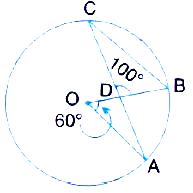
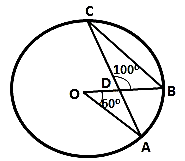
In the following figure, O is the centre of the circle,
∠AOB = 60° and ∠BDC = 100° Find ∠OBC.
Answer

Here, $\angle A C B=\frac{1}{2} \angle A O B=\frac{1}{2} \times 60^{\circ}=30^{\circ}$
(Angle at the centre is double the angle at the circumference subtended by the same chord)
By angle sum property of ΔBDC,
∴ ∠DBC =180° - 100°- 30° = 50°
Hence, ∠OBC =50°
View full question & answer
Question 482 Marks
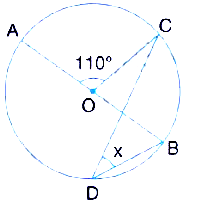
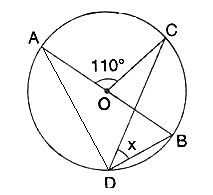
In the figure, given below, AOB is a diameter of the circle and ∠AOC = 110°. Find ∠BDC.
Answer

Join AD.
Here, $\angle A D C=\frac{1}{2} \angle A O C=\frac{1}{2} \times 110^{\circ}=55^{\circ}$
(Angle at the centre is double the angle at the circumference subtended by the same chord)
Also, ∠ADB = 90°
(Angle in a semicircle is a right angle)
∴ ∠BDC = 90° - ∠ADC = 90° - 55° = 35°
View full question & answer
[2 Mark Question Answer] - Mathematics STD 10 Questions - Vidyadip