Question 12 Marks
If the point $(x, y)$ is at equidistant from the point $(a + b, b – a)$ and $(a-b, a + b)$. Prove that ay $= bx.$
AnswerGiven that $(x, y)$ is equidistant from the point $(a + b, b - a)$ and $(a - b, a + b).$
Hence, distance of $(x, y)$ from both points will be same.
Hence, $\sqrt{(y-b+a)^2+(x-a-b)^2}$
$=\sqrt{(y-a-b)^2+(x-a+b)^2}$
On squaring and expanding :
$y^2 + b^2 + a^2 - 2by - 2ab + 2ay + x^2 + a^2 + b^2 - 2ax + 2ab - 2bx$
$= y^2 + a^2+ b^2 - 2ay + 2ab - 2by + x^2 + a^2 + b^2 - 2ax - 2ab + 2bx$
$2ay - 2bx = 2bx - 2ay$
$4ay = 4bx$
$\Rightarrow ay = bx$
Hence proved.
View full question & answer→Question 22 Marks
Show that the points $A(- 2, 5), B(2, – 3)$ and $C(0, 1)$ are collinear.
Answer$m_1$ = Slope of AB
$ =\frac{-3-5}{2-(-2)}=\frac{8}{4}=-2$
$m _2=\text { slop of BC }$
$=\frac{1-(-3)}{0-2}=\frac{4}{-2}=-2 $
Hence $m_1=m_2=-2$
So, $AB$ is parallel to $BC.$
But $B$ is common to $AB$ and $BC.$
Hence, $A, B$ and $C$ must lies on the same line.
Hence proved
View full question & answer→Question 32 Marks
With out Pythagoras theorem, show that $A(4, 4), B(3, 5)$ and $C(-1, -1)$ are the vertices of a right angled.
AnswerSlope of $B C=m_1=\frac{-1-5}{-1-3}=\frac{3}{2}$
Slope of $C A=m_2=\frac{4-(-1)}{4-(-1)}=1$
Also, slope of $A B=m_3-\frac{5-4}{3-4}=-1$
Since,$ m_2m_3 = 1 x (-1) = -1$, So, AB and CA are perpendicular to each.
Thus, ΔABC is a right angled triangle at A.
Hence proved.
View full question & answer→Question 42 Marks
P and Q are two points whose coordinate are $\left(\frac{a}{t^2}, \frac{-2 a}{t}\right)$ and S is the point $(a, 0).$ Prove that $\frac{1}{ SP }+\frac{1}{ SQ }$ is constant for all values of it.
AnswerThe given points are $P(at^2 , 2at)$, Q $\left(\frac{a}{t^2}, \frac{-2 a}{t}\right)$ and $S(a, 0)$
Now,
$\text { SP }=\sqrt{\left(a t^2-a\right)^2+(2 a t-0)^2} $
$ =\sqrt{a^2\left(t^4+1-2 t^2\right)+4 a^2 t^2} $
$ =a \sqrt{t^4+1+2 t^2}$
$ =a \sqrt{\left(t^2+1\right)^2} $
$\text { SP }= a \left( t ^2+1\right) \text { units. }$
$\text { Also, } SQ =\sqrt{\left(\frac{a}{t^2}-a\right)^2+\left(\frac{-2 a}{t}-0\right)^2} $
$ =\sqrt{a^2\left(\frac{1}{t^4}+1-\frac{2}{t^2}\right)+\frac{4 a^2}{t^2}} $
$ =a \sqrt{\frac{1}{t^2}+1+\frac{2}{t^2}} $
$=a \sqrt{\left(\frac{1}{t^2}+1\right)^2}$
View full question & answer→Question 52 Marks
A line is of length 10 units and one end is at the point (2, – 3). If the abscissa of the other end be 10, prove that its ordinate must be 3 or – 9.
Question 62 Marks
The midpoint of the line segment joining $(2a, 4)$ and $(-2, 2b)$ is $(1, 2a+1).$ Find the value of $a$ and $b.$
show that the points $A(- 1, 2), B(2, 5)$ and $C(- 5, – 2)$ are collinear.
AnswerMidpoint of $(2a , 4)$ and $(-2 , 2b)$ is $(1 , 2a + 1)$
$x=\frac{x_1+x_2}{2}$
$1=\frac{2 a-2}{2}$
$1=a-1$
$\therefore a=2$
$y=\frac{y_1+y_2}{2}$
$2 a+1=\frac{4+2 b}{2}$
$2 a+1=2+b$
$\therefore 5-2=b$
$\therefore b=3$
Therefore, $a = 2, b = 3.$
View full question & answer→Question 72 Marks
$KM$ is a straight line of $13$ units If $K$ has the coordinate $(2, 5)$ and M has the coordinates $(x, – 7)$ find the possible value of $x.$
AnswerUsing distance formula
$(x_2 - x_1)^2 + (y_2 - y_1)^2 = d^2$
$\Rightarrow (x - 2)^2 + (-7 - 5)^2 = 13^2$
$\Rightarrow x^2 - 4x + 4 + 144 = 169$
$\Rightarrow x^2 - 4x + 148 - 169 = 0$
$\Rightarrow x^2 - 4x - 21 = 0$
$\Rightarrow x^2 - 7x + 3x - 21 = 0$
$\Rightarrow (x - 7) +3 (x - 7) = 0$
$\Rightarrow (x + 3) (x - 7) = 0$
$x = 7, -3.$
View full question & answer→Question 82 Marks
The three vertices of a parallelogram taken in order are $(-1, 0), (3, 1)$ and $(2, 2)$ respectively. Find the coordinates of the fourth vertex.
AnswerLet $A(-1, 0), B(3, 1), C(2, 2)$ and $D(x, y)$ be the vertices of a parallelogram $ABCD$ taken in order.
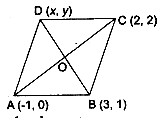
Since, the diagonals of a parallelogram bisect each other.
So, coordinates of the mid point of $AC =$ coordinates of mid point of $BD$
$\Rightarrow\left(\frac{-1+2}{2}, \frac{0+2}{2}\right)=\left(\frac{3+x}{2}, \frac{y+1}{2}\right)$
$\Rightarrow\left(\frac{1}{2}, 1\right)=\left(\frac{3+x}{2}, \frac{y+1}{2}\right)$
$\frac{3+x}{2}=\frac{1}{2}$
$\Rightarrow x =-2$
$\text { Also } \frac{y+1}{2}=1$
$\Rightarrow y + 1 = 2$
$\Rightarrow y = 1$
The forth vertex of parallelogram $= (-2, 1).$ View full question & answer→Question 92 Marks
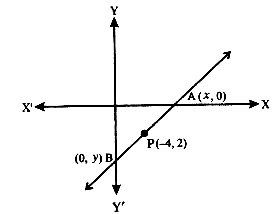
In the following figure line $APB$ meets the X-axis at $A,$ Y-axis at $B.$ P is the point $(4, -2)$ and $AP: PB = 1: 2.$ Write down the coordinates of $A$ and $B.$
AnswerLet $(x, 0)$ and $(0, y)$ be the coordinates of $A$ and $B$ respectively.
Point P divides AB in the ratio of $1: 2$
So coordinates of $P$
$4=\frac{1 \times 0+2 \times x}{1+2}$
$\Rightarrow 2 x=4 x 3$
$\Rightarrow x=6$
$\text { Also }-2=\frac{2 \times 0+1 \times y}{1+2}$
$\Rightarrow-6=y$
$\Rightarrow y=-6 .$
Hence, the coordinates of $A$ and $B$ are $(-6, 0)$ and $(0, 6)$ respectively. View full question & answer→Question 102 Marks
In the figure given below, the line segment $AB$ meets $X-$ axis at $A$ and $Y-$ axis at $B.$ The point $P (- 3, 4)$ on $AB$ divides it in the ratio $2 : 3.$ Find the coordinates of $A$ and $B.$
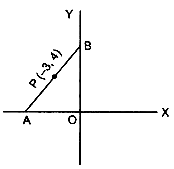
Answer$A P: P B=2: 3$
$\text { Let } A(x, 0) \text { and } B(0, y)$
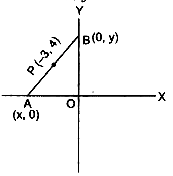
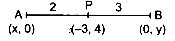
$\therefore \text { By section formula }$
$\frac{2 \times 0+3 \times x}{2+3}=-3$
$\Rightarrow 3 x=-15$
$x=-5$
$\text { and } \frac{2 \times y+3 \times 0}{2+3}=4$
$\Rightarrow 2 y=20$
$\Rightarrow y=10$
$\therefore \text { Coordinates of } A=(x, 0)=(-5,0)$
$\text { and } B=(0, y)=(0,10) .$ View full question & answer→Question 112 Marks
If the line joining the points $A(4, - 5)$ and $B(4, 5)$ is divided by the point P such that $\frac{ AP }{ AB }=\frac{2}{5}$, find the coordinates of P.
AnswerFrom the given
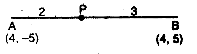
$\frac{ AP }{ AB }=\frac{2}{5} $
$ \Rightarrow \frac{ AP }{ AB }=\frac{5}{2}$
$ \frac{ AB }{ AP }-1=\frac{5}{2}-1 $
$ \Rightarrow \frac{ PB }{ AP }=\frac{3}{2}$
$\therefore$ coordinates of P
$=\left(\frac{m x_2+n x_1}{m+x}, \frac{m y_2+x y_1}{m+x}\right) $
$ =\left(\frac{2 \times 4+3 \times 4}{2+3}, \frac{2 \times 5+3 \times(-5)}{2+3}\right) $
$ =\left(\frac{8+12}{5}, \frac{10-15}{5}\right) $
$=(4,-1)$ View full question & answer→Question 122 Marks
The line through $A (- 2, 3)$ and $B (4, b)$ is perpendicular to the line $2a – 4y = 5.$ Find the value of $b.$
Answer$\text { Slope of } AB =\frac{b-3}{4+2}$
$m _1=\frac{b-3}{6}$
$2 x -4 y =5$
$\Rightarrow 4 y =2 x -5$
$\Rightarrow y =\frac{1}{2} x-\frac{5}{4}$
$\text { slope }\left( m _{2)}=\frac{1}{2}\right.$
Since both lines are perpendicular to each other
$\text { so, } m_1 \cdot m_2=-1$
$\frac{b-3}{6} \cdot \frac{1}{2}=-1$
$b-3=-12$
$b=-9 .$
View full question & answer→Question 132 Marks
Find the equations of a line passing through the point $(2, 3)$ and having the $x\ –$ interecpt of $4$ units.
AnswerSince x-intercept is $4$ units coordinates of point are $(4, 0).$ Equation of a line passing through $(2, 3)$ and $(4, 0)$ is
$y-y_1=\frac{y_2-y_1}{x_2-x_1}\left(x-x_1\right) $
$ \Rightarrow y-3=\frac{0-3}{4-2}(x-2) $
$ \Rightarrow y-3=\frac{-3}{2}(x-2)$
$ \Rightarrow 2 y-6=-3 x+6$
$\Rightarrow 3 x+2 y=12 $
View full question & answer→Question 142 Marks
Find the value, of $k,$ if the line represented by $kx – 5y + 4 = 0$ and $4x – 2y + 5 = 0$ are perpendicular to each other.
AnswerHere, $kx - 5y + 4 = 0$
$\Rightarrow y =\frac{k x}{5}+\frac{4}{5}$
$\therefore$ The slope of the line is $\frac{k}{5}$.
Also $4x - 2y + 5 = 0$
$y=2 x+\frac{5}{2}$
$\therefore$ The slope of line is $2 .$
Since, the given lines are perpendicular to each other, we have
$\left(\frac{k}{5}\right)(2)=-1$
$\Rightarrow k =\frac{-5}{2} .$
View full question & answer→Question 152 Marks
The line segment joining $A (2, 3)$ and $B (6, – 5)$ is intersected by the $X$ axis at the point $K.$ Write the ordinate of the point $K.$ Hence find the ratio in which $K$ divides $AB.$
Answer$A (2, 3)$ and $B (6,- 5)$
Intersected at $X$ axis at $K.$
$\therefore y = 0$ or ordinate $= 0$
$K (x, 0)$
Let required ratio be $a: 1$
$\therefore$ Ordinate of $K = 0$
$0=\frac{a \times-5+1 \times 3}{a+1}$
$0=-5 a+3$
$5 a=3, a=\frac{3}{5}$
$\therefore$ K divides $AB$ in ratio of $3 : 5$
View full question & answer→Question 162 Marks
Give the relation that must exist between $x$ and $y$ so that $(x, y)$ is equidistant from $(6, -1)$ and $(2, 3).$
AnswerLet $P(x,y). A(6, - 1)$ and $b(2, 3)$ be the given points.
Since $PA = PB$
So $\sqrt{(x-6)^2+(y+1)^2}=\sqrt{(x-2)^2+(y-3)^2}$
Squaring both sides
$ x^2+36-12 x+y^2+1+2 y=x^2+4-4 x+y^2+9-6 y$
$\Rightarrow-8 x+8 y=13-36-1$
$\Rightarrow-8(x-y)=-24$
$\Rightarrow x-y=3 . $
View full question & answer→Question 172 Marks
A line passing through the points $(a, 2a)$ and $(- 2, 3)$ is perpendicular to the line $4a + 3y + 5 = 0.$ Find the value of $a.$
AnswerLet $m_1$ be the slope of the joining at the points $(a, 2a)$ and $(-2, 3),$ then
$m_1$ = $\frac{2 a-3}{a+2}$
Also slope of the line $4x + 3y + 5 = 0.$
$m_2=-\frac{4}{3}$
Since, both the line are perpendicular.
So, $m_1m_2 = -1$
$\Rightarrow \frac{2 a-3}{a+2} \times \frac{(-4)}{3}=-1$
$\Rightarrow 8 a-12=3 a+6$
$\Rightarrow 8 a-3 a=18$
$\Rightarrow 5 a=18$
$\Rightarrow a=\frac{18}{5}$
$\Rightarrow a=3 \frac{3}{5} .$
View full question & answer→Question 182 Marks
Find the equation of a straight line which cuts an intercept of $5$ units on Y-axis and is parallel to the line joining the points $(3, – 2)$ and $(1, 4).$
AnswerLet m be the slope of the required line and since the required line is parallel to the line joining the points $(3, - 2)$ and $(1, 4).$
Hence, slope of the line
$m = \frac{4+2}{1-3}$
$=\frac{6}{-2}$
$=-3 .$
Also, Y-intercept $c = 5$ units
So, equation of the required line be
$y = mx + c$
$\Rightarrow y = -3x + 5$
$\Rightarrow 3x + y - 5 = 0.$
View full question & answer→Question 192 Marks
$PQ$ is straight line of $13$ units. If $P$ has coordinate $(2, 5)$ and $Q$ has coordinate $(x, – 7)$ find the possible values of $x$.
AnswerHere $PQ = 13$
$PQ^2 = 13^2$
$\therefore (x - 2)^2 + (-7 - 5)^2 = 169$
$\Rightarrow (x - 2)^2 = 169 - 144$
$= 25 = 5^2$
or
$(x - 2) = ± 5$
$\Rightarrow x = 7 or -3.$
View full question & answer→