Calculate the distance between $A (7, 3)$ and $B$ on the x-axis, whose abscissa is $11.$
View full solution →Question types
Coordinate Geometry question types
62 questions across 5 question groups — pick any mix to generate a Mathematics paper with step-by-step answer keys.
62
Questions
5
Question groups
5
Question types
01
[1 Mark Question Answer]
8 Q→02[2 Mark Question Answer]
19 Q→03[3 marks sum]
20 Q→04[5 marks sum]
5 Q→05[4 marks sum]
10 Q→Sample Questions
Coordinate Geometry questions
One sample from each question group in this chapter. Select any group above to see the full set with answer keys.
Find the distance of the following points from origin.
$(a \cos \theta, a \sin \theta).$
View full solution →$(a \cos \theta, a \sin \theta).$
Find the distance of the following points from origin.
$(a+b, a-b)$
View full solution →$(a+b, a-b)$
Find the distance of the following points from origin.
$(5, 6)$
View full solution →$(5, 6)$
Find the equation of a line with slope 1 and cutting off an intercept of 5 units on Y-axis.
If the point $(x, y)$ is at equidistant from the point $(a + b, b – a)$ and $(a-b, a + b)$. Prove that ay $= bx.$
View full solution →Show that the points $A(- 2, 5), B(2, – 3)$ and $C(0, 1)$ are collinear.
View full solution →With out Pythagoras theorem, show that $A(4, 4), B(3, 5)$ and $C(-1, -1)$ are the vertices of a right angled.
View full solution →P and Q are two points whose coordinate are $\left(\frac{a}{t^2}, \frac{-2 a}{t}\right)$ and S is the point $(a, 0).$ Prove that $\frac{1}{ SP }+\frac{1}{ SQ }$ is constant for all values of it.
View full solution →A line is of length 10 units and one end is at the point (2, – 3). If the abscissa of the other end be 10, prove that its ordinate must be 3 or – 9.
Show that the points $(a, a), (-a, -a)$ and $(-a \sqrt{3}, a \sqrt{3})$ are the vertices of an equilateral triangle.
View full solution →Show that the line joining $(2, – 3)$ and $(- 5, 1)$ is:
(i) Parallel to line joining $(7, -1)$ and $(0, 3).$
(ii) Perpendicular to the line joining $(4, 5)$ and $(0, -2).$
View full solution →(i) Parallel to line joining $(7, -1)$ and $(0, 3).$
(ii) Perpendicular to the line joining $(4, 5)$ and $(0, -2).$
Show that the points $A(1, 3), B(2, 6), C(5, 7)$ and $D(4, 4)$ are the vertices of a rhombus.
$=a\left(\frac{1}{t^2}+1\right)=\frac{a\left(t^2+1\right)}{t^2}$
$\text { Now } \frac{1}{ SP }+\frac{1}{ SQ }=\frac{1}{a\left(t^2+1\right)}+\frac{1 \times t^2}{a\left(t^2+1\right)}$
$=\frac{\left(1+t^2\right)}{a\left(t^2+1\right)}$
$\frac{1}{ SP }+\frac{1}{ SQ }=\frac{1}{a} .$
View full solution →$=a\left(\frac{1}{t^2}+1\right)=\frac{a\left(t^2+1\right)}{t^2}$
$\text { Now } \frac{1}{ SP }+\frac{1}{ SQ }=\frac{1}{a\left(t^2+1\right)}+\frac{1 \times t^2}{a\left(t^2+1\right)}$
$=\frac{\left(1+t^2\right)}{a\left(t^2+1\right)}$
$\frac{1}{ SP }+\frac{1}{ SQ }=\frac{1}{a} .$
Prove that $A(4, 3), B(6, 4), C(5, 6)$ and $D(3, 5)$ are the angular points of a square.
View full solution →Given a line segment $AB$ joining the points $A (- 4, 6)$ and $B (8, – 3).$ Find:
(i) the ratio in which $AB$ is divided by the $y-$ axis.
(ii) find the ordinates of the point of intersection.
(iii) the length of $AB.$
View full solution →(i) the ratio in which $AB$ is divided by the $y-$ axis.
(ii) find the ordinates of the point of intersection.
(iii) the length of $AB.$
The figure alongside (not drawn to scale) represents the lines y = x + 1 and y = $\sqrt{3} x-1$.
(i) Find the angle which the line y = x + 1 makes with X-axis.
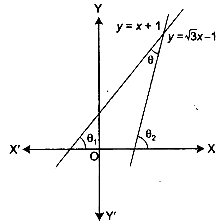
(ii) Find the angle which the line y = $\sqrt{3} x-1$ makes with X-axis.
(iii) Determine angle θ.
(iv) Find the point where the line y = x + 1 meets X-axis.
(v) Find the point where the line y = $\sqrt{3} x-1$ meets Y-axis.
View full solution →(i) Find the angle which the line y = x + 1 makes with X-axis.
(ii) Find the angle which the line y = $\sqrt{3} x-1$ makes with X-axis.
(iii) Determine angle θ.
(iv) Find the point where the line y = x + 1 meets X-axis.
(v) Find the point where the line y = $\sqrt{3} x-1$ meets Y-axis.
The vertices of a triangle are $A(10, 4), B(- 4, 9)$ and $C(- 2, -1).$ Find the
View full solution →Find the value of ‘a’ for which the following points $A (a, 3), B (2, 1)$ and $C (5, a)$ are collinear. Hence find the equation of the line.
View full solution →Find the image of a point $(-1, 2)$ in the line joining $(2, 1)$ and $(- 3, 2).$
View full solution →Determine the centre of the circle on which the points $(1, 7), (7 – 1),$ and $(8, 6)$ lie. What is the radius of the circle?
View full solution →Show that the quadrilateral with vertices $(3, 2), (0, 5), (- 3, 2)$ and $(0, -1)$ is a square.
View full solution →Show that each of the triangles whose vertices are given below are isosceles :
$(i)\ (8, 2), (5,-3)$ and $(0,0)$
$(ii)\ (0,6), (-5, 3)$ and $(3,1).$
View full solution →$(i)\ (8, 2), (5,-3)$ and $(0,0)$
$(ii)\ (0,6), (-5, 3)$ and $(3,1).$
By using the distance formula prove that each of the following sets of points are the vertices of a right angled triangle.
(i) $(6, 2), (3, -1)$ and $(- 2, 4)$
(ii) $(-2, 2), (8, -2)$ and $(-4, -3).$
View full solution →(i) $(6, 2), (3, -1)$ and $(- 2, 4)$
(ii) $(-2, 2), (8, -2)$ and $(-4, -3).$
If the image of the point $(2,1)$ with respect to the line mirror be $(5, 2).$ Find the equation of the mirror.
View full solution →Find a general equation of a line which passes through:
$(i) (0, -5)$ and $(3, 0) (ii) (2, 3)$ and $(-1, 2).$
View full solution →$(i) (0, -5)$ and $(3, 0) (ii) (2, 3)$ and $(-1, 2).$
Generate a Coordinate Geometry paper free
Pick question groups from the list above, set marks and difficulty, and export a branded PDF with step-by-step answer keys. First 3 chapters free — no signup.