Question 13 Marks
Show that the points $(a, a), (-a, -a)$ and $(-a \sqrt{3}, a \sqrt{3})$ are the vertices of an equilateral triangle.
AnswerThe given points are let
$A(a, a), B(-a, a)$ and C $(-a \sqrt{3}, a \sqrt{3})$.
$ AB =\sqrt{(-a-a)^2+(-a-a)^2}$
$=\sqrt{4 a^2+4 a^2}=2 \sqrt{2} a \text { units. }$
$BC =\sqrt{(-a \sqrt{3}+a)^2+(a \sqrt{3}+a)^2}$
$=\sqrt{3 a^2+a^2-2 \sqrt{3} a^2+3 a^2+a^2+2 \sqrt{3} a^2}$
$=\sqrt{8} a^2=2 \sqrt{2} a \text { units. }$
$ \text { and } C A=\sqrt{(a \sqrt{3}-a)^2+(-a \sqrt{3}-a)^2}$
$=\sqrt{3 a^2+a^2+2 \sqrt{3} a^2+3 a^2+a^2+2 \sqrt{3} a^2}$
$=\sqrt{8} a^2=2 \sqrt{2} a \text { units. }$
$\text { as } AB = BC = CA =2 \sqrt{2} a .$
$\Rightarrow \triangle A B C$ is an equilateral triangle.
Hence proved.
View full question & answer→Question 23 Marks
Show that the line joining $(2, – 3)$ and $(- 5, 1)$ is:
(i) Parallel to line joining $(7, -1)$ and $(0, 3).$
(ii) Perpendicular to the line joining $(4, 5)$ and $(0, -2).$
AnswerLet m1 be the slope of line joining $(2, -3)$ and $(-5, 1)$ then
$ m _1=\frac{Y-2-y_1}{x_2-x_1}$
$=\frac{1-(-3)}{-5-2}=-\frac{4}{7}$
(i) Let $m_2$ be the slope of the line joining $(7, -1)$ and $(0, 3),$ then
$m_2=\frac{3-(-1)}{0,7}=-\frac{4}{7}$
Since, $m_1= m_2$, the two lines are parallel.
Hence proved.
(ii) Let $m_3$ be the slope of the line joining $(4, 5)$ and $(0, -2)$ then
$ m _3=\frac{-2-5}{0-4}=\frac{7}{4}$
$\text { Now } m _1 m _3=-\frac{4}{7} \times \frac{7}{1}=-1$
Hence, the two lines are perpendicular.
Hence proved.
View full question & answer→Question 33 Marks
Show that the points $A(1, 3), B(2, 6), C(5, 7)$ and $D(4, 4)$ are the vertices of a rhombus.
$=a\left(\frac{1}{t^2}+1\right)=\frac{a\left(t^2+1\right)}{t^2}$
$\text { Now } \frac{1}{ SP }+\frac{1}{ SQ }=\frac{1}{a\left(t^2+1\right)}+\frac{1 \times t^2}{a\left(t^2+1\right)}$
$=\frac{\left(1+t^2\right)}{a\left(t^2+1\right)}$
$\frac{1}{ SP }+\frac{1}{ SQ }=\frac{1}{a} .$
AnswerTo show that $A B C D$ is a rhombus, it is sufficient to show that
(i) $ABCD$ is a parallelogram i.e., $AC$ and $BD$ have the same mid point.
(ii) A pair of adjacent sides are equal.
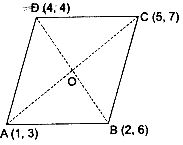
Now, midpoint of $A C=\left(\frac{1+5}{2}, \frac{3+7}{2}\right)$
$= (3, 5).$
Midpoint of $BD =\left(\frac{4+2}{2}, \frac{4+6}{2}\right)$
$= (3, 5).$
Thus, $A B C D$ is a parallelogram..
Also $AB^2 = (2 - 1)^2 + (6 - 3)^2$
$= 1 + 9 = 10$ units.
$BC^2= (5 - 2)^2 + (7 - 6)^2$
$= 9 + 1 = 10$ units.
Therefore $A B^2=B C^2$
$\Rightarrow A B=B C$
Hence, $A B C D$ is a rhombus. View full question & answer→Question 43 Marks
Prove that $A(4, 3), B(6, 4), C(5, 6)$ and $D(3, 5)$ are the angular points of a square.
AnswerNow
$AB = \sqrt{(4-6)^2+(3-4)^2}$
$=\sqrt{4+1}=\sqrt{5} \text { units }$
$B C=\sqrt{(6-5)^2+(4-6)^2}=\sqrt{1+4}$
$B C=\sqrt{5} \text { units. }$
$C D=\sqrt{(5-3)^2+(6-5)^2}=\sqrt{4+1}$
$C D=\sqrt{5} \text { units }$
$\text { Also DA }=\sqrt{(4-3)^2+(3+5)^2}$
$=\sqrt{1+4}=\sqrt{5}$
$\text { DA }=\sqrt{5} \text { units }$
$\text { So } A B=B C=C D=D A .$
Now slope of $A B=m_1-\frac{4-3}{6-4}=\frac{1}{2}$
Slope of $B C=m_2=\frac{6-4}{5-6}=\frac{2}{-1}$
Slope of $C A=m_3=\frac{5-6}{3-5}=\frac{1}{2}$
Slope of DA $=m_4=\frac{5-3}{3-4}=\frac{2}{-1}$
Since $m_1 = m_3$ and $= m_2 = m_4$
So $AB \| CD$
and $BC \| DA.$
Therefore, $AB \perp BC$
$\therefore ABCD$ is a square.
Hence proved.
View full question & answer→Question 53 Marks
Given a line segment $AB$ joining the points $A (- 4, 6)$ and $B (8, – 3).$ Find:
(i) the ratio in which $AB$ is divided by the $y-$ axis.
(ii) find the ordinates of the point of intersection.
(iii) the length of $AB.$
Answer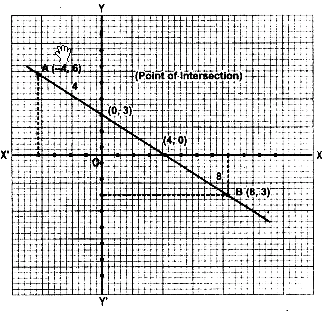
$A(-4, 6), B(8, -3)$
Let ratio be $k: 1$
(i) Where the y-axis divide $AB, x = 0$
$\therefore x =\frac{m_1 x_2+m_2 x_1}{m_1+m_2}$
$\therefore 0=\frac{k \times 8+1 \times(-4)}{k+1}$
$\Rightarrow 8 k -4=0$
$\Rightarrow 8 k =4$
$\Rightarrow k =\frac{4}{8}=\frac{1}{2}$ .
So, ratio be $1: 2$
$\text { (ii) Now, } y=\frac{1 \times(-3)+2 \times 6}{1+2}$
$=\frac{-3+12}{3}=3$
So, point of intersection $(0, 3)$
$\text { (iii) } A B=\sqrt{(8+4)^2+(-3-6)^2}$
$=\sqrt{(12)^2+(-9)^2}$
$=\sqrt{144+81}=\sqrt{225}$
$=15 \text { units. }$ View full question & answer→Question 63 Marks
Use distance formula to show that the points $A(-1, 2), B(2, 5)$ and $C(-5, -2)$ are collinear.
AnswerIf using distance formula we have to prove that $A, B$ and $C$ are collinear, then we have to show:
$BC = AC + AB$
Hence $AB = \sqrt{(5-2)^2+(2+1)^2}=\sqrt{9+9}$
$=\sqrt{18}=3 \sqrt{2} \text { units. }$
$BC =\sqrt{(-2-5)^2+(-5-2)^2}$
$=\sqrt{49+49}=\sqrt{98}=7 \sqrt{2} \text { units. }$
$\text { and } AC =\sqrt{(-2-2)^2+(-5+1)^2}$
$=\sqrt{16+16}=\sqrt{32}=4 \sqrt{2} \text { units. }$
$\text { as } 7 \sqrt{2}=4 \sqrt{2}+3 \sqrt{2}$
$\Rightarrow BC = AB + AC$
$\Rightarrow \text { Points } A , B \text { and } C \text { are collinear. }$
$\text { Hence proved. }$
View full question & answer→Question 73 Marks
In $\triangle ABC, A(3, 5), B(7, 8)$ and $C(1, –10).$ Find the equation of the median through $A.$
AnswerThe vertices of $\triangle ABC$ are $A(3, 5), B(7, 8)$ and $C(1, –10).$
Coordinates of the mid-point D of $BC = \left(\frac{7+1}{2}, \frac{8-10}{2}\right)=\left(\frac{8}{2}, \frac{-2}{2}\right)=(4,-1)$
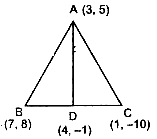
$\text { Slope of AD }=\frac{y_2-y_1}{x_2-x_1}$
$=\frac{-1-5}{4-3} $
$=\frac{-6}{1}$
Slope of $AD = - 6$
Now, the equation of median $AD$ is given by
$y - y_1 = m(x - x_1)$
$\therefore y - 5 = - 6(x - 3)$
$\therefore y - 5 = - 6x + 18$
$\therefore 6x + y - 5 - 18 = 0$
$\therefore 6x + y - 23 = 0$ View full question & answer→Question 83 Marks
Find the equation of a straight line which cuts an intercept – 2 units from Y-axis and being equally inclined to the axis.
Answer
Since, the required line is equally inclined with coordinate axis, therefore, it makes either an angle of 45° or 135° with the X-axis.
So, its slope is m = tan 45° ⇒ m = 1
or m = tan 135° ⇒ m = -1
Y-intercept, c = -2
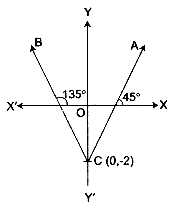
Hence, the equation of required lines are
y = mx + x
i.e., y = 1·x - 2 or y = -1·x - 2
⇒ y = x - 2 or y = -x - 2
⇒ x - y - 2 = 0 or x + y + 2 = 0.
View full question & answer→Question 93 Marks
The centre $‘O’$ of a circle has the coordinates $(4, 5)$ and one point on the circumference is $(8, 10).$ Find the coordinates of the other end of the diameter of the circle through this point.
AnswerLet $(x, y)$ be the coordinates of the other end of the diameter of the circle.
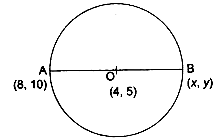
Since, centre is the midpoint of the diameter of the circle.
So coordinates of midpoint of diameter
$AB =\left(\frac{8+x}{2}, \frac{10+y}{2}\right)$
But $O(4, 5)$ is the centre hence
$\frac{8+x}{2}=4$
$\Rightarrow x =8-8=0 .$
$\text { Also } \frac{10+y}{2}=5$
$\Rightarrow y =10-10=0 .$
Hence $(0, 0)$ be the coordinates of the other end. View full question & answer→Question 103 Marks
The midpoint of the line segment $AB$ shown in the diagram is $(4, – 3).$ Write down the coordinates of $A$ and $B.$
AnswerLet the coordinates of $A$ and Bare $(x, 0)$ and $(0, y).$
so $x=\frac{m x_2+n x_1}{m+n}, y=\frac{m y_2+n y_1}{m+n}$
$ m =2, n =3$
$x _1=4, x _2=4$
$y _1=-5, y _2=5$
$\therefore x=\frac{2 \times 4+3 \times 4}{2+3}=\frac{8+12}{5}=\frac{20}{5}=4$
$y=\frac{2 \times 5+3 \times-5}{2+3}$
$=\frac{10-15}{5}$
$=\frac{-5}{5}$
$=-1$
$\therefore$ Co-ordinates of $P$ are $(4, -1).$
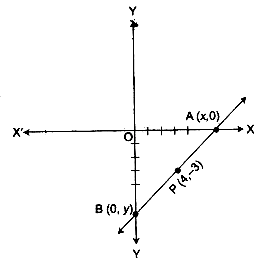
Thus, the coordinates of midpoints of
$ AB =\left(\frac{x+2}{2}, \frac{y+0}{2}\right) $
$=\left(\frac{x}{2}, \frac{y}{2}\right)$
According to question, the coordinates of midpoint $= (4, -3)$
$\therefore \frac{x}{2}=4, x =8 $
$ \frac{y}{2}=-3, y =-6$
$\therefore$ The required points are $(9, 0)$ and $(0, -6).$ View full question & answer→Question 113 Marks
Determine the ratio in which the line $3x + y – 9 = 0$ divides the line joining $(1, 3)$ and $(2, 7).$
AnswerSuppose the line $3x + y - 9 = 0$ divides the line joining $A(1, 3)$ and $B(2, 7)$ in the ratio of $\lambda: 1$ at point $C.
$
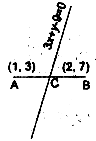
Coordinates of $C=\left(\frac{2 \lambda+1}{\lambda+1}, \frac{7 \lambda+3}{\lambda+1}\right)$
But point C lies on the line $3x + y - 9 = 0.$
Therefore,
$3\left(\frac{2 \lambda+1}{\lambda+1}\right)+\left(\frac{7 \lambda+3}{\lambda+1}\right)-9=0 $
$\Rightarrow 6 \lambda+3+7 \lambda+3-9 \lambda-9=0 $
$\Rightarrow 4 \lambda-3=0 $
$\Rightarrow \lambda=\frac{3}{4}$
The required ratio
$=\lambda: 1 $
$=3: 4 .$ View full question & answer→Question 123 Marks
From the adjacent figure:
(i) Write the coordinates of the points $A, B$, and
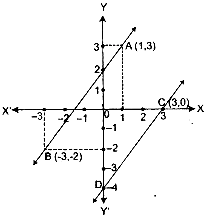
(ii) Write the slope of the line $AB.$
(iii) Line through $C,$ drawn parallel to $AB$, intersects $Y$-axis at $D.$ Calculate the co-ordinates of $D.$ Answer(i) Coordinates of the points $A, B$ and $C$ are $(1, 3), (-3, -2)$ and $(3, 0)$ respectively.
(ii) Slope of AB = $\frac{-2-3}{-3-1}=\frac{5}{4}$.
(iii) Line through $C(3, 0)$ and parallel to $AB.$
$\therefore$ Slope $=\frac{5}{4}$.
$\therefore$ Equation to the line is
$y - y_1 = m(x - x_1)$
$y - 0 = \frac{5}{4}(x-3)$
$4y = 5x - 15$
This line intersects Y-axis at $D.$
$\therefore$ On solving
$4y = 5x - 15$
and $x = 0, ...$(Equation to Y-axis)
We get, $4y = -15$
$y=-\frac{15}{4}$
$\therefore$ Coordinates of point D are $\left(0,-\frac{15}{7}\right)$.
View full question & answer→Question 133 Marks
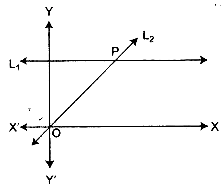
Given equation of line $L_1$ is $y=4$.
(i) Write the slope of line, if $L_2$ is the bisector of angle $O .$
(ii) Write the coordinates of point $P .$
(iii) Find the equation of $L_2$
AnswerEquation of$ L_1$ is $y = 4$ (given)
(i) As $L_2$ is bisector of $O$
$\Rightarrow L_2$ is inclined at an angle of $45^\circ$ with XX'
$\therefore $ Slope of $L_2 = m =\tan 45^\circ = 1$
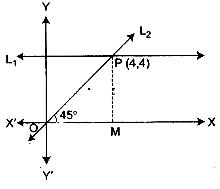
$\text { (ii) Slope of } L _2=\frac{4-0}{x-0}$
$\Rightarrow 1=\frac{4}{x}$
$\Rightarrow x =4$
So coordinates of $P$ are $(4, 4).$
(Since the slope of $L_2$ is $1, L_2 \Rightarrow PM = OM$)
(iii) $L_2$ passes through $O(0, 0), P(4, 4)$ and has slope $m = 1$
$\therefore $ Equation of $L_2$ is
$y - y_1 = m (x - x_1)$
$y - 0 = 1 (x - 0)$
or $y = x$
or $x - y = 0.$ View full question & answer→Question 143 Marks
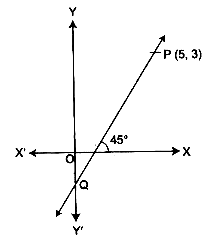
The line through P (5, 3) intersects Y axis at Q.
(i) Write the slope of the line.
(ii) Write the equation of the line.
(iii) Find the coordinates of Q.
Answer$(i)$
$m = \tan \theta = \tan 45^\circ$
$m = 1$
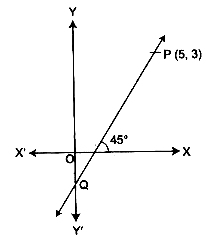
(ii) Equation of line $PQ$
$y - y_1= m(x - x_1)$
$y - 3 = 1 (x - 5)$
$y - 3 = x - 5$
$\Rightarrow x - y - 2 = 0$
(iii) Equation of $PQ$ is
$x - y - 2 = 0$
Put $x = 0$ (coordinates of $Q)$
$-y -2 = 0$
$\Rightarrow y = -2$
So, coordinates of $Q(0, -2).$ View full question & answer→Question 153 Marks
In the adjoining figure, write
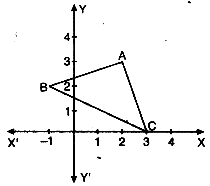
(i) The coordinates of A, B and C.
(ii) The equation of the line through A and | | to BC.
Answer(i) $A = (2, 3), B = (-1, 2), C = (3, 0).$
(ii) Slope of $BC = \frac{y_2-y_1}{x_2-x_1}=\frac{2-0}{-1-3}=\frac{2}{-4}$
$m_1=\frac{-1}{2}$
Since lines are parallel
$\therefore m_1 = m_2$
Hence, $m_2= -\frac{1}{2}$
and passing through point $(2, 3)$
$\because $ Equation of line is $y - y_1 = m_2 (x - x_1)$
$∴$ required line is $y - 3 = \frac{-1}{2}(x-2)$
$2 y-6=-x+2$
$x+2 y=8.$
View full question & answer→Question 163 Marks
Find the equation of the straight line perpendicular to $5x – 2y = 8$ and which passes through the mid-point of the line segment joining $(2, 3)$ and $(4, 5).$
Answer$5x - 2y = 8$
$2y = 5x - 8$
$\Rightarrow y=\frac{5}{2} x-4 $
$y=m x+c$
$ \therefore m_1=\frac{5}{2}$
Since lines are perpendicular to each other
$\therefore m _1 \times m _2=-1$
$\frac{5}{2} \times m_2=-1$
$m _2=-1+\frac{2}{5} $
$m _2=-\frac{2}{5}$
Coordinates of midpoints
$=\frac{2+4}{2}, \frac{3+5}{2}$
$\text { Passing Point }=(3,4)$
$\therefore \text { Equation of line, }$
$y-y_1=m\left(x-x_1\right)$
$\Rightarrow y-4=\frac{-2}{5}(x-3)$
$\Rightarrow 5 y-20=-2 x+6$
$\Rightarrow 2 x+5 y=26 .$
View full question & answer→Question 173 Marks
Find the equation of the straight line which has Y-intercept equal to $4/3$ and is perpendicular to $3x – 4y + 11 = 0.$
AnswerEquation of the given line is
$3x - 4y + 11 = 0$
Slope of this line $y = mx + c$
$4y = 3x + 11$
$y =\frac{3}{4} x+\frac{11}{4} $
$ m _1=\frac{3}{4}$
Let $m_2$ be the slope of the line which is perpendicular toi the given line then
$m_1m_2 = -1$
$\frac{3}{4} m_2=-1$
$\Rightarrow m_2=-\frac{4}{3} .$
Also, $Y$-intercept $c=\frac{4}{3}$.
Equation of the required line
$y=m_2 x+c$
$y=\frac{-4}{3} x+\frac{4}{3} $
$\Rightarrow 3 y=-4 x+4$
$\Rightarrow 4 x+3 y-4=0 .$
View full question & answer→Question 183 Marks
Find the equation of a line passing through $(3, – 2)$ and perpendicular to the line.
$x - 3y + 5 = 0.$
Answer$x - 3y + 5 = 0$
$\Rightarrow 3y = x + 5$
$\therefore y =\frac{x}{3}+\frac{5}{3}$
$\therefore m _1=\frac{1}{3}$
Since lines are perpendicular to each other
$\therefore m_1 \times m_2 = -1$
$\frac{1}{3} \times m_2=-1 $
$m_2=-1 \times 3$
$m_2=-3$
$\text { Passing point is }(3,-2)$
$\therefore \text { Equation of line }$
$y-y_1=m\left(x-x_1\right)$
$\Rightarrow y+2=-3(x-3)$
$\Rightarrow y+2=-3 x+9$
$\Rightarrow 3 x+y+2-9=0$
$\Rightarrow 3 x+y=7$
View full question & answer→Question 193 Marks
Find the equation of the line passing through $(0, 4)$ and parallel to the line $3x + 5y + 15 = 0.$
AnswerSince line is parallel to
$3x + 5y + 15 = 0$
$5y = -3x - 15$
$y =\frac{-3}{5} x-3$
$\therefore m _1=\frac{-3}{5}$
$m _1= m _2 \ldots(\because \text { lines are parallel })$
$\therefore m _2=\frac{-3}{5}$
$\text { and passing point }=(0,4)$
$\text { Equation of line }$
$y- y _1= m \left( x - x _1\right)$
$\Rightarrow y -4=\frac{-3}{5}(x-0)$
$\Rightarrow 5 y-20=-3 x$
$\Rightarrow 3 x+5 x =20 .$
View full question & answer→Question 203 Marks
Find the equation of a line that has Y-intercept $3$ units and is perpendicular to the line joining $(2, – 3)$ and $(4, 2).$
AnswerLet m be the slope of required line
Slope of the given line = $=\frac{2+3}{4-2}=\frac{5}{2}$
But the required line is perpendicular to the given line.
Hence,
$m x$ Slope of the given line $= -1$
$\Rightarrow m \times \frac{5}{2}=-1$
$\Rightarrow m =\frac{-2}{5}$
Y-intercept, $c = 3$
Hence, equation of the required line is given by
$y = mx + c$
$\text { i.e., } y=-\frac{2}{5} x+3$
$\Rightarrow 5 y=-2 x+15$
$\Rightarrow 2 x+5 y-15=0$
View full question & answer→