Questions

[5 marks sum]

🎯

Test yourself on this topic

5 questions · timed · auto-graded

Question 15 Marks
The figure alongside (not drawn to scale) represents the lines y = x + 1 and y = $\sqrt{3} x-1$.
(i) Find the angle which the line y = x + 1 makes with X-axis.
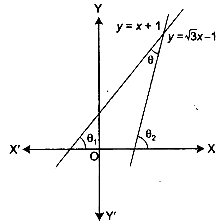

(ii) Find the angle which the line y = $\sqrt{3} x-1$ makes with X-axis.
(iii) Determine angle θ.
(iv) Find the point where the line y = x + 1 meets X-axis.
(v) Find the point where the line y = $\sqrt{3} x-1$ meets Y-axis.
Answer
$\text { (i) } y=x+1$
$\Rightarrow m_1=\tan \theta_1=1=\tan 45^{\circ}$
$\Rightarrow \theta_1=45^{\circ} .$
$\text { (ii) } y=\sqrt{3} x-1$
$\Rightarrow m_2=\tan \theta_2=\sqrt{3}=\tan 60^{\circ}$
$\Rightarrow \theta_2=60^{\circ}$
(iii) $\therefore \theta=\theta_2-\theta_1$.
( $\because$ Exterior $\angle=$ Sum of interior opposite $\angle s$ )
$=60^{\circ}-45^{\circ}=15^{\circ} \text {. }$
(iv) Put $y=0$ in $y=x+1$, we get
$0=x+1$
$\Rightarrow x=-1$
$\therefore$ The required points is $(-1,-0)$.
(v) Put $x =0$ in $y =\sqrt{3} x-1$, we get $y =-1$
$\therefore$ The required point is $(0,-1)$.
View full question & answer
Question 25 Marks
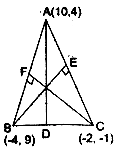
The vertices of a triangle are $A(10, 4), B(- 4, 9)$ and $C(- 2, -1).$ Find the
Answer
Let AD, BE and CF be the three altitudes of ΔABC then
$AD \perp BC$
$BE \perp CA$
and $CF \perp AB.$​​​​​​​


Slope of $B C=\frac{-1-9}{-2+4}=-5$
Since $A D \perp B C$
Slope of $B C \times$ slope of $A D=-1$
Slope of $A D=\frac{-1}{-5}=\frac{1}{5}$
Therefore $AD \perp BC$
Since, $AD$ passes through $A(10, 4)$
So, equation of $AD$ is
$y - y_1= m (x - x_1)$
$y-4=\frac{1}{5}(x-10)$
$\Rightarrow 5y - 20 = x - 10$
$\Rightarrow x - 5y + 10 = 0 ...(i)$
Now , Slope of AC = $\frac{4+1}{10+2}=\frac{-5}{12}$
since $BE \perp AC$
Slope of $BE x$ Slope of $AC = -1$
So, Slope of BE = $\frac{-1 \times 12}{5}=-\frac{12}{5}$.
Equation of BE which passes through $B(-4, 9)$ is
$y - y_1 = m(x - x_1)$
$y-9=\frac{-12}{5}(x+4)$
or $12x + 5y + 3 = 0 ...(ii)$
Slope of AB x Slope of $CF = -1$
$\Rightarrow-\frac{5}{14} \times$ Slope of CF $=-1$
$\Rightarrow$ Slope of CF $=\frac{14}{5}$
Equation of CF which passes through $C(-2, -1)$ is
$y - y_1 = m (x - x_1)$
$y+1=\frac{14}{5}(x+2)$
$\Rightarrow 14x - 5y + 23 = 0 ...(iii)$
Thus, the equation of altitudes of $\triangle ABC$ are
$x - 5y + 10 = 0$
$12x + 5y + 3 = 0$
and $14x - 5y + 23 = 0.$
View full question & answer
Question 35 Marks
Find the value of ‘a’ for which the following points $A (a, 3), B (2, 1)$ and $C (5, a)$ are collinear. Hence find the equation of the line.
Answer
Equation of the line passing through AC is
$(y-3)=\left(\frac{a-3}{5-a}\right)(x-a)$
As if A, B and C are callinear than B will satisfy it, i.e.,


$(1-3)=\left(\frac{a-3}{5-a}\right)(2-a) $
$-2(5-a)=(a-3)(2-a)$
$ -10+2 a=2 a-6-a^2+3 a $
$ a^2-3 a-4=0 $
$ a^2-4 a+a-4=0$
$a(a-4)+1(a-4)=0$
$ (a-4)(a+1)=0$
$ \Rightarrow a=4 \text { or }-1.$
Thus, required equation of straight line is
$(y-3)=\left(\frac{4-3}{5-4}\right)(x-4) $
$y-3=\left(\frac{1}{1}\right)(x-4)$
$x-y-1=0$
or
$(y-3)=\left(\frac{-1-3}{5+1}\right)(x+1) $
$(y-3)=\left(-\frac{4}{6}\right)(x+1) $
$y-3=\frac{-2}{3}(x+1)$
$3y - 9 - 2x - 2$
$2x + 3y - 7 = 0.$
View full question & answer
Question 45 Marks
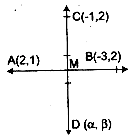
Find the image of a point $(-1, 2)$ in the line joining $(2, 1)$ and $(- 3, 2).$
Answer
Let $D(\alpha , \beta)$ be the image of point $C(-1, 2)$ in the line joining the points $A(2, 1)$ and $B(-3, 2).$
Since $AB$ is the perpendicular bisector of $CD.$
So, Slope of $AB\ x$ Slope of $CD = -1$
$\Rightarrow \frac{2-1}{-3-2} \times \frac{\beta-2}{\alpha+1}=-1$
$\Rightarrow \frac{1}{-5} \times \frac{\beta-2}{\alpha+1}=-1$
$\Rightarrow \beta-2=5 \alpha+5$
$\Rightarrow 5\alpha - \beta + 7 = 0 ...(i)$


Equation of line $A B$,
$y-1=\frac{2-1}{-3-2}(x-2)$
$\Rightarrow y-1=\frac{1}{-5}(x-2)$
$\Rightarrow-5(y-1)=x-2$
$\Rightarrow x-2+5 y-5=0$
$\Rightarrow x + 5y - 7 = 0 ...(ii)$
Since, midpoint of $C D\left(\frac{\alpha-1}{2}, \frac{\beta+2}{2}\right)$ lies on $A B$.
$\frac{\alpha-1}{2}+5\left(\frac{\beta+2}{2}\right)-7=0$
$\Rightarrow \alpha-1+5 \beta+10-14=0$
$\Rightarrow \alpha+5 \beta-5=0 \quad \ldots \text { (iii) }$
Solving (i) and (iii), we get
$\alpha=\frac{-15}{13} \text { and } \beta=\frac{16}{13}$
Hence, coordination of $D$ are $\left(-\frac{15}{13}, \frac{16}{13}\right)$.
View full question & answer
Question 55 Marks
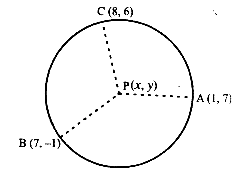
Determine the centre of the circle on which the points $(1, 7), (7 – 1),$ and $(8, 6)$ lie. What is the radius of the circle?
Answer
Let $P(x, y)$ be the centre of the circle and $A(1, 7), B(7, -1)$ and $C(8, 6)$ be the given points.


Then PA = PB = PC = radius
$\Rightarrow PA^2 = PB = PC = r^2$
$\Rightarrow (x - 1)^2 + y( - 7)^2 = r^2 ...(i)$
$(x - 7)^2 + (y + 1)^2= r^2 ...(ii)$
Also $(x - 8)^2 + (y - 6)^2 = r^2 ...(iii)$
Subtracting (ii) from (i)
$(x^2 + 1 - 2x + y^2 + 49 - 14y)$
$-(x^2 + 49 - 14x + y^2 + 1 + 2y) = 0$
$\Rightarrow 12x - 16y = 0$
$y=\frac{3}{4} x$ ...(iv)
Subtracting (iii) from (ii)
$\Rightarrow\left(x^2+49-14 x+y^2+1+2 y\right)$
$-\left(x^2+64-16 x+y^2+36-12 y\right)=0$
$\Rightarrow 2 x+14 y-50=0$
$\Rightarrow x+7\left(\frac{3}{4} x\right)-25=0$
$\Rightarrow \frac{25 x}{4}=25$
$\Rightarrow x =4$
From (iv) $y=\frac{3}{4} x=\frac{3}{4} \times 4$
$y = 3.$
The centre is $P(4, 3).$
$\text { Also radius, } r=P A=\sqrt{(4-1)^2+(3-7)^2}$
$=\sqrt{9+16}$
$=5 \text { units. }$
View full question & answer
[5 marks sum] - Mathematics STD 10 Questions - Vidyadip